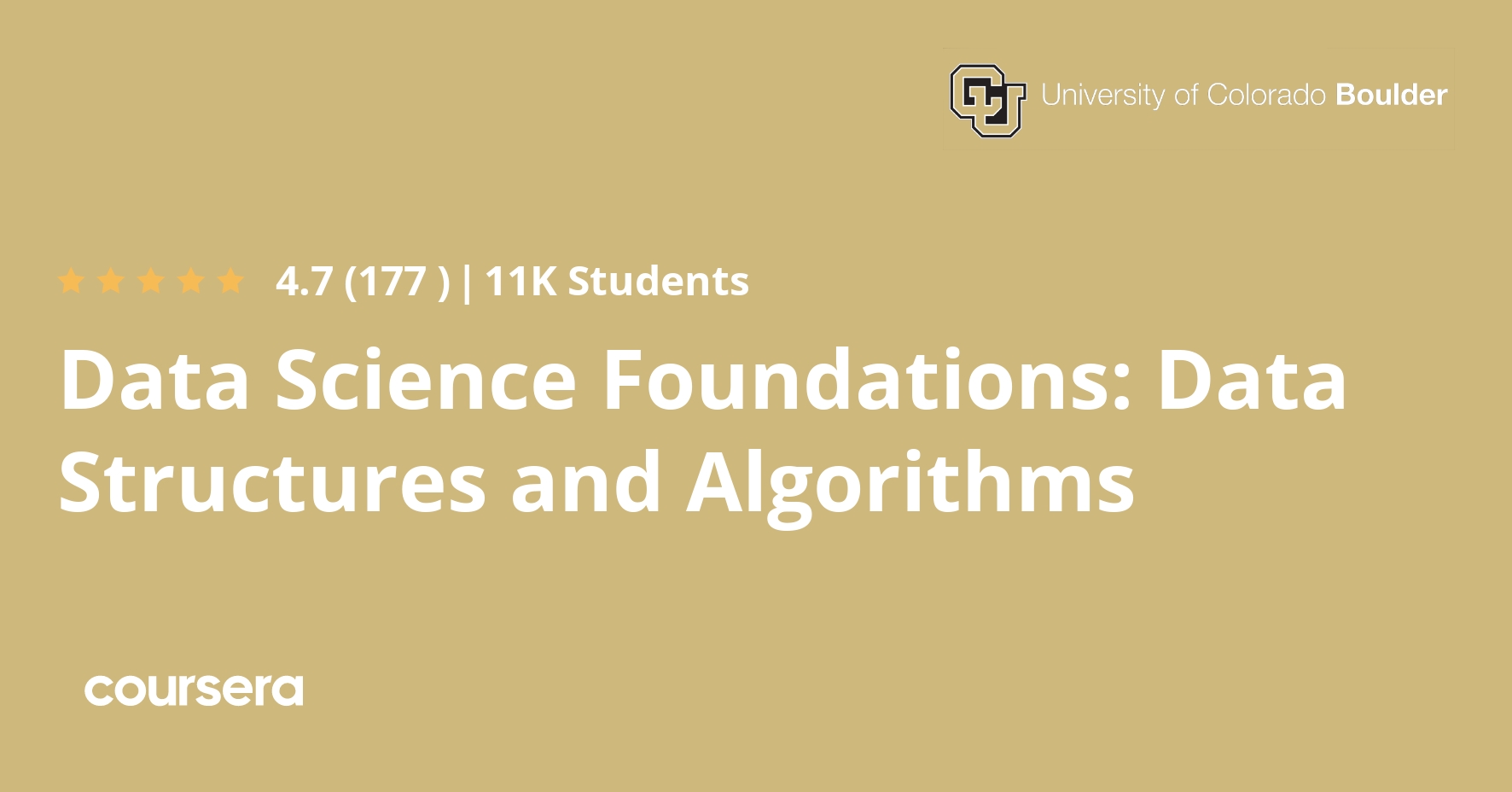
Description
Building fast and highly performant data science applications requires an intimate knowledge of how data can be organized in a computer and how to efficiently perform operations such as sorting, searching, and indexing. This course will teach the fundamentals of data structures and algorithms with a focus on data science applications. This specialization is targeted towards learners who are broadly interested in programming applications that process large amounts of data (expertise in data science is not required), and are familiar with the basics of programming in python. We will learn about various data structures including arrays, hash-tables, heaps, trees and graphs along with algorithms including sorting, searching, traversal and shortest path algorithms.
The courses in this specialization can be taken for academic credit as part of CU Boulder’s Master of Science in Data Science (MS-DS) degree offered on the Coursera platform. The MS-DS is an interdisciplinary degree that brings together faculty from CU Boulder’s departments of Applied Mathematics, Computer Science, Information Science, and others. With performance-based admissions and no application process, the MS-DS is ideal for individuals with a broad range of undergraduate education and/or professional experience in computer science, information science, mathematics, and statistics. Learn more about the MS-DS program at https://www.coursera.org/degrees/master-of-science-data-science-boulder.
Learners will solve data-structure problems by analyzing and designing algorithms for searching, sorting, and indexing; creating trees and graphs; and addressing intractability. Courses also include conceptual algorithm design problems as well as
opportunities to program data-structures/algorithms in the python
programming language.

Questions & discussion
Share a useful question or correction. Comments appear after moderation. Please avoid personal or sensitive information.