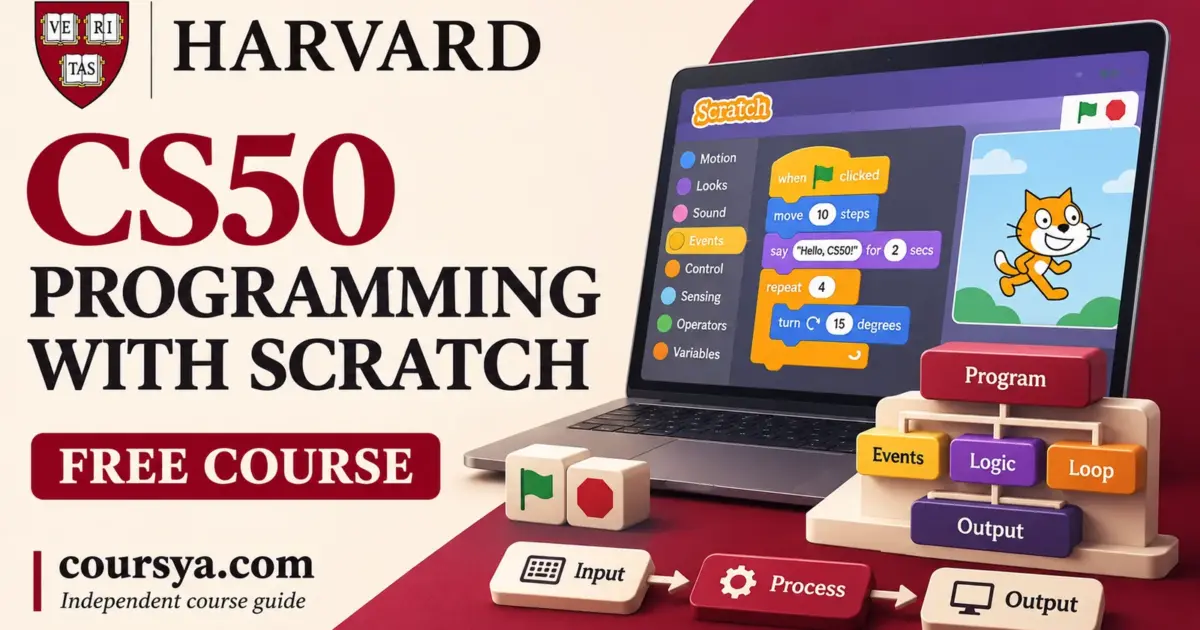
CS50 Scratch introduces programming through visual blocks rather than typed syntax. Learners explore ideas such as events, values, conditions, repetition and stored state while making interactive creations. It is a useful first step when the mechanics of a text-based language would distract from learning how a program behaves.
Quick answer: CS50's Introduction to Programming with Scratch is a beginner-level Harvard course taught in English. Its open learning materials are free.
Independent guide by the Coursya Editorial Team. Sources reviewed .
+ Course guide contents
Course facts at a glance
| Official course name | CS50's Introduction to Programming with Scratch |
|---|---|
| Provider / school | Harvard School of Engineering and Applied Sciences |
| Learning platform | CS50 OpenCourseWare |
| Instructors listed by Harvard | David J. Malan |
| Instruction language | English |
| Level | Introductory |
| Length / pace | 9 weeks of course material; study at your own pace |
| Weekly study estimate | No separate weekly estimate confirmed; allow extra time for practice |
| Free route | Free OpenCourseWare |
| Certificate / credit | Free CS50 certificate subject to completion rules; verified edX certificate separate |
What you will learn and the skills you can build
- Connect events with program actions.
- Use conditions and loops to express behavior.
- Track changing information with variables.
- Break an interactive idea into understandable components.
Who should take this course?
Complete beginners, educators and learners who prefer a visual introduction before moving to Python or a broader computer-science course.
Preparation and entry knowledge
Scratch provides a visual introduction for learners without previous programming experience.
Practice using a browser and saving a project. Start with a very small interactive idea so that you can explain every block you add.
The preparation advice in this guide is Coursya’s recommendation. Check the current provider page for formal prerequisites, required software, readings or equipment before enrolling.
Is the course free, and what about the certificate?
The current CS50 OpenCourseWare site makes the course materials available free of charge. Follow its setup and submission instructions if you want your work assessed. Reading this guide does not register you with Harvard or create a student account.
The course offers a free CS50 certificate after successful completion of its nine required projects under the current scoring rules. A verified edX certificate is a separate option and is not the same credential.
How to study this course effectively
- Set up the tools described on the current CS50 site and read the academic-honesty and submission instructions.
- Work through each lecture and its associated practice before moving to the next topic. Trace a small example yourself rather than only watching the solution.
- Attempt the required work independently. Use feedback to identify a concept to revisit, and keep notes about errors you learned to diagnose.
- Complete any required final project and review the current completion checklist. Keep official assessment answers private where the course rules require it.
Independent practice: turn learning into a useful result
Create a two-question interactive quiz with a clear start and reset state. Test it by answering correctly, incorrectly and restarting midway. Explain which variable stores progress and which event begins the interaction. Ask someone to try it without instructions and improve any confusing behavior. Use original artwork or appropriately licensed assets.
This is an original Coursya practice suggestion, not an official Harvard assignment, assessment or certificate requirement.
A mistake to avoid
Visual programming still requires clear logic. A large collection of blocks is harder to understand than a small design with a clear purpose.
What to study before and after this course
These are optional study-path recommendations from Coursya, not an official Harvard sequence. Choose the preparation you need and the next step that fits your goal; you do not need to complete every linked course.
Possible next steps
- CS50's Introduction to Programming with Python — Next learning focus: organize a program with functions and clear inputs.
- CS50: Introduction to Computer Science — Next learning focus: break a problem into an implementable algorithm.
Frequently asked questions
Is CS50's Introduction to Programming with Scratch free?
The current CS50 OpenCourseWare site makes the course materials available free of charge. Follow its setup and submission instructions if you want your work assessed. Reading this guide does not register you with Harvard or create a student account.
Does the free route include a certificate?
The course offers a free CS50 certificate after successful completion of its nine required projects under the current scoring rules. A verified edX certificate is a separate option and is not the same credential.
How long should I allow?
9 weeks of course material; study at your own pace. Treat the stated length as a planning guide; prior knowledge and practice time affect your own pace.
Does Scratch knowledge transfer to Python?
Ideas such as conditions, repetition and variables transfer well. You will still need to learn the syntax and tools of a text-based language.
Main instruction language: English
Learner reviews
Tell other learners what you actually tried. Reviews are moderated and may come from learners who have started or completed the course.
No published learner reviews yet.
Sign in to write a reviewQuestions still belong in the discussion below. Review and ranking rules.