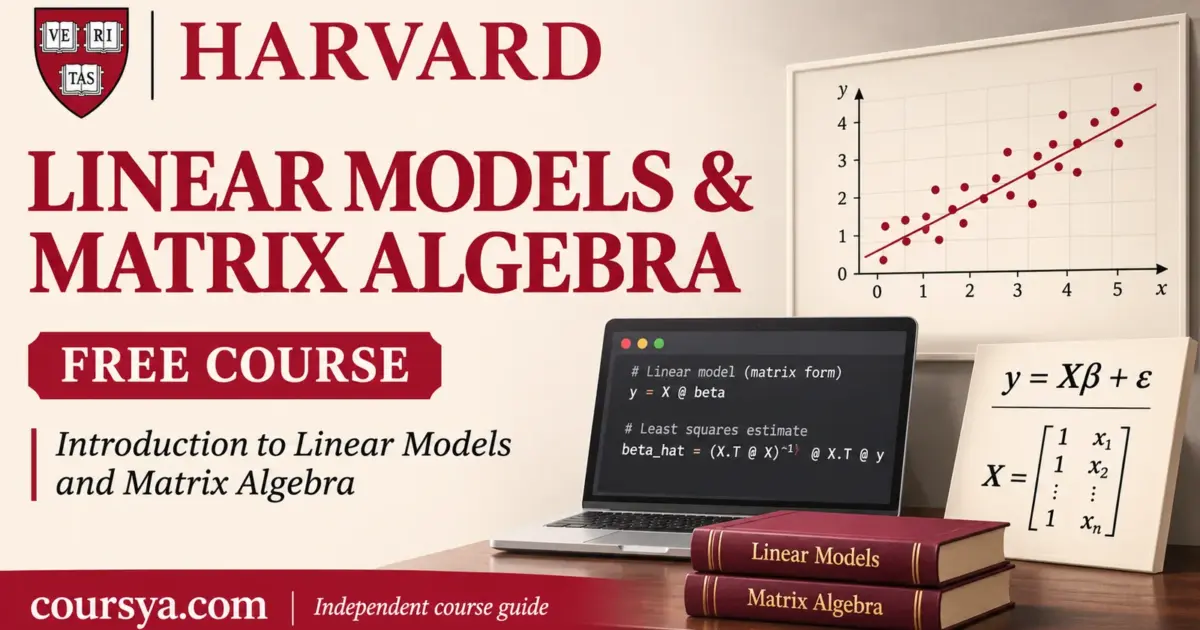
This course links matrix notation with linear models used in data analysis. R is used to connect mathematical representations with differences between experimental units. It is a focused bridge between algebra and statistical work, useful when a learner wants to understand what software is calculating rather than only how to run a function.
Quick answer: Introduction to Linear Models and Matrix Algebra is an intermediate-level Harvard course taught in English. A free learning route is listed by the provider.
Independent guide by the Coursya Editorial Team. Sources reviewed .
+ Course guide contents
Course facts at a glance
| Official course name | Introduction to Linear Models and Matrix Algebra |
|---|---|
| Provider / school | Harvard T.H. Chan School of Public Health |
| Learning platform | edX |
| Instructors listed by Harvard | Rafael Irizarry, Michael Love |
| Instruction language | English |
| Level | Intermediate |
| Length / pace | 4 weeks long |
| Weekly study estimate | 2 – 4 hours per week |
| Free route | Free audit; optional paid certificate |
| Certificate / credit | Verified certificate not included in free audit; paid upgrade may be available |
What you will learn and the skills you can build
- Read and manipulate matrix expressions.
- Represent a linear model in matrix form.
- Connect a model with an experimental comparison.
- Interpret the role of numerical decomposition methods.
Who should take this course?
R users and science or data-analysis students ready to strengthen the mathematical foundation behind modeling.
Preparation and entry knowledge
Review basic algebra, vectors and introductory R. Make sure you can explain the dimensions of a matrix before attempting to interpret a model output.
The preparation advice in this guide is Coursya’s recommendation. Check the current provider page for formal prerequisites, required software, readings or equipment before enrolling.
Is the course free, and what about the certificate?
Harvard lists this course with a free audit option. On the enrollment platform, look for the audit or free-learning route and read what it includes before selecting a paid upgrade. Audit access can be time-limited and may exclude graded assessments or other paid-track features.
The free audit route does not include a verified certificate. An optional paid upgrade may provide a certificate and assessed work under the provider’s current rules. Check the live enrollment page for the fee, deadlines and included features; this guide does not promise a free certificate.
How to study this course effectively
- Check the platform’s free-access window and required tools before making a study schedule.
- For each unit, connect a key idea with a worked example. Reproduce the reasoning or calculation, then change one assumption and explain what changes.
- Keep a short error log: the initial mistake, why it happened and the check that would detect it next time.
- Finish with an independent artifact that explains your method, assumptions and limitations. Use the exercise below as a starting point, not as a replacement for official coursework.
Independent practice: turn learning into a useful result
Construct a tiny synthetic dataset with one outcome and a small number of explanatory variables. Write the model in words, then as a matrix expression. Label the dimensions of every component. Fit the model with the tools shown in the course and explain what each coefficient represents under your chosen coding.
This is an original Coursya practice suggestion, not an official Harvard assignment, assessment or certificate requirement.
A mistake to avoid
A coefficient’s meaning depends on the model and coding choices. Do not interpret it in isolation from the variables and comparison being represented.
What to study before and after this course
These are optional study-path recommendations from Coursya, not an official Harvard sequence. Choose the preparation you need and the next step that fits your goal; you do not need to complete every linked course.
Useful preparation
- Statistics and R — Preparation focus: explore a dataset before choosing a method.
Possible next steps
- High-Dimensional Data Analysis — Next learning focus: reason about distance in a data representation.
- Introduction to Bioconductor — Next learning focus: recognize common high-throughput genomic data types.
Frequently asked questions
Is Introduction to Linear Models and Matrix Algebra free?
Harvard lists this course with a free audit option. On the enrollment platform, look for the audit or free-learning route and read what it includes before selecting a paid upgrade. Audit access can be time-limited and may exclude graded assessments or other paid-track features.
Does the free route include a certificate?
The free audit route does not include a verified certificate. An optional paid upgrade may provide a certificate and assessed work under the provider’s current rules. Check the live enrollment page for the fee, deadlines and included features; this guide does not promise a free certificate.
How long should I allow?
4 weeks long. 2 – 4 hours per week. Treat the stated length as a planning guide; prior knowledge and practice time affect your own pace.
Is this a complete statistics curriculum?
No. It develops a specific mathematical foundation that can support further study in inference, high-dimensional analysis and genomics.
Main instruction language: English
Learner reviews
Tell other learners what you actually tried. Reviews are moderated and may come from learners who have started or completed the course.
No published learner reviews yet.
Sign in to write a reviewQuestions still belong in the discussion below. Review and ranking rules.