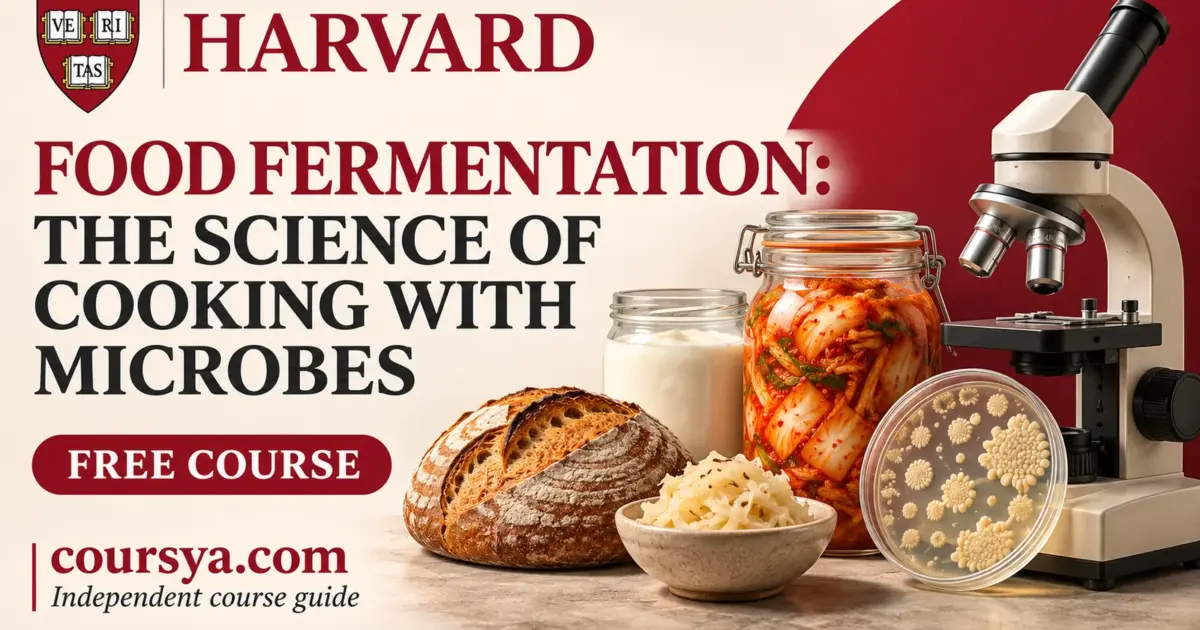
Food Fermentation connects food culture with chemistry and microbiology. It examines how microorganisms influence food characteristics and how experimental methods help investigate those changes. The course can support scientific understanding of fermentation, while safe food handling requires appropriate tested procedures and careful attention to the specific activity.
Quick answer: Food Fermentation: The Science of Cooking with Microbes is a beginner-level Harvard course taught in English. A free learning route is listed by the provider.
Independent guide by the Coursya Editorial Team. Sources reviewed .
+ Course guide contents
Course facts at a glance
| Official course name | Food Fermentation: The Science of Cooking with Microbes |
|---|---|
| Provider / school | Harvard School of Engineering and Applied Sciences |
| Learning platform | edX |
| Instructors listed by Harvard | Pia Sörensen, Roberto Kolter |
| Instruction language | English |
| Level | Introductory |
| Length / pace | 10 weeks long |
| Weekly study estimate | 2 – 3 hours per week |
| Free route | Free audit; optional paid certificate |
| Certificate / credit | Verified certificate not included in free audit; paid upgrade may be available |
What you will learn and the skills you can build
- Connect fermentation with microbial processes.
- Distinguish useful processes from contamination concerns.
- Interpret experimental observations and measurements.
- Relate chemical changes to food characteristics.
Who should take this course?
Food-science enthusiasts, culinary learners and beginners interested in applying scientific reasoning to familiar materials.
Preparation and entry knowledge
Review basic microbiology and experimental variables. Read all provider safety instructions before any practical work, and do not improvise procedures for producing food to consume.
The preparation advice in this guide is Coursya’s recommendation. Check the current provider page for formal prerequisites, required software, readings or equipment before enrolling.
Is the course free, and what about the certificate?
Harvard lists this course with a free audit option. On the enrollment platform, look for the audit or free-learning route and read what it includes before selecting a paid upgrade. Audit access can be time-limited and may exclude graded assessments or other paid-track features.
The free audit route does not include a verified certificate. An optional paid upgrade may provide a certificate and assessed work under the provider’s current rules. Check the live enrollment page for the fee, deadlines and included features; this guide does not promise a free certificate.
How to study this course effectively
- Check the current syllabus, reading requirements and any time limit on free access. Reserve time for reflection as well as watching lessons.
- For each unit, identify the main claim, its supporting evidence and a question you still cannot answer.
- Compare at least two examples before applying an idea to a new situation. Keep historical facts, interpretations and your own judgments distinct.
- Create a short explanation or analysis for another learner. Use the independent exercise below to test whether you can apply an idea rather than simply repeat terminology.
Independent practice: turn learning into a useful result
Begin with a paper-based comparison of two provider-approved demonstrations. Identify the question, variable changed, observations and conditions held constant. Use supplied or safely obtained data to make a graph and discuss alternative explanations. A thoughtful analysis of existing data is a useful learning artifact even when you choose not to perform an experiment.
This is an original Coursya practice suggestion, not an official Harvard assignment, assessment or certificate requirement.
A mistake to avoid
Smell, taste or appearance alone cannot establish that an experimental food is safe. Keep educational observations separate from food-safety judgments.
What to study before and after this course
These are optional study-path recommendations from Coursya, not an official Harvard sequence. Choose the preparation you need and the next step that fits your goal; you do not need to complete every linked course.
Useful preparation
- Cell Biology: Mitochondria — Preparation focus: connect cellular organization with function.
- Science & Cooking: From Haute Cuisine to Soft Matter Science (chemistry) — Preparation focus: relate a cooking observation to a scientific question.
Possible next steps
- Science & Cooking: From Haute Cuisine to Soft Matter Science (physics) — Next learning focus: connect texture with physical behavior.
- Principles of Biochemistry — Next learning focus: relate molecular structure to biological function.
Frequently asked questions
Is Food Fermentation: The Science of Cooking with Microbes free?
Harvard lists this course with a free audit option. On the enrollment platform, look for the audit or free-learning route and read what it includes before selecting a paid upgrade. Audit access can be time-limited and may exclude graded assessments or other paid-track features.
Does the free route include a certificate?
The free audit route does not include a verified certificate. An optional paid upgrade may provide a certificate and assessed work under the provider’s current rules. Check the live enrollment page for the fee, deadlines and included features; this guide does not promise a free certificate.
How long should I allow?
10 weeks long. 2 – 3 hours per week. Treat the stated length as a planning guide; prior knowledge and practice time affect your own pace.
Must I make fermented foods at home?
Check the current activity requirements. You can prepare by studying the scientific questions and supplied examples before deciding which supervised or approved practical activities are appropriate.
Main instruction language: English