Listed as Free on Udemy when checked on 8 November 2026. No coupon or subscription trial is required for the listed lessons. Enrollment needs a Udemy account; availability can change.
About this course
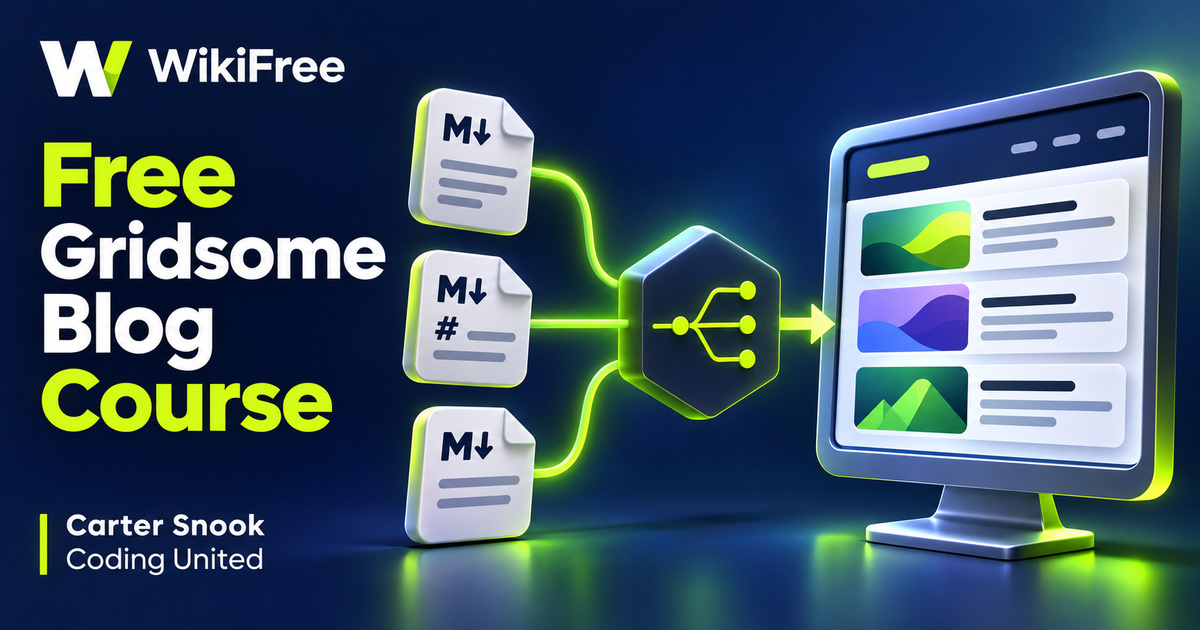
A blog can have separate post addresses and reusable page layouts without rebuilding every page by hand. This free Gridsome course from Carter Snook and Coding United introduces that workflow through a small website with home, about and blog pages. It connects Vue components, Markdown content and GraphQL queries so you can follow how source material becomes a navigable site.
The June 2020 course contains ten videos across four sections, totaling about 63 minutes. It expects some HTML, CSS and JavaScript knowledge, Node.js experience and a code editor. That makes it a better fit for learners who already recognize a frontend project than for someone opening their first HTML file. The focus is a compact site-building example, with older tooling that needs version-aware study.
| Official course | Building a Static Website w/ Blog Using Vue JS and Gridsome |
|---|---|
| Created by | Carter Snook; Coding United |
| Platform | Udemy |
| Language | English |
| Level | Intermediate |
| Listed duration | 63 minutes; 10 lectures across 4 sections |
| Completion terms | Not included with a new free enrollment |
What you’ll learn
Explore the project structure, shared layouts and a reusable header before configuring Sass styling. The blog lessons introduce post routes, Markdown content, GraphQL queries and a listing page that links to individual entries. A separate lesson demonstrates Disqus integration, and the final section introduces the Pages API for generating pages from data supplied to a template.
Skills you’ll gain
- Static site architecture
- Reusable Vue layouts
- Markdown content modeling
- GraphQL query reading
- Blog route planning
- Page generation concepts
Follow the content through the project
Start by distinguishing the website's content from the components that present it. A post has information such as a title, author and body. A template decides how that information appears. A listing page presents a collection of entries and provides links to their individual addresses. Keeping those roles separate makes it easier to understand a new post without treating it as a completely new design.
The directory lesson examines configuration, pages, layouts and assets. The header lesson then shows a shared navigation element used through the default layout, including a query for the site name. These are useful examples of reuse: a change to shared presentation should have a clear home, rather than requiring the same edit in several unrelated page files.
Understand when the data becomes a page
Gridsome's documented workflow imports content into a local data layer, makes that data available through GraphQL and generates static output during a build. Its documentation explicitly says the data layer does not maintain a real-time connection to the original source. When that source changes, the generated website needs rebuilding to include the updated content.
This distinction gives the blog example its context. A page generated from Markdown can have its own address and still be static output. That is different from running a new database query for every visitor request. Browser-side features can add dynamic behavior separately, but the presence of GraphQL in a project does not by itself mean the deployed site exposes a live GraphQL service.
Connect individual posts with their listing
The post-routing lesson introduces a template and fields for a title, author and thumbnail. Subsequent lessons retrieve post content and construct the blog roll. When studying the flow, compare one individual post with the collection view: which fields appear in both, which are only useful on the detail page and which value supplies the link?
The final Pages API lesson extends that idea beyond Markdown posts. The official API supports creating pages with a path, component and optional context. The course uses a simulated API example, so treat it as a page-generation demonstration rather than a verified integration with a live product service. Distinguishing sample data from a real external dependency makes the example easier to adapt responsibly.
Separate optional services from free lessons
Disqus is an external commenting service. Its current Basic offering is advertising-supported and has eligibility and plan conditions; free course access does not guarantee an ad-free comment system or permanently unchanged service terms. The integration lesson can be studied without making comments a requirement for every static site. Any hosting, domain or optional service costs remain separate from watching the lessons.
Likewise, the course's descriptions of speed and superiority should not be read as measured guarantees. A framework choice alone does not establish search rankings, accessibility, security or the performance of a finished site. This is historical material: check the actual project dependencies before following setup instructions. If a dependency chain uses Vue 2, remember that Vue 2 reached end of life in December 2023; compatibility with a current environment is not assumed.
For independent practice, outline a fictional reading journal with three Markdown posts. Choose fields for the listing and detail views, assign distinct paths and note when a rebuild would be necessary after an edit. This original planning exercise is separate from the instructor's examples and does not claim a tested project. It gives you a concrete way to explain the architecture before attempting installation or deployment.
Read the Gridsome data-layer documentation: Distinguish generated data from a live connection. Review the Pages API: Compare page paths, components and context.
Related courses for your next step
- Review HTML and CSS foundationsFree HTML and CSS Foundations Course
Revisit page structure and layout concepts.
Beginner
- Compare a CSS page projectFree CSS Layout Course
Explore another product-page layout approach.
Beginner
Frequently asked questions
Is this suitable for a complete programming beginner?
The stated prerequisites include HTML, CSS and JavaScript knowledge plus Node.js experience. Basic web-development preparation will help before this course.
Does GraphQL keep the generated blog synchronized automatically?
No. Gridsome's documented data layer produces static content, and source updates normally require rebuilding the site. Client-side data access is a separate design choice.
Are comments and hosting included with the free course?
The course demonstrates an external comment service. Service plans, hosting, domains and any optional subscriptions are separate from free lesson access.
Learner reviews
Tell other learners what you actually tried. Reviews are moderated and may come from learners who have started or completed the course.
No published learner reviews yet.
Sign in to write a reviewQuestions still belong in the discussion below. Review and ranking rules.
Questions & discussion
Share a useful question or correction. Comments appear after moderation. Please avoid personal or sensitive information.