Listed as Free on Udemy when checked on 8 November 2026. No coupon or subscription trial is required for the listed lessons. Enrollment needs a Udemy account; availability can change.
About this course
A collection can look simple until changing one variable also changes another. Tony de Araujo’s free Go arrays and slices course focuses on the behavior behind those surprises. Through short lessons and practice-oriented examples, it explores how ordered values are declared, traversed, copied, and rearranged. The emphasis is a specific part of Go syntax and data handling, rather than a large application project.
The course is the second volume in the instructor’s series, but its requirements describe it as self-contained. Prior familiarity with variables and basic functions will help you get more from the examples. It is a useful option for learners moving beyond their first Go programs, or programmers returning to the language who want a concentrated review of collections.
| Official course | Succinct Go Language Tutorial: Arrays & Slices (BOOK 2) |
|---|---|
| Created by | Tony de Araujo |
| Platform | Udemy |
| Language | English |
| Level | Intermediate |
| Listed duration | 106 minutes; 49 lectures across 1 section |
| Completion terms | Not included with a new free enrollment |
What you’ll learn
Study array declarations, default values, indexing, and iteration before moving to slices and their relationship with underlying storage. The sequence covers length and capacity, appending individual values or another slice, copying into a destination, and inserting or removing elements. Later examples revisit these operations in combinations and introduce two-dimensional arrays. Short exercise and solution entries provide opportunities to pause and predict a result before continuing.
Skills you’ll gain
- Go array declarations
- Slice length and capacity
- Collection iteration
- Copy and append operations
- Shared-storage reasoning
- Indexed data updates
Start with the shape of the data
Arrays provide a clear starting point because their length is part of their type. Working with a fixed set of slots makes it easier to reason about indices, zero values, and the position of the last element. The course then uses loops and range-based iteration to move through those values. This progression helps connect a collection’s structure to the code that reads or modifies it.
The lessons also distinguish passing an array value from working through an array pointer. That distinction matters when a function should leave its input unchanged, or when an update is intended to affect the original collection. Rather than memorizing a title such as “pass by reference,” ask what value is actually being passed and which storage the operation can change.
Follow the storage behind a slice
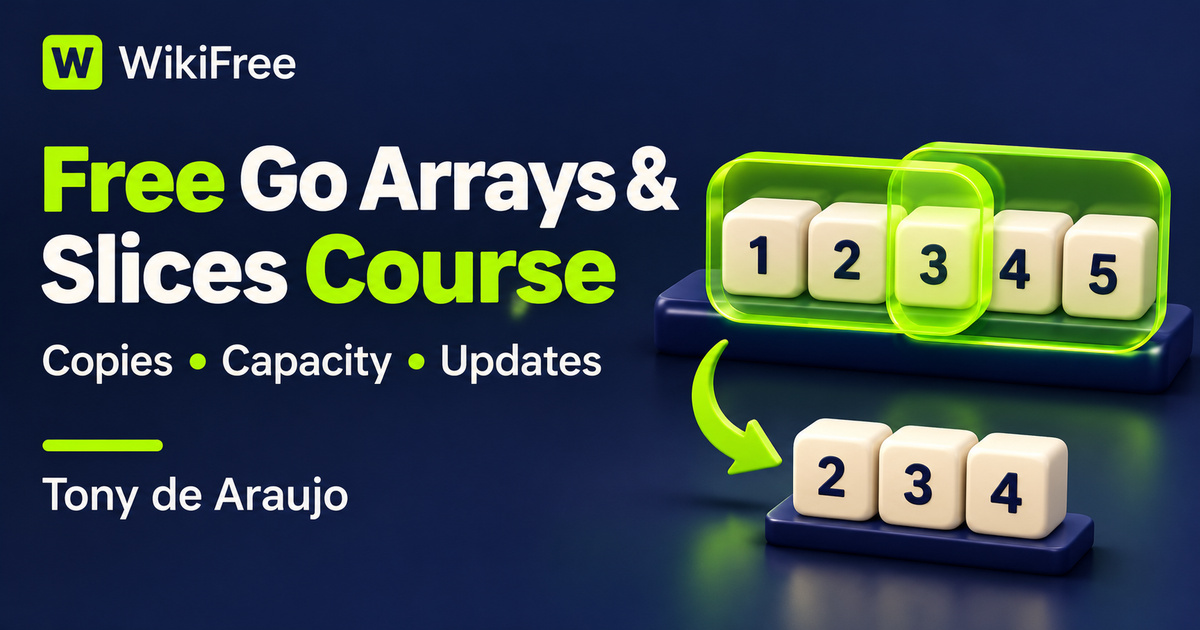
A slice is more than a pointer: it describes an underlying array segment together with a length and capacity. Two slices can refer to the same storage, so changing a shared element may be visible through both. Re-slicing selects a view into that storage; it does not automatically create an independent copy of the elements. Drawing the backing array beside each slice is a useful way to follow these examples.
Appending introduces a second question: is there enough capacity? Go’s append operation can reuse the backing array or allocate a new one, and it returns the resulting slice. Copying has different behavior: copy transfers up to the smaller of the source and destination lengths. These details explain why changing a slice’s length, changing its elements, and creating a separate copy are different operations.
Practice predicting the next result
Several course entries pair a small task with a solution, including selecting odd values and combining or rearranging slices. The lesson descriptions make the intended practice clear, while keeping the scope focused. You can use this structure as a prompt to pause, write a prediction, and compare it with the explanation rather than immediately advancing to the answer.
For an additional independent exercise, draw a five-slot array containing fictional parcel counts. Create two overlapping slice views on paper, change one shared slot, and predict both views. Then sketch a separate destination, copy selected counts into it, and consider which later changes should remain isolated. This is an editorial practice suggestion, not an extra course assignment or a claim about the contents of downloadable files.
Keep the boundaries precise
The course includes a lesson comparing strings and byte slices. Keep the language distinction clear: Go strings are immutable sequences of bytes, while a byte slice is a different type. Indexing a string returns a byte, not necessarily a complete Unicode character. This precision helps you use the examples without carrying an overly broad analogy into later programs.
The English course lists one section with forty-nine lecture entries, twenty-one advertised articles, and roughly one hour and forty-six minutes of combined material. It also advertises downloadable resources and an optional quiz. The instructor identifies the Go Playground as the setting for exercises and notes testing with Go 1.24. That version note is not a guarantee for every environment or future version. Other volumes are separate courses; their availability and pricing should be checked independently.
Read about Go slice behavior: Explore the relationship between a slice and its underlying storage. Consult the Go language specification: Check precise definitions of strings, slices and built-in operations.
Related courses for your next step
- Review basic program structureFree Python Programming Course
Explore introductory programming in a different language.
Beginner
- Compare another systems languageFree Rust Foundations Course
Begin with Cargo, types and variables.
Beginner
Frequently asked questions
Is this Go course free?
The current Udemy listing is free. That applies to this arrays-and-slices course, not automatically to the instructor’s other volumes or external services.
Is it suitable for a complete programming beginner?
The requirements describe an intermediate Go study course. Some exposure to variables and basic functions is helpful, even though this volume is self-contained.
Does assigning one slice to another copy the elements?
No. The slice values can share an underlying array. Use an appropriately sized separate destination and copy when you need independent element storage, and consider the element types involved.
Learner reviews
Tell other learners what you actually tried. Reviews are moderated and may come from learners who have started or completed the course.
No published learner reviews yet.
Sign in to write a reviewQuestions still belong in the discussion below. Review and ranking rules.
Questions & discussion
Share a useful question or correction. Comments appear after moderation. Please avoid personal or sensitive information.