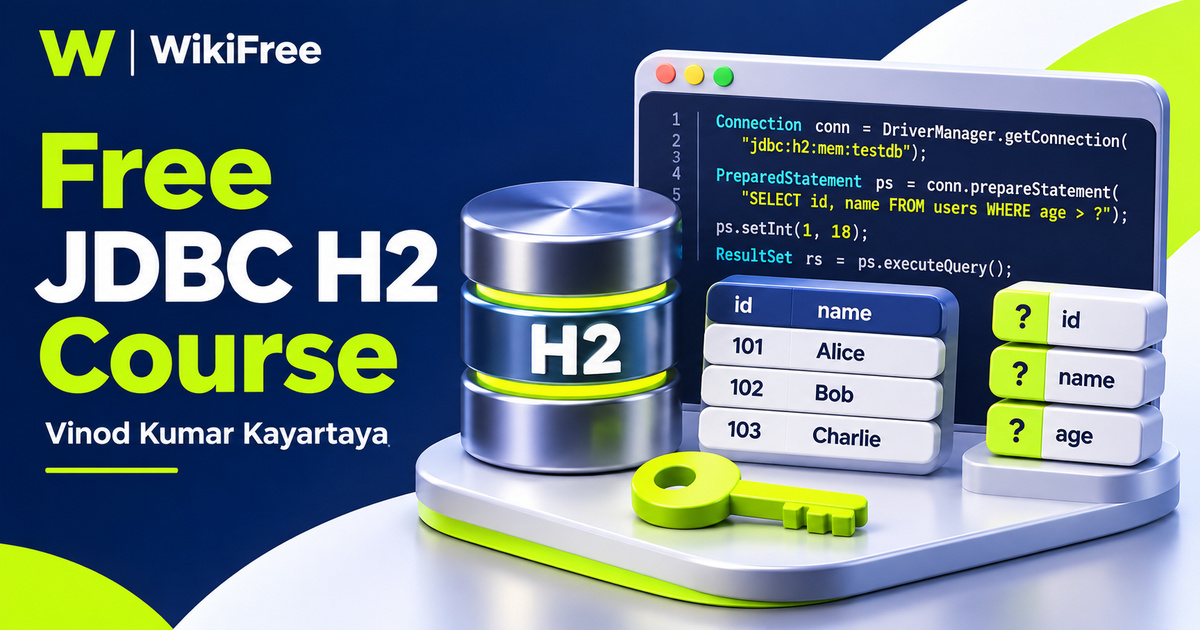
Listed as Free on Udemy when checked on 8 November 2026. No coupon or subscription trial is required for the listed lessons. Enrollment needs a Udemy account; availability can change.
About this course
A Java application can collect a value, send it to a database, and display a result in only a few lines of code. Understanding those lines takes more care. You need to know which object opens the connection, how values become SQL parameters, and what the returned information actually tells the application. That small sequence is a useful foundation for reading data-access code with confidence.
Vinod Kumar Kayartaya's Everything you need to know about JDBC introduces that sequence through H2 database examples. The free English course contains five sections and about ninety minutes of listed material. Despite its broad title, the useful promise is focused: an introduction to connecting Java code to a relational database, executing commands, and handling results. Basic Java knowledge is expected, with some SQL familiarity helpful.
| Official course | Everything you need to know about JDBC |
|---|---|
| Created by | Vinod Kumar Kayartaya |
| Platform | Udemy |
| Language | English |
| Level | Intermediate |
| Listed duration | 90 minutes; 13 lectures across 5 sections |
| Completion terms | Not included with a new free enrollment |
What you’ll learn
The lessons move from JDBC architecture and H2 setup into connection code, a DbUtil helper, table creation, inserting records, and prepared statements. Later topics cover batch execution, retrieving multiple or individual records, and obtaining a generated primary key. Study this as a connected data-access workflow: request a connection, prepare an operation, provide its values, execute it, and interpret the response.
Skills you’ll gain
- JDBC connection concepts
- H2 learning environment setup
- SQL parameter binding
- Batch execution awareness
- Result set handling
- Generated key retrieval
Understand the boundary between Java and SQL
JDBC gives Java programs a common API for interacting with relational databases through suitable drivers. That shared API does not make every database identical. SQL syntax, supported features, connection details, and driver behaviour still matter. H2 provides the course's concrete setting, allowing you to focus on the relationship between application objects and database operations without treating every engine as interchangeable.
As you study a connection example, identify which information describes the destination and which information authenticates the connection. Then separate that setup from the operation you want to perform. A helper class can reduce repeated setup code, but moving values into a properties file does not encrypt credentials or establish a complete secret-management approach. Keep demonstration credentials separate from any real account information.
Treat input as data and results as evidence
Prepared statements are a central part of the course's progression. Binding a value to a parameter separates that value from the SQL statement's syntax. This helps address injection risks associated with constructing SQL by concatenating input. It does not, by itself, validate business rules, authorise a user, or make an entire application secure. Those are separate responsibilities that remain outside this introductory course's promise.
Reading results deserves similar attention. A lookup can return no matching record, while a list query can return several. A generated key is another kind of result: it identifies a newly created record rather than representing the number of rows affected by an operation. When reviewing an example, ask what the returned object means and how the surrounding code handles an empty or unexpected outcome.
Keep batch execution distinct from transaction decisions
The batch lesson introduces grouping repeated operations. A batch can reduce overhead, but calling a batch method does not automatically establish an all-or-nothing transaction. JDBC provides update counts and batch exceptions; driver behaviour after a failed command can vary. Commit and rollback decisions depend on transaction handling and the connection's configuration, not simply on whether commands were submitted together.
This is a useful boundary to carry into further study. If three attempted inserts produce an error, you need evidence about which commands ran and what was committed before deciding whether a retry is appropriate. Repeating everything without understanding that state can create a second problem. Treat this as a question to investigate with documentation and disposable test data, not as a production retry strategy supplied by the short course.
Learn the concepts while checking the environment
The page lists a May 2020 update, and its public setup summary names an older H2 release. Current H2 documentation describes substantial changes between older 1.x databases and version 2, including a migration process rather than a simple file replacement. Use current vendor guidance to choose a learning environment; do not assume that an old database file or every recorded SQL example works unchanged with a newer release.
For an independent practice plan, sketch a small fictional repair-parts table. Describe an insertion, a lookup that finds nothing, and a lookup that returns several parts. Beside each operation, write the information the Java code must provide and the evidence it should receive. This paper exercise helps turn short examples into questions you can test later without confusing introductory familiarity with production readiness.
Check H2 version changes: Review the documented migration boundary. Understand batch results: Distinguish execution results from transaction decisions.
Related courses for your next step
- Explore a different database environmentFree SQLite Fundamentals Course
Compare introductory SQL work in a separate database system.
Beginner
Frequently asked questions
Is this course free to watch?
The course is currently listed as free in English. Optional training offered elsewhere by the instructor is separate from this course.
Is prior Java experience needed?
Yes. The instructor requests basic Java knowledge, and basic relational database and SQL knowledge will help. This is an introduction to JDBC rather than a first programming course.
Does it cover every JDBC feature or guarantee compatibility?
No. It is a short introductory sequence using H2 examples. Check current Java, driver, and H2 documentation before reproducing the recorded setup. No certification or production-readiness outcome is promised.
Learner reviews
Tell other learners what you actually tried. Reviews are moderated and may come from learners who have started or completed the course.
No published learner reviews yet.
Sign in to write a reviewQuestions still belong in the discussion below. Review and ranking rules.
Questions & discussion
Share a useful question or correction. Comments appear after moderation. Please avoid personal or sensitive information.