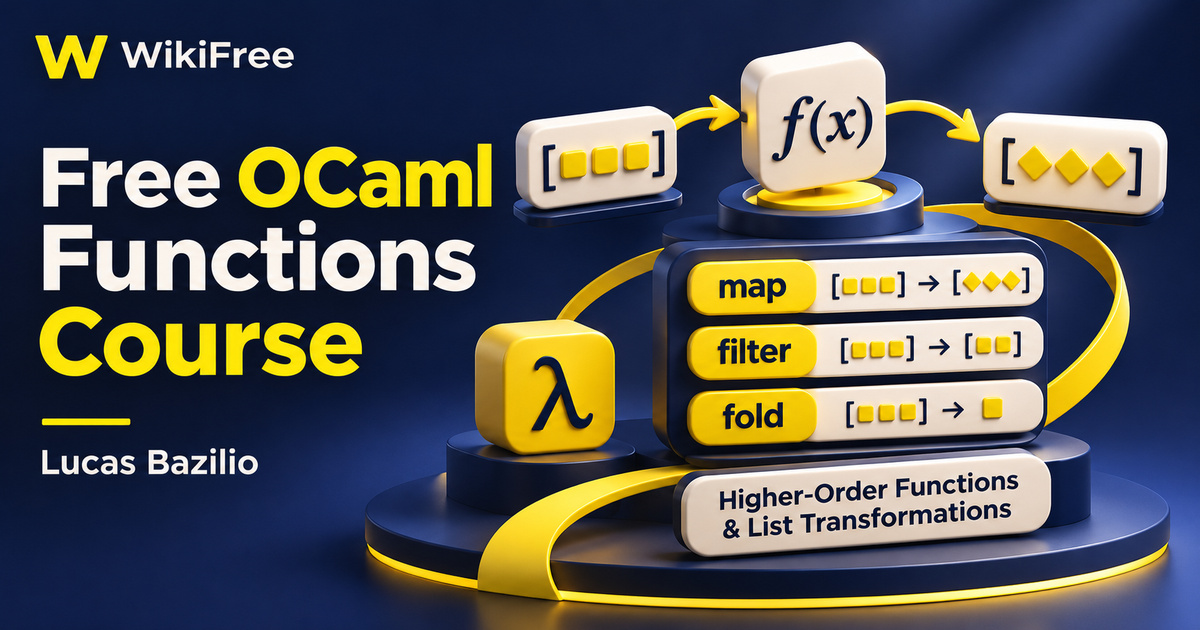
Listed as Free on Udemy when checked on 8 November 2026. No coupon or subscription trial is required for the listed lessons. Enrollment needs a Udemy account; availability can change.
About this course
Passing a function into another function can feel abstract until you use it to solve a small, concrete problem. A list of values offers a useful place to start: decide what should change, what should remain, and what result you want. This free OCaml course provides a focused sequence of worked problems for learners ready to practice that style of reasoning.
Lucas Bazilio teaches Introduction to OCaml Programming – Higher Order Functions in English on Udemy. The October 2023 course contains a brief introduction and nine problem sessions, totaling approximately one hour and forty-nine minutes. Its requirements include basic programming knowledge and completion of Parts 1 and 2. Treat it as a continuation for prepared learners; the previous parts are not included in this ten-lesson outline.
| Official course | Introduction to OCaml Programming – Higher Order Functions |
|---|---|
| Created by | Lucas Bazilio |
| Platform | Udemy |
| Language | English |
| Level | Intermediate |
| Listed duration | 109 minutes; 10 lectures across 2 sections |
| Completion terms | Not included with a new free enrollment |
What you’ll learn
Explore higher-order functions through problems involving equality, products, even results, powers of two, scalar products and list operations. The final problems address flattening, length, reversal and occurrences. The course description connects these exercises with anonymous functions, composition, currying, recursion and pattern matching. Its emphasis is working through examples rather than introducing an entire development environment or building a finished application.
Skills you’ll gain
- Higher-order function reasoning
- Function composition awareness
- Partial application
- List transformation
- Recursive problem decomposition
- Input and output analysis
Recognize the function inside the operation
In OCaml, a function is a value: it can be passed as an argument or returned as a result. A higher-order function uses that capability to make some part of its behavior configurable. Instead of writing a separate traversal for every transformation, you can describe the transformation with a function and pass it to an operation that handles the traversal.
The official OCaml documentation uses mapping to explain this relationship. Mapping applies a supplied function to list elements and produces a new list of results. The input and output element types need not match, provided the supplied function has the corresponding type. By comparison, iteration is useful for performing an action for each element. Keeping those purposes distinct helps you read code by following its types and intended result.
Keep the data shape in view
An OCaml list contains elements of one type. A nested list therefore has a different shape from a flat list, even when both ultimately contain integers. Before following a solution, write down the input shape and the expected output shape. That small habit makes it easier to distinguish transforming each value from combining several values or removing a level of nesting.
Empty inputs deserve their own attention. A nonempty list has a head and a tail; an empty list has neither. Standard library operations also have specific contracts, and some operations over two lists require matching lengths. Read the relevant function documentation before adapting a short classroom example to unfamiliar data. A successful demonstration with one input is a starting point for testing, not evidence that every edge case is handled.
Understand partial application before shortening code
Currying lets a function accept its arguments through successive function applications. Supplying some arguments can produce a function that waits for the rest. This makes partial application useful when preparing a specialized transformation for another operation. It does not by itself destructure a list; pattern matching serves a different purpose.
When an expression becomes difficult to read, temporarily name its intermediate functions. Explain what each one accepts and returns before combining them again. Concise code is helpful when the relationships remain visible. There is no need to compress a solution into one line to demonstrate understanding, and a functional style alone does not establish correctness or performance.
Make a small practice notebook
For an independent exercise, invent a list of short inventory labels. Write down three separate tasks: transform every label, retain labels satisfying a rule, and summarize a property of the collection. Predict the result for each task before trying an implementation. Include an empty list, repeated labels and a single-element list, then explain which changes affect the result and why.
This is an editorial practice activity, not a promised instructor assignment. Keep your first attempt and a revised version side by side, adding a sentence about the reason for each change. The most useful outcome is a solution you can explain and test. Use the recorded problems as prompts for that process, allowing additional time for revision beyond their playback duration.
Review higher-order functions: Read the official OCaml explanations of currying and function application. Review list operations: Check list shapes and standard library contracts.
Related courses for your next step
- Explore another functional languageFree Elixir Basics Course
Compare a separate introduction to patterns and small functions in Elixir.
Beginner
Frequently asked questions
Is this course free?
The reviewed Udemy page offers these recorded lessons free in English. Earlier parts and other courses have separate availability and terms.
Can an absolute beginner start here?
The requirements specify programming knowledge and prior Parts 1 and 2. Build those foundations before treating this as a suitable starting point.
Have the downloadable resources been reviewed?
No. The page advertises eighteen resources, but their contents have not been inspected. No certificate or complete application outcome is promised here.
Learner reviews
Tell other learners what you actually tried. Reviews are moderated and may come from learners who have started or completed the course.
No published learner reviews yet.
Sign in to write a reviewQuestions still belong in the discussion below. Review and ranking rules.
Questions & discussion
Share a useful question or correction. Comments appear after moderation. Please avoid personal or sensitive information.