Listed as Free on Udemy when checked on 8 November 2026. No coupon or subscription trial is required for the listed lessons. Enrollment needs a Udemy account; availability can change.
About this course
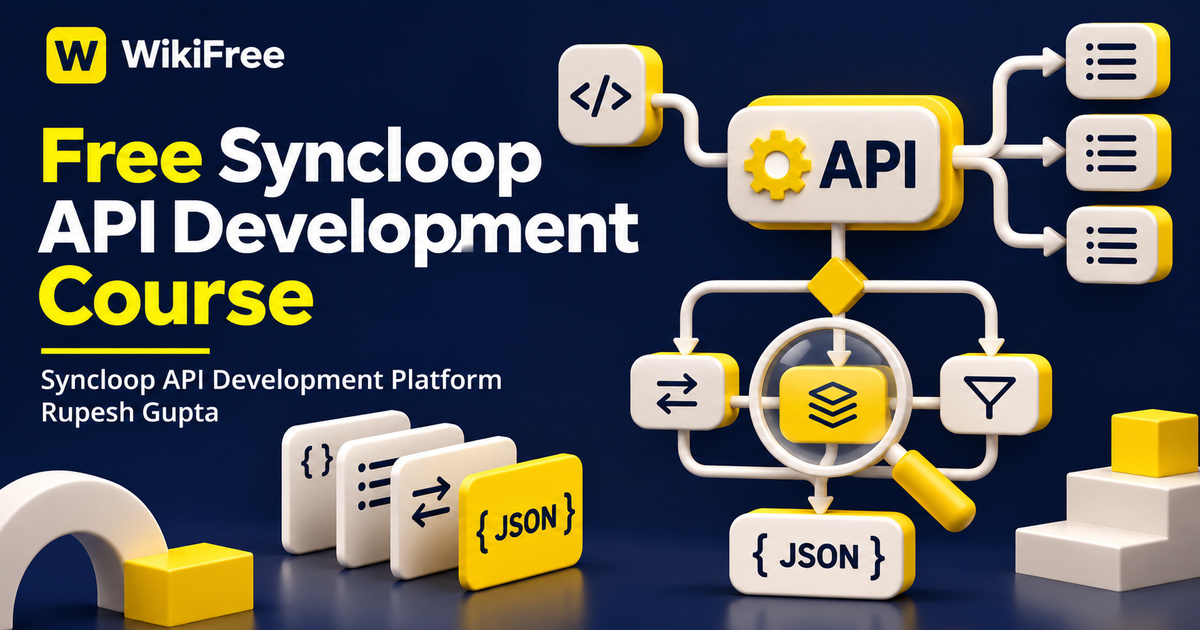
An API integration becomes easier to understand when you can trace its inputs, decisions and outputs. This free English course from Syncloop API Development Platform and Rupesh Gupta introduces that process through visual service examples. It starts with a greeting response, country-capital selection and loops, then moves toward external services, transformations, response handling and debugging.
The listed material was updated in March 2024. Its seven sections contain fifteen timed lectures, including short project and program introductions. Minimal coding skills are the stated prerequisite, although familiarity with requests, responses and structured data will make the examples easier to follow. Treat the course as an introduction to the platform’s workflow, with individual demonstrations to study rather than a promise of a production-ready system.
| Official course | Basic + Advanced Course on Syncloop API Development Platform |
|---|---|
| Created by | Syncloop API Development Platform; Rupesh Gupta |
| Platform | Udemy |
| Language | English |
| Level | Intermediate |
| Listed duration | 111 minutes; 15 lectures across 7 sections |
| Completion terms | Not included with a new free enrollment |
What you’ll learn
Explore how service steps connect, how data moves between them and where response handling fits into an API flow. The syllabus includes JSON transformation, XML-to-CSV conversion, external API access, GraphQL and snapshot-based debugging. These topics provide several angles on the same practical question: what happens to an input before a caller receives the result?
Skills you’ll gain
- Visual API flow design
- Conditional routing
- Loop reasoning
- Data mapping
- Response handling
- Debugging interpretation
Separate local logic from outside dependencies
The platform’s official training material distinguishes its country-capital example, which selects from predefined switch cases, from its weather example, which consumes an external service using coordinates. The currency-conversion example similarly retrieves rate information from an external API. That is a data-integration example; it should not be read as investment guidance or a lesson in executing trades.
Before copying a flow, identify which values your own service determines and which depend on another provider. A successful local calculation cannot establish that an external response is current, complete or available. Add a note to your learning journal for each dependency: what it returns, what could be missing and how your service should respond when it cannot obtain a useful result.
Make transformations explainable
The JSON and XML-to-CSV lessons offer an opportunity to think beyond rearranging fields. A transformation needs an explicit relationship between the incoming structure and the outgoing one. Names, missing values, repeated records and field types all deserve attention when you describe that relationship.
Try an independent planning exercise with invented library records. Give each record a book code, title and a list of shelf locations. Sketch the JSON input, then draw a proposed CSV output. Decide whether each shelf location creates another row or whether you deliberately combine them into one field. Neither choice should be accidental: write down what information a person reading the result will be able to recover.
Now introduce a record with no shelf location and another with punctuation in its title. Describe the output you expect before touching a tool. This makes your assumptions visible and gives you examples to compare against a later implementation. The exercise is an editorial suggestion, separate from the course project, and can be completed on paper without an account or live customer data.
Inspect failures as carefully as successful responses
The course covers custom HTTP response elements, exception handling and a debugging workflow that records values at service steps. A useful way to study these features is to ask where the first unexpected value appears. An error at the final response may originate much earlier, such as a missing input or a transformation that changed a field’s meaning.
Extend your library example with two cases: an unfamiliar book code and an unavailable outside service. Explain what the caller should learn from each response, and keep internal diagnostic details separate from information intended for that caller. Use synthetic inputs while learning to inspect snapshots, since captured values may contain information that should not be shared. Catching an exception helps control failure behavior; it does not demonstrate that the underlying service is error-free.
Keep access and outcomes in perspective
The free offer covers the Udemy lessons. A Syncloop workspace, external API access and any cloud resources have separate access conditions and possible costs. Check current documentation before reproducing a 2024 setup. The short AI-access and GraphQL segments are introductions, while internship selection and the separate badge program are not guaranteed outcomes of watching the course. Choose a small integration you can explain clearly before expanding its scope.
Explore the platform training outline: Compare the purposes of the service examples. Review API documentation guidance: Check version-specific documentation before implementing a flow.
Related courses for your next step
- Compare a code-based API exampleFree Node API Course
Explore a separate introductory API project using Node and Express.
Beginner
Frequently asked questions
Does the course include a production deployment guarantee?
No. It introduces platform workflows and examples. Deployment reliability, security and compatibility require their own project-specific work.
Is every external tool or API free?
No such promise is made. The recorded lessons are listed free; workspace access, provider accounts and cloud usage must be checked separately.
Does the currency example teach trading?
The reviewed description and official training outline identify an external conversion-rate API example. They do not establish trading execution or an investment strategy.
Learner reviews
Tell other learners what you actually tried. Reviews are moderated and may come from learners who have started or completed the course.
No published learner reviews yet.
Sign in to write a reviewQuestions still belong in the discussion below. Review and ranking rules.
Questions & discussion
Share a useful question or correction. Comments appear after moderation. Please avoid personal or sensitive information.