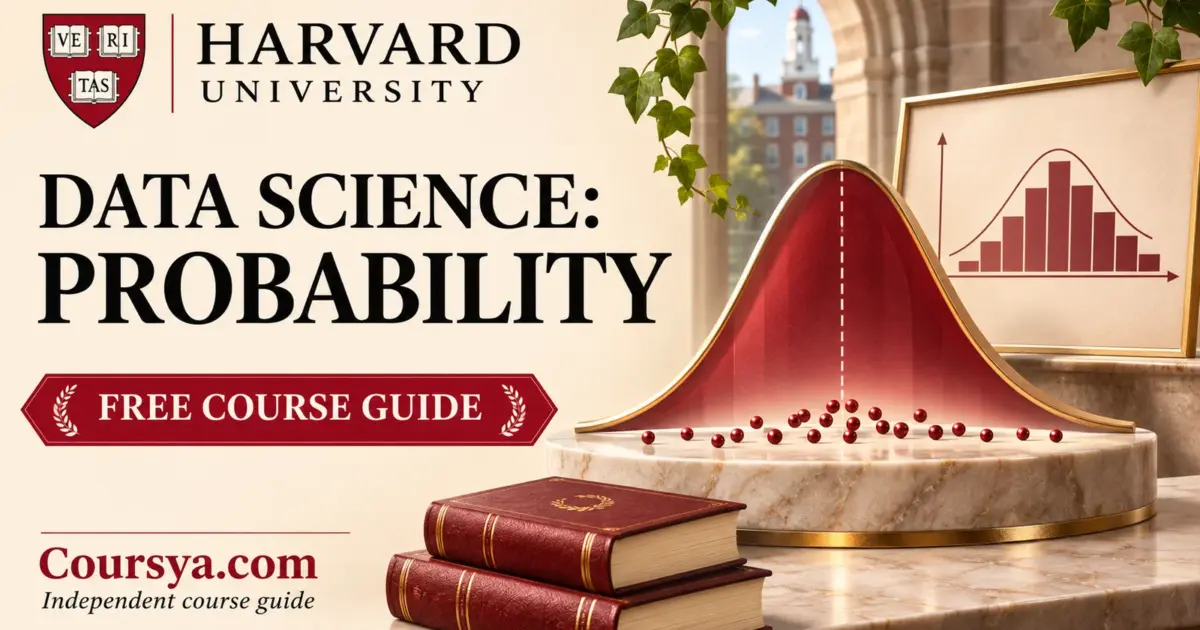
Probability helps explain how results vary even when the underlying process has not changed. This course develops the foundations needed to reason about uncertainty and later statistical inference. R-based computation and simulation make abstract ideas easier to investigate. Rather than treating one observed result as a certainty, you learn to describe possible outcomes, state assumptions and compare what a model predicts with what repeated experiments produce.
Quick answer: Data Science: Probability is an English-language Harvard course with a free audit route. This guide explains the skills, preparation and practical next steps.
Independent guide by the Coursya Editorial Team. Sources reviewed .
+ Course guide contents
Course facts at a glance
| Official course | Data Science: Probability |
|---|---|
| Provider / school | Harvard T.H. Chan School of Public Health |
| Instructor | Rafael Irizarry |
| Platform | edX |
| Language | English |
| Level | Introductory |
| Length / pace | 8 weeks long; self-paced |
| Study estimate | 1 – 2 hours per week |
| Free access | Free audit; optional paid certificate |
What you will learn and the skills you can build
- Describe random variables, independence and expected values.
- Use Monte Carlo simulation to explore uncertain outcomes.
- Distinguish variation in individual observations from variation in estimates.
- Explain why the Central Limit Theorem matters for statistical inference.
Who should take this course?
Beginning data scientists, students preparing for inference and analysts who want stronger quantitative reasoning. It is also valuable for project professionals who need to understand simulation results without confusing a forecast with a guarantee.
Preparation and entry knowledge
Review fractions, percentages, averages and basic algebra. Coursya recommends introductory R so that assigning variables, using vectors and running a script are familiar. Keep a small glossary of probability terms and write an example for each definition. Check the current provider syllabus for formal requirements.
Preparation suggestions in this guide are Coursya's editorial advice. Review the live syllabus for required software, readings, formal prerequisites and any changes to course access.
Is the course free, and what about the certificate?
Harvard lists a free audit route for this course. On the enrollment page, select the audit or free-learning option where available and check what it includes before choosing an upgrade. Access periods and available activities can differ from the paid track, so review the current terms for your account.
A verified certificate is not included in the free audit route. The provider offers an optional paid upgrade under its current terms. Completing a free course does not by itself award a Harvard degree or the entire professional certificate programme. Coursya does not issue Harvard credentials.
How to study this course effectively
- Describe a simple random process in words before writing code. State the possible outcomes and the assumptions about how they are generated.
- Calculate a small example manually, then reproduce it in R. Compare the exact result with simulation output and explain the difference.
- Repeat a simulation with different sample sizes. Observe which quantities stabilize and which sources of uncertainty remain.
- Write a plain-language interpretation that includes the model assumptions. Explain how the conclusion would change if independence were not plausible.
Independent practice: turn learning into a useful result
Model a fictional quality-control process where each item has a stated defect probability. Simulate batches of different sizes and compare the distribution of defect proportions. Record the random seed, number of repetitions and assumed probability. Then discuss what changes if defects arrive in clusters rather than independently. Do not present the simulation as measured factory performance. Produce one chart, a reproducible script and a short note separating simulated variation from uncertainty about the assumed defect rate.
Suggested deliverable: A documented simulation with explicit assumptions, reproducible code and an explanation of uncertainty.
Test your understanding by asking a colleague to change one assumption in your example. Explain the expected effect before rerunning the simulation. If the output surprises you, investigate whether the problem lies in the code, the model or your interpretation. Keeping these three possibilities separate is a useful habit for later data-science work.
This is an original Coursya practice suggestion, not an official Harvard assignment, assessment or certificate requirement.
A mistake to avoid
An expected value is a long-run average under a model, not a promise about the next outcome. A larger simulation can reduce computational noise while leaving a poorly chosen assumption unchanged.
What to study before and after this course
The following links are optional Coursya study recommendations. Choose preparation that fills a gap and a next step that fits your goal; this is not an official mandatory Harvard sequence.
Useful preparation
Possible next steps
Frequently asked questions
Is this Harvard course free?
Harvard lists a free audit route for this course. On the enrollment page, select the audit or free-learning option where available and check what it includes before choosing an upgrade. Access periods and available activities can differ from the paid track, so review the current terms for your account.
Does free access include a certificate?
A verified certificate is not included in the free audit route. The provider offers an optional paid upgrade under its current terms. Completing a free course does not by itself award a Harvard degree or the entire professional certificate programme. Coursya does not issue Harvard credentials.
How much time should I plan?
8 weeks long. Harvard lists 1 – 2 hours per week. Allow extra practice time if the tools or subject are new to you; the estimate is not a guaranteed personal completion time.
Do I need advanced mathematics first?
The listing is introductory. Basic algebra and comfort with R will make practice easier; a separate advanced probability course can follow if you need deeper mathematical treatment.
Can I use the independent exercise in a portfolio?
You can develop your own permitted-data exercise and explain your contribution. Clearly distinguish it from official course assessment, respect source licences and do not claim a credential you have not earned.
Main instruction language: English
Learner reviews
Tell other learners what you actually tried. Reviews are moderated and may come from learners who have started or completed the course.
No published learner reviews yet.
Sign in to write a reviewQuestions still belong in the discussion below. Review and ranking rules.