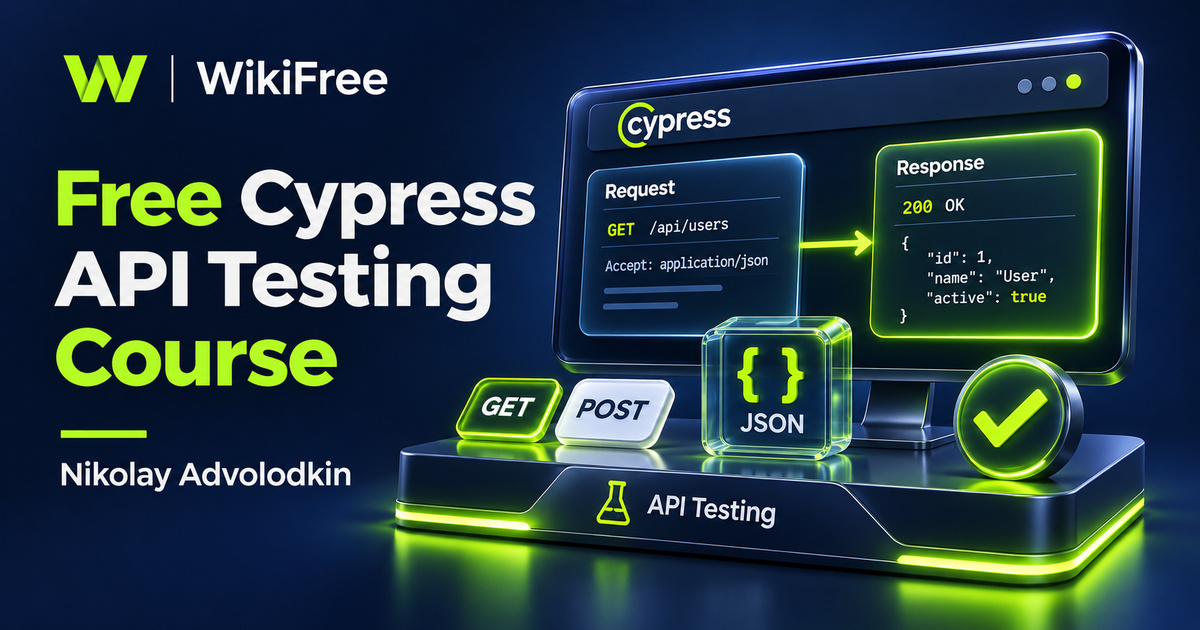
Listed as Free on Udemy when checked on 7 November 2026. No coupon or subscription trial is required for the listed lessons. Enrollment needs a Udemy account; availability can change.
About this course
An API test becomes useful when it asks a precise question about a response. Did the endpoint return the expected status? Does its body contain the right fields? This free Cypress API testing course introduces that habit through JavaScript examples, alternating short exercises with solutions so you can compare an intended check with an implementation.
Nikolay Advolodkin teaches API Testing with JavaScript and Cypress 10 for developers who already understand basic JavaScript. The course has six sections and twenty-seven videos totaling sixty-nine minutes and fifty seconds, plus one listed bonus article. It moves from setup and an initial test into GET requests, POST requests and authentication-related examples.
The recordings were last updated in December 2022 and specifically use Cypress 10. Expect a compact introduction to API test construction, not a complete security assessment or a guarantee that the original hosted environment is available today. Read current setup instructions for the versions and services you choose while keeping the request, response and assertion concepts in view.
| Official course | API Testing with JavaScript and Cypress 10 |
|---|---|
| Created by | Nikolay Advolodkin |
| Platform | Udemy |
| Language | English |
| Level | Intermediate |
| Listed duration | 70 minutes; 28 lectures across 6 sections |
| Completion terms | Not included with a new free enrollment |
What you’ll learn
Work through the structure of a Cypress test, inspect HTTP responses and add assertions that express an expected result. Explore GET requests and their options, then POST requests with request bodies and response-field checks. The later section introduces authenticated interactions and compares API-oriented checks with tests that also involve a login interface.
Skills you’ll gain
- API test design
- Cypress request commands
- HTTP response assertions
- GET request options
- POST payload validation
- Authentication test reasoning
Make a passing test mean something
The early exercise-and-solution sequence is an opportunity to separate running a test from testing a behavior. A test can finish without checking the property you care about. Before writing an assertion, state the expected outcome in plain language. For a request that retrieves comments, that might include the documented success status and the presence of a field your application needs.
The GET lessons progress from issuing a request to examining status and body values, then introduce request options. Notice which parts identify the endpoint and which change how the request is sent. In current Cypress, cy.request sends requests through Node.js rather than the browser. That distinction means a successful request is not, by itself, a test of whether a browser-facing cross-origin setup behaves correctly.
Understand what the endpoint actually changes
POST examples add a body and examine the response returned by the service. Keep an echoed field separate from evidence that a record was stored. JSONPlaceholder, used among the course examples, simulates write operations: a created-looking response does not mean a later request will retrieve a newly persisted record. Design your expectation around the endpoint’s documented behavior.
Errors also need specific expectations. A status code alone does not explain every cause, and a lesson title containing a number is not a universal rule for an API. Identify the request, the documented response and the condition being exercised. When deliberately testing an error response, understand the test runner’s default failure behavior before deciding how to inspect that response.
Keep authentication checks focused
The authentication section includes exercises and solutions around API access and login flows. Use these as an introduction to the relationship between credentials, tokens, requests and the behavior being asserted. A valid login response does not establish that every protected operation is authorized correctly. Test only systems and accounts you are allowed to use, and keep real credentials out of shared code and logs.
Keep request retries distinct from assertion retries. Current Cypress documentation says assertions chained to cy.request run once; separate options govern retries for certain network or status failures. If a check fails intermittently, investigate the response and the intended timing before simply adding more retries. Repeating a request can matter especially when the endpoint changes data.
Build a small, explainable test set
As an optional practice idea, write down three checks for a local demonstration API: retrieving an item, rejecting an invalid request and accepting a documented payload. Record the expected status and one meaningful body property for each. Then consider which checks require persistent storage and which can use a fake API. Keep your expectations explicit so another developer can understand why a check passes or fails.
The lessons are listed as free, while external hosted development environments and API services have their own availability and account terms. Exercise and solution entries are videos; they should not be confused with a separately assessed coding assignment. Use the course to develop a clearer testing vocabulary and a small set of understandable checks before expanding into broader integration or end-to-end testing.
Related courses for your next step
- Explore requests manually firstFree Postman API Testing Course
Inspect a request and response before expressing the same expectation in an automated test.
Beginner
Frequently asked questions
Do I need JavaScript experience?
Yes. The course expects basic JavaScript knowledge and is aimed at intermediate developers learning API testing.
Are the original hosted tools guaranteed to be free today?
No. Free access to the recorded lessons is separate from external services, accounts and hosted environments. Check their current terms and setup requirements.
Does an API test prove a service is secure?
No. These lessons introduce functional checks and authentication examples. Security, authorization coverage and production readiness require additional work.
Questions & discussion
Share a useful question or correction. Comments appear after moderation. Please avoid personal or sensitive information.