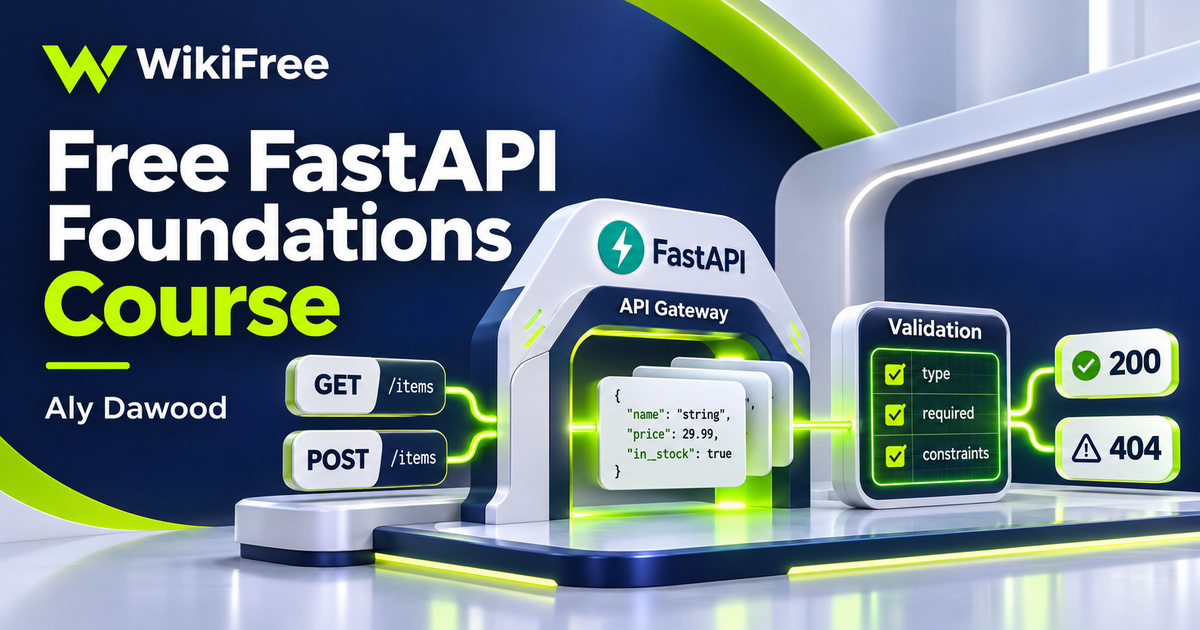
Listed as Free on Udemy when checked on 7 November 2026. No coupon or subscription trial is required for the listed lessons. Enrollment needs a Udemy account; availability can change.
About this course
A useful API makes its expectations clear: what a client can request, what data it accepts and how it responds when something goes wrong. This free FastAPI foundations course follows that path through a small Python project. Aly Dawood connects HTTP concepts with routes, interactive documentation and validation so the framework has a concrete purpose.
Crash Course On FastAPI For Web Developers—Level 1 Part 1 is the first installment of a larger series. Its five sections list twenty video lessons, totaling one hour, fifty-four minutes and fifteen seconds, alongside six article entries and eight quizzes. The public listing also identifies eighteen downloadable resources. The lessons use movie records to introduce API operations, with a books assignment listed separately.
This is a framework introduction for learners who already know Python variables, functions, control flow and object-oriented programming. Basic web development, HTML, command-line use and database concepts are also expected. The source classifies the course as Intermediate. Familiarity with these foundations lets you concentrate on the behavior of an API instead of learning Python syntax at the same time.
| Official course | Crash Course On FastAPI For Web Developers- Level 1 Part1 |
|---|---|
| Created by | Aly Dawood |
| Platform | Udemy |
| Language | English |
| Level | Intermediate |
| Listed duration | 115 minutes; 26 lectures across 5 sections |
| Completion terms | Not included with a new free enrollment |
What you’ll learn
Set up a project environment, distinguish HTTP requests from responses, and connect methods and URL paths with endpoint behavior. Explore FastAPI through Swagger UI, introduce Pydantic models and field rules, and use status codes and HTTP exceptions to make successful and unsuccessful outcomes understandable to clients.
Skills you’ll gain
- FastAPI endpoint design
- HTTP request structure
- Virtual-environment setup
- Swagger UI exploration
- Pydantic validation concepts
- API error responses
Start with a controlled project environment
The setup section introduces Python virtual environments and includes a Windows demonstration. An isolated environment helps keep project dependencies separate from those of other applications. It is not a security sandbox, and creating one does not by itself make a setup reproducible. Keep a record of the versions used when you follow the demonstrations, particularly when your installed packages differ from the recording.
Connect HTTP concepts with routes
The HTTP section gives each request a structure. A method expresses the operation, a path identifies an endpoint, and headers or a body carry further information where appropriate. Distinguish a path parameter identifying a particular record from a query parameter used to refine a request. This makes it easier to explain why two URLs call different behavior even when they concern the same collection.
Swagger UI provides an interactive view of the API definition and a convenient place to send practice requests. FastAPI serves this interface at /docs by default, although an application can change or disable that address. Read the request and response together when experimenting. Seeing a successful response once is useful feedback, but it is not a replacement for a repeatable test suite.
Describe acceptable input explicitly
The project section develops movie-record endpoints and then adds validation. Pydantic models make the expected structure explicit, while field constraints and custom rules describe acceptable values. Validation concerns the rules your application defines; it does not prove that submitted information is factually true or that a caller is authorized to change a record. Authentication and access control need their own design.
The listing was updated in January 2025, so compare examples with the documentation for the versions you install. Pydantic V2 changed several APIs from V1, including validator decorators. If you encounter an older validator example, consult the migration guide instead of assuming it will work unchanged. Learn the purpose of each rule before adapting its syntax to another release.
Make errors useful to clients
Status-code and exception lessons complete the request cycle. A client should be able to distinguish a successful operation from a missing record or invalid input. In FastAPI, raise an HTTPException when that error should interrupt the request and produce the intended response; simply returning an exception object is a different operation. Keep internal implementation details out of messages intended for ordinary clients.
Practice one request at a time
For an optional exercise, sketch an API for a small equipment inventory. Describe one request that retrieves an item, one that submits a new item and one that asks for a nonexistent identifier. Write the expected method, input and response before trying any code. Add a deliberately invalid quantity and explain which validation rule should reject it. This is a suggested practice activity, separate from the course’s listed books assignment.
The course description places SQLAlchemy database connectivity in Level 1 Part 2. Keep that distinction when planning your study: this first installment introduces routes and validation, rather than promising persistent database integration or a deployed production service. The listing distinguishes the books assignment and solution as article entries, with quizzes and downloadable resources alongside the lessons.
The recorded lessons are listed as free, and FastAPI and Pydantic are open-source tools. Hosting, external services and any additional programs have separate terms. Use this installment to understand a small request-and-response workflow, then build on it with testing, persistence, security and deployment study as your project requires.
Related courses for your next step
- Practice inspecting API behaviorFree Postman API Testing Course
Develop request and response checks with a dedicated API client.
Beginner
Frequently asked questions
Is this a Python course for complete beginners?
No. It assumes Python programming and basic web, command-line and database knowledge, then introduces FastAPI.
Does Part 1 teach SQLAlchemy database connectivity?
The description assigns that topic to Part 2. This article covers the first installment’s setup, HTTP, routing, validation and error-handling scope.
Can I copy every validator into a current project unchanged?
Do not assume that. Check the installed Pydantic version and its documentation; V2 introduced changes from V1, including validator APIs.
Questions & discussion
Share a useful question or correction. Comments appear after moderation. Please avoid personal or sensitive information.