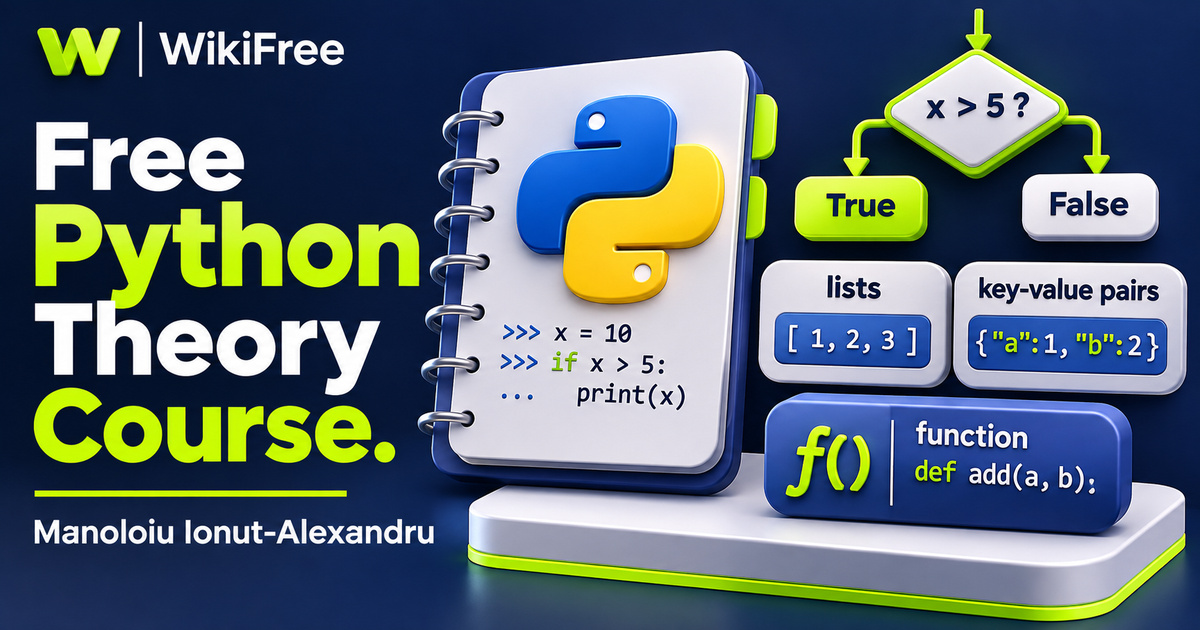
Listed as Free on Udemy when checked on 7 November 2026. No coupon or subscription trial is required for the listed lessons. Enrollment needs a Udemy account; availability can change.
About this course
Before a Python program becomes useful, its small decisions need to make sense: what type of value is stored, which branch runs, and what a function sends back. Manoloiu Ionut-Alexandru’s Python fundamentals course provides a compact way to study those rules. Its focus on theory suits learners who want to read short programs with more confidence before taking on larger projects.
The English lessons are free to watch on Udemy, with no previous programming experience listed as a requirement. Five sections contain fifteen videos totaling about one hour and forty-five minutes, plus an article about how Python works. The course also lists fifteen downloadable resources. The emphasis is on foundational understanding and PCEP-related theory, rather than a complete application-building bootcamp.
| Official course | Learn Python Fundamentals and PCEP Certification Theory |
|---|---|
| Created by | Manoloiu Ionut-Alexandru |
| Platform | Udemy |
| Language | English |
| Level | Beginner |
| Listed duration | 111 minutes; 16 lectures across 5 sections |
| Completion terms | Not included with a new free enrollment |
What you’ll learn
Connect Python values, expressions, decisions and collections into a coherent picture of how a short program behaves. Work through the purpose of input and output, distinguish collection types, and examine functions and exceptions. Use the explanations to practice tracing code instead of relying only on memorized definitions or recognizing familiar syntax.
Skills you’ll gain
- Python code tracing
- Input and type conversion
- Operator reasoning
- Conditional and loop design
- Collection selection
- Functions and exception handling
Start with a working mental model
The opening section introduces the instructor and the development setup. Its setup lesson covers installing Python, configuring PyCharm and creating a first project. PyCharm is the demonstrated editor, not the definition of Python itself. If you prefer another editor, the language concepts still apply. Check current installation instructions for your operating system before following a recorded setup screen.
The basics section then moves through output, input, variables and numerical operators. Output is more than placing text on screen: separators, line endings and escape sequences determine how information is presented. Input brings the opposite problem into view. The input function returns text, so a value intended for arithmetic needs an appropriate conversion. A typed number and a numeric-looking string are not interchangeable simply because they look similar when printed.
Operators add another layer of precision. Division, floor division, remainder and exponentiation answer different questions, while precedence affects how an expression is evaluated. Try predicting a small expression before running it. When learning floor division, remember that rounding is toward negative infinity, which matters when a result is negative; treating it as merely deleting the decimal portion can lead to a wrong prediction.
Follow decisions and repetition
The control-flow section separates bitwise operations from conditional decisions, logical operators and loops. That distinction helps prevent a common beginner mix-up: operations on integer bits serve a different purpose from combining conditions. The lessons on if, elif and else introduce alternative paths through a program. For and while loops then add repetition, with range, break and continue providing more control over iteration.
Keep the meaning of logical operators precise as you practice. Python’s and and or use short-circuit evaluation and return an operand; they do not always produce the Boolean values True or False. A condition can still test the truth value of the returned object. This is a useful detail to understand when an expression involves strings, numbers or collections rather than only comparisons.
Choose data structures deliberately
The collections section brings strings, lists, tuples, sets and dictionaries together. Ask what each structure preserves and what it allows you to change. Strings and tuples are immutable sequences, lists support changes, and sets represent unique hashable elements without positional indexing. Dictionaries associate keys with values. Modern Python dictionaries preserve insertion order, so an older description of them as simply unordered should not guide your expectations about iteration.
Organize behavior and failures
The final section examines exceptions and functions. Exception handling introduces deliberate responses to specific failures through try and except, with else, finally and raise adding further control. Functions organize reusable behavior through parameters, arguments and return values. Scope and name shadowing help explain why a value available in one part of a program may not be the same value used elsewhere. Recursion appears here as an introductory concept, not a complete study of algorithm design.
Separate learning from certification
The listing was updated in October 2026 and identifies PCEP-30-02 in its certification panel. Python Institute now also publishes a PCEP-30-03 syllabus, revised in November 2026, that includes file handling and module imports. This short course should therefore be treated as a foundation, not proof of complete alignment with the exam version you plan to take. Check that version’s official objectives and practice any gaps, especially topics without a dedicated lesson in this listing.
Watching the course does not itself award the PCEP credential or include an exam voucher. Registration, exam fees and testing requirements are separate. There is no need to pursue certification to benefit from the Python concepts, and no passing score or career outcome is guaranteed by completing these lessons.
Connect the ideas in a small exercise
For optional practice, plan a tiny equipment-loan tracker on paper. Choose a collection for item names, another for item-to-borrower relationships, and a condition for checking whether an item is available. Describe what should happen when a requested key is missing. Then sketch a function that returns a result rather than printing everything internally. This is an editorial exercise, separate from the course resources, designed to connect several concepts without requiring a large project.
Related courses for your next step
- Add a practical Python introductionFree Python Programming Course
Explore another introductory course focused on writing and testing your first programs.
Beginner
Frequently asked questions
Is previous coding experience required?
No prior programming experience is listed. The course focuses on introductory Python concepts and is suitable as a theoretical foundation.
Does free course access include the PCEP exam?
No. The exam, voucher and credential are separate from watching these lessons. Check the official requirements and syllabus for the exam version you intend to take.
Is this a complete project-based Python bootcamp?
No. It is a short fundamentals and theory course. Pair the explanations with your own small programs and further practice.
Questions & discussion
Share a useful question or correction. Comments appear after moderation. Please avoid personal or sensitive information.