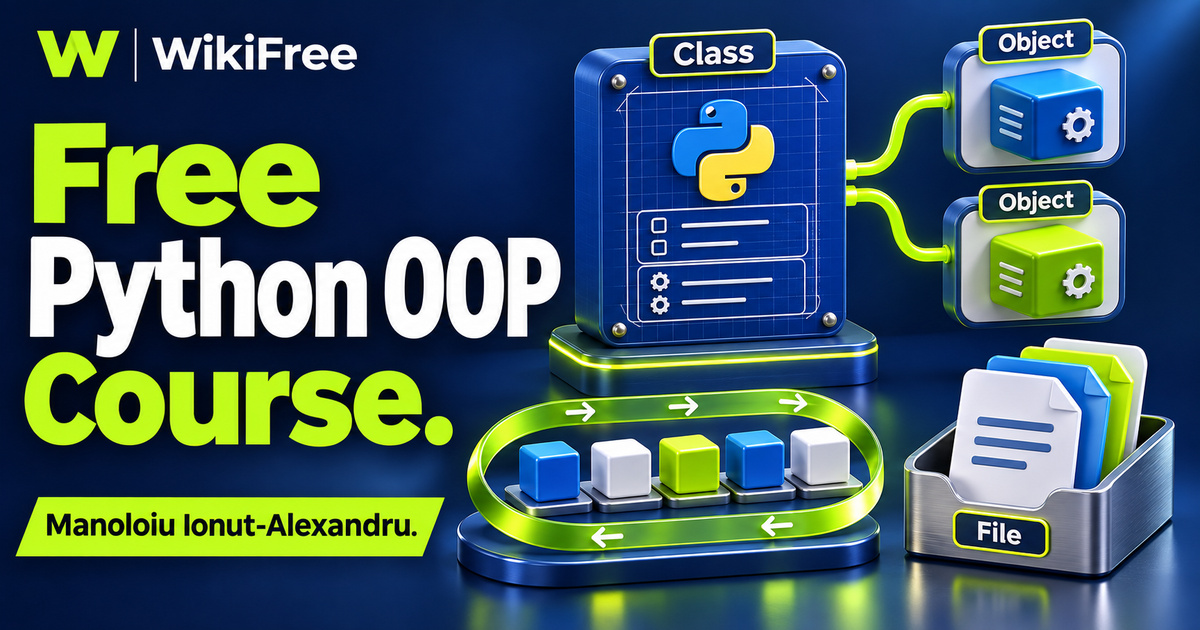
Listed as Free on Udemy when checked on 7 November 2026. No coupon or subscription trial is required for the listed lessons. Enrollment needs a Udemy account; availability can change.
About this course
Once variables, loops and functions feel familiar, Python raises a different set of questions. Which information belongs to an individual object? How does an inherited method get selected? What stays available after a function returns? Manoloiu Ionut-Alexandru’s PCAP Theory Part 2 course offers a short route into these questions through object-oriented programming, iteration, closures and file handling.
The English course is free to watch on Udemy. Two sections contain eight videos totaling about eighty-four minutes, and the listing includes eight downloadable resources. Basic Python syntax and familiarity with variables, loops and functions are expected. Completing Part 1 is one suggested preparation route, but equivalent beginner knowledge also meets the stated prerequisite.
| Official course | PCAP Certification – Python Theory Study Guide (Part 2) |
|---|---|
| Created by | Manoloiu Ionut-Alexandru |
| Platform | Udemy |
| Language | English |
| Level | Intermediate |
| Listed duration | 84 minutes; 8 lectures across 2 sections |
| Completion terms | Not included with a new free enrollment |
What you’ll learn
Explain how classes combine state and behavior, distinguish instance data from shared class data, and follow inherited methods through a class hierarchy. Connect those ideas with iterators, closures, short anonymous functions and list comprehensions. Review file modes and context managers so that reading or writing a file becomes a deliberate operation rather than a copied line of code.
Skills you’ll gain
- Object-oriented reasoning
- Instance and class state
- Method resolution
- Iterators and closures
- Lambda and comprehension use
- File mode selection
Give objects a clear structure
The first section starts with the vocabulary of objects: classes, instances, properties, methods, encapsulation and inheritance. These terms become easier to understand when attached to a small example. A class describes a kind of thing, while individual instances can hold different state. Methods provide behavior associated with that structure. The aim is to understand these relationships before reaching for a large framework or an elaborate hierarchy.
The properties lesson separates instance variables from class variables and introduces attribute inspection. A useful study habit is to draw two instances beside the class that created them, then mark where each value belongs. If information should differ between objects, sharing it unintentionally can produce surprising behavior. The lesson also introduces __dict__, hasattr and class metadata such as __name__, __module__ and __bases__ as ways to examine structures.
Keep a precise distinction between a naming convention and an access restriction. Python’s double-leading-underscore name mangling helps avoid accidental collisions with names in subclasses; it does not make data inaccessible or provide a security boundary. Understanding that limit is more useful than assuming that a “private” attribute works exactly like private members in every other programming language.
Follow methods through inheritance
The methods lesson considers instance, class and static methods, with self explaining how an instance method works with a particular object. Inheritance then adds parent and child classes, overriding and multiple inheritance. When following an example, ask which implementation is called and why. In cooperative inheritance, super follows the method resolution order; it is not simply a permanent shortcut to one named parent class.
Understand traversal and captured context
The second section turns to ways of moving through data and retaining function context. Iterators expose a sequence of values through the iteration protocol, including __iter__ and __next__. Closures allow an inner function to retain access to names from its enclosing scope after the enclosing function has returned. These are distinct ideas: one concerns traversal, while the other concerns the context available to a function.
Generators also appear in the course description as part of the discussion of iteration and lazy evaluation. Treat this as an introduction to the idea, not a promise of exhaustive coverage of asynchronous generators or high-performance data pipelines. Learning to explain when a value is produced, and what state remains between steps, is a more useful early goal than memorizing advanced terminology.
Make file operations deliberate
The file-handling lesson covers opening, reading, writing and closing files, along with text and binary modes. Pay particular attention to the difference between read, write and append. Opening an existing file in write mode can erase its previous contents. Practice with disposable copies. A with statement manages closing the file when its block finishes, including when an exception occurs; it does not automatically undo changes already written.
Use concise syntax thoughtfully
Lambdas and list comprehensions complete the course. A lambda contains a single expression and can be passed where a small function is useful. A comprehension can transform or filter items while building a list, and nested comprehensions extend that pattern. Keep clarity ahead of brevity. The lesson description groups reduce with built-in functions, but in Python 3 it is provided by functools and needs to be imported.
Plan beyond the exam label
This is a compact theory course published with a June 2025 update, not a complete certification pathway. Its Udemy certification panel names PCAP-31-03, while Python Institute now publishes a PCAP-31-04 syllabus revised in November 2026. That newer outline includes testing, debugging, collaborative development and AI assistance alongside the language topics. Check the syllabus for your chosen exam version and plan further study for objectives absent from these eight lessons.
Free access to the lessons does not include an exam voucher or award the PCAP credential. Certification requires its own examination process, and completing this course does not guarantee a passing score, professional competence or employment. It can also be used simply to strengthen Python understanding without pursuing an exam.
Connect the concepts in a small model
For optional practice, sketch a weather-reading class with separate temperature values for two observations. Decide which information belongs to each instance, describe a method that returns a readable summary, and outline how a collection of readings could be filtered. Finally, choose whether a practice text file should be read, replaced or appended. This is an editorial exercise rather than a supplied course project; its purpose is to connect object state, iteration and file modes in one manageable scenario.
Related courses for your next step
- Refresh the Python foundations firstFree Python Programming Course
Review introductory Python programming before moving into classes, iteration and file handling.
Beginner
Frequently asked questions
Is this suitable for a complete beginner?
The stated prerequisites include Python variables, loops and functions. Complete an introductory course or equivalent practice first.
Does this course cover the entire current PCAP exam?
No complete current-exam alignment is promised. Compare its eight lessons with the official objectives for the exam version you intend to take.
Are the exam and certification included for free?
No. Free viewing of these lessons is separate from exam registration, vouchers and the PCAP credential.
Questions & discussion
Share a useful question or correction. Comments appear after moderation. Please avoid personal or sensitive information.