Listed as Free on Udemy when checked on 7 November 2026. No coupon or subscription trial is required for the listed lessons. Enrollment needs a Udemy account; availability can change.
About this course
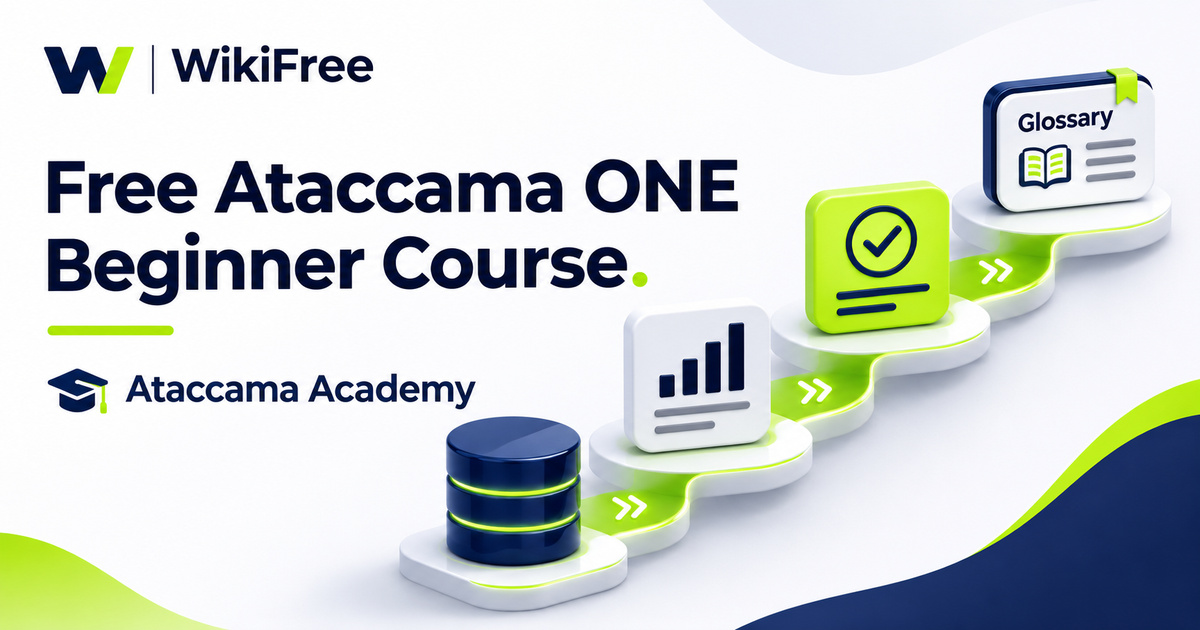
A first visit to a data platform is easier to understand when it follows one small project. Ataccama Academy’s introductory course connects the main pieces of ONE around a single workflow: bring in a source, examine its data, document an asset, evaluate a quality condition and publish a business term. The emphasis is on how these activities relate, rather than an exhaustive tour of every feature.
This free English course is labeled Beginner and contains six videos across three sections, totaling thirty-six minutes and twelve seconds. It requires no prior ONE experience or coding background. A basic understanding of databases or data files can help. Analysts, stewards and project team members can use it for orientation; practical work requires appropriate platform access, which the free recording offer does not establish is included.
| Official course | UDY01-Getting Started with Ataccama ONE |
|---|---|
| Created by | Ataccama Academy |
| Platform | Udemy |
| Language | English |
| Level | Beginner |
| Listed duration | 36 minutes; 6 lectures across 3 sections |
| Completion terms | Not included with a new free enrollment |
What you’ll learn
Identify the roles of the Knowledge Catalog, Business Glossary and quality framework. Follow the route from a source connection to imported catalog items, examine profiling results and add documentation. Understand how a business term can connect an attribute with a quality rule, then consider the review and publication of shared definitions.
Skills you’ll gain
- Platform navigation
- Source connection concepts
- Profiling interpretation
- Catalog documentation
- Quality rule reasoning
- Business term publication
Connect the platform concepts
The opening lesson introduces the platform and its web application. Keep three questions in mind while following the orientation: where is an asset described, what business meaning is assigned to it and what checks have been applied? The catalog, glossary and quality framework answer different parts of these questions. Understanding the connections helps you avoid treating a technical inventory as a complete explanation of the data.
Follow a source into the catalog
The source-connection lesson moves from setup to a metadata synchronization and the appearance of imported tables as catalog items. Importing metadata and analyzing values are separate ideas. A visible table entry does not by itself show that profiling has completed successfully. In a real environment, connection permissions and the configured processing flow also determine which operations are available.
Read profiles with their limits
The profiling lesson looks at column statistics, distributions and patterns. These observations can point to missing information or unusual values worth investigating. Current ONE documentation distinguishes sample profiling from full profiling: the former examines a subset, while the latter processes the catalog item’s full set of records. A clean sample cannot establish that every record meets a business requirement, and a statistical pattern does not explain its cause.
Add meaning to an asset
The catalog-item lesson adds descriptions, ownership and suggested terms. Useful documentation should help a colleague understand an asset’s purpose and whom to approach with questions. Review term suggestions against the actual business meaning instead of accepting a plausible label automatically. The lesson also introduces draft and published states, making the distinction between an individual edit and shared information part of the workflow.
Ask a precise quality question
The quality lesson introduces the Condition Builder, an evaluation rule and its connection to an attribute through a business term. Think of a rule as a specific question about data, with a defined result when a condition matches. Test examples that should pass, examples that should fail and relevant missing values. A successful result for one condition does not show that the entire dataset is correct, complete or suitable for every use.
Publish a shared definition
The final lesson brings the workflow back to business language by defining a term, linking it to an attribute and submitting it for approval. Official guidance for ONE version 16 explains that review and publication behavior depends on permissions and configuration. Some users can publish directly, while others request review. Do not assume that the same sequence of approvals or the same privileges applies to every installation.
Match the introduction to your environment
The source identifies ONE v16.x as its intended environment and was updated in September 2026. Screens, processing options and review controls can differ in another version. Although the course headline mentions a short completion target, actual progress also depends on access, data availability and review requirements. Treat the videos as a compact introduction, without a promise of production readiness, professional certification or a fixed project completion time.
Outline one small project
For optional practice, outline a fictional equipment register on paper. Give it a purpose, describe one identifier field and define a business term for an active item. Write a simple quality question, two example values and the result you expect for each. Finally, identify who should review your definition. This editorial exercise is separate from the course demonstrations and does not require connecting a real data source.
Related courses for your next step
- Explore data transformation foundationsFree SQL to Python pandas Course
Build context for the tables and transformations that a catalog can describe.
Intermediate
Frequently asked questions
Do I need coding experience?
No. The course is designed for beginners without a coding or data engineering background. Basic familiarity with a database or file is helpful.
Is an Ataccama platform license included?
The listing establishes free access to the course recordings. It does not establish that a platform license, configured source or practice environment is included.
Does a passing quality rule prove all the data is correct?
No. Interpret the result within the rule’s conditions, inputs and scope. Other requirements may need separate checks and business review.
Questions & discussion
Share a useful question or correction. Comments appear after moderation. Please avoid personal or sensitive information.