Listed as Free on Udemy when checked on 7 November 2026. No coupon or subscription trial is required for the listed lessons. Enrollment needs a Udemy account; availability can change.
About this course
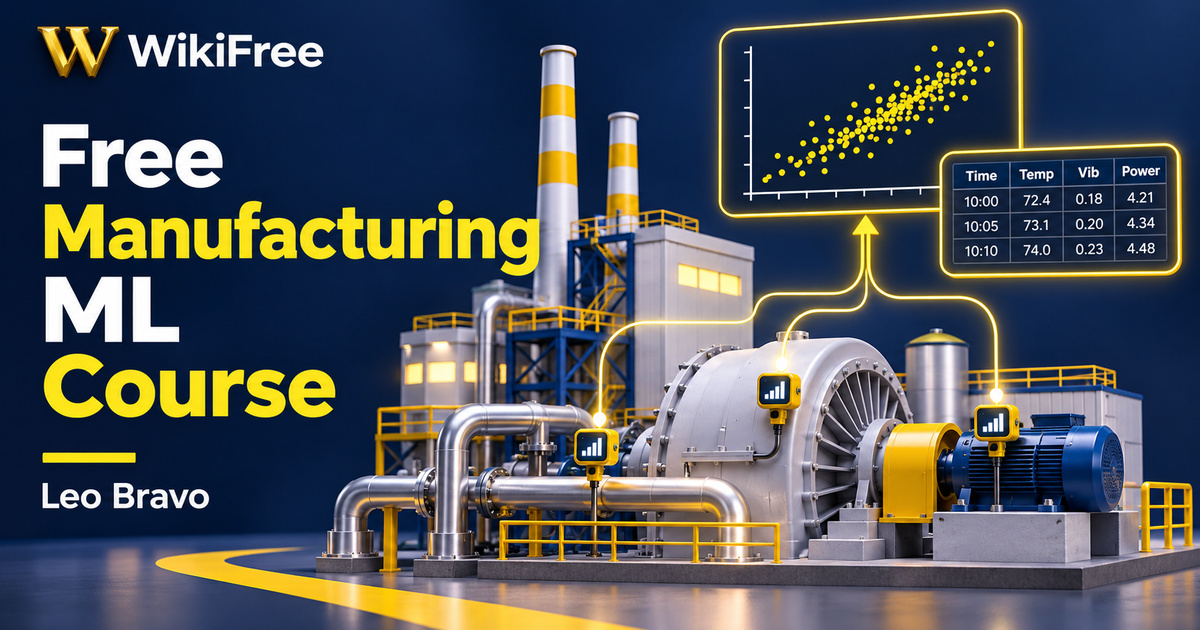
A production measurement becomes more useful when you can connect it to a clear analytical question. This free manufacturing machine learning course introduces that process through a power plant example: understanding the setting, examining a dataset and building regression models to estimate electrical output. It offers a focused bridge between basic Python and an industrial data analysis project.
Leo Bravo begins with manufacturing concepts before moving into the modeling workflow. You do not need previous machine learning or manufacturing knowledge, but the instructor does require basic Python. The project uses familiar scientific Python tools, including pandas, NumPy, Matplotlib and scikit-learn, with Jupyter Notebook presented as an environment for developing the analysis.
| Official course | Machine Learning applied to manufacturing processing |
|---|---|
| Created by | Leo Bravo |
| Platform | Udemy |
| Language | English |
| Level | Beginner |
| Listed duration | 118 minutes; 17 lectures across 6 sections |
| Completion terms | Not included with a new free enrollment |
What you’ll learn
Explore the connection between process measurements, an analytical objective and a prediction target. Follow data loading, distributions and correlations before comparing regression with one input, regression with multiple inputs and a workflow that incorporates principal component analysis. The closing reporting section brings the work back to communicating the main findings rather than stopping at a model output.
Skills you’ll gain
- Industrial data framing
- Python dataset exploration
- Regression model comparison
- PCA workflow understanding
- Prediction evaluation awareness
- Analytical report planning
Start with the process and the question
The six sections contain 17 videos totaling about 118 minutes. The opening material introduces unit operations, monitoring and production measurements. A second section explains supervised and unsupervised learning, linear regression, PCA and the training workflow. These foundations lead into a specific power plant case, then exploration, modeling and a short report-building conclusion.
A useful way to approach the project is to separate three questions: what was measured, what you want to estimate and how you will judge the estimate. Write those questions before choosing a model. That habit helps prevent a visually appealing correlation from becoming an unsupported explanation of how the plant works. The course is an introductory analysis project, not training to operate or modify industrial control equipment.
Keep the dataset in its original context
The dataset link in the lesson description points to the UCI Combined Cycle Power Plant collection. UCI describes 9,568 observations collected during full-load operation between 2006 and 2011. Its four inputs concern temperature, ambient pressure, relative humidity and exhaust vacuum, with electrical output as the target. This is a historical dataset with a defined operating context, not a live feed from an arbitrary factory.
As you inspect the columns, distinguish their names, units and roles. A prediction based on recorded measurements does not automatically establish a causal relationship or demonstrate performance under different operating conditions. Keep the original data source and collection context alongside your analysis. UCI provides attribution information for the dataset; retain that credit when sharing work based on it.
Compare representations without assuming improvement
The modeling section progresses from a single-input regression example to multiple inputs and then PCA followed by regression. This gives you several ways to think about the same analytical task. More inputs or fewer dimensions do not automatically make a model better. Compare results using a consistent evaluation approach, and keep the intended prediction question visible as you change the representation.
For current technical context, scikit-learn documents PCA as centering inputs without automatically scaling each feature. Decide whether differences in units require preprocessing for your particular analysis. Its guidance also warns that transformations, including PCA, must be learned from training data rather than from the test set. Treat evaluation data separately so that preprocessing does not give the model information it should not have.
Turn the analysis into an understandable report
The final lesson focuses on reporting important insights. For an optional study exercise, draft a one-page outline containing the prediction question, the dataset context, one finding and one limitation. Add a sentence explaining what further evidence would be needed before using the model elsewhere. This is an editorial practice suggestion, not an advertised assessment or a claim that a particular report template is supplied.
The recording was last updated in March 2020, so check current package documentation when older examples differ from your environment. The listing advertises two downloadable resources, while some lesson descriptions offer optional slides through a separate subscription form. Free access to the listed videos should not be read as a promise about every supplementary item or external software license. The course supports introductory study without guaranteeing operational accuracy, professional certification or a production-ready system.
Read the dataset context: Check the collection period, variables and attribution details. Check preprocessing and evaluation: Review the separation of training and test data.
Related courses for your next step
- Review dataframe operationsFree Python pandas Course
Practice the tabular data concepts used before modeling.
Beginner
- Present an analysis interactivelyFree Streamlit Data Analysis Course
Explore a separate introduction to displaying a Python analysis in an app.
Beginner
Frequently asked questions
Is manufacturing experience required?
No prior manufacturing or machine learning knowledge is listed as necessary. Basic Python knowledge is required.
Does this course train me to operate a power plant?
The scope is an introductory data analysis and modeling project. It does not establish operational competence or authorize changes to industrial equipment.
Are the optional slides included without extra steps?
The descriptions offer slides through a separate subscription form. That supplementary material is distinct from access to the listed free videos.
Questions & discussion
Share a useful question or correction. Comments appear after moderation. Please avoid personal or sensitive information.