Coursya learning path 16 · Beginner
The discovery lens
Understand the need before specifying the feature.
Turn fictional interview evidence into prioritized requirements, acceptance examples and a traceable validation plan.
Video duration uses the selected lessons only. Reading and practice times are planning estimates; repeat difficult work as needed.
Table of Contents
A clear starting point
Who this is for
Basic workplace communication and a text editor; no prior business-analysis role is required.
Your practical result
Turn fictional interview evidence into prioritized requirements, acceptance examples and a traceable validation plan.
This is requirements discovery for a small service change, not CBAP preparation or comprehensive enterprise business analysis.
Access and cost
Assigned public videos can be watched free. Complete the original case in a text editor, on paper or in a spreadsheet you already have. No paid course, exam or provider certificate is included.
The project pack contains an original workbook, case inputs, an evidence log and reference notes. Some technical paths include starter code and a runnable reference. Read the pack README before starting.
Three-minute readiness check
Answer first, then open each explanation. A missed answer identifies what to revisit; it does not stop you from starting.
Is a requested app already a validated requirement?
It is a proposed solution; first identify the need and constraint.
Can an interview quote establish how common a problem is?
Not by itself. It is evidence from that case or participant.
What makes acceptance useful?
An observable result under a stated condition.
The case you will work on
Elm Equipment Library lends tools. Staff propose a mobile app, but the case evidence concerns unclear availability and return reminders. The training goal is to establish what must change before selecting software.
| Evidence ID | Fictional observation |
|---|---|
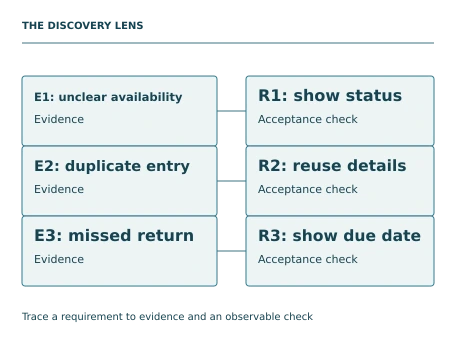
| E1 | A borrower phoned twice because the online list did not show whether a drill was available. |
| E2 | A volunteer copied return dates from paper into a spreadsheet at the end of each day. |
| E3 | A borrower missed a return date because no reminder was received. |
| E4 | Some borrowers use a shared phone and prefer a printed receipt. |
These are supplied synthetic inputs, not observations from a real organization. Label assumptions and any additional data you create.
Keep an evidence trail
Save each stage output in the project folder. In evidence_log.csv, record the decision, the artifact or test that supports it, what failed, and the revision you made.
Your route from learning to evidence
- Stage 1Separate evidence from assumptionsAn evidence and question log60 minutes of original practice
- Stage 2Describe the present workflowA current-state workflow60 minutes of original practice
- Stage 3Write solution-neutral needsA prioritized requirement set75 minutes of original practice
- Stage 4Make acceptance observableAn acceptance-example table75 minutes of original practice
- Stage 5Plan validation and manage changesA traceability matrix and change decision60 minutes of original practice
- Final projectMake the evidence reviewableConnect the five stage outputs and test a change.150 minutes estimated
Progress stays in this browser. Tick a stage only after its evidence check passes. This is a personal checklist, not a certificate.
Why these source courses
The path uses selected material from courses already published on Coursya. The original exercises below connect that material to one practical outcome. Follow only the listed assignments; completing the full source courses is optional.
Free UX Design Course: Research to Prototypes by Google
Selected research and prototype-testing lessons support discovery and validation.
Access: Free Video
Certificate: Free video viewing; a Google certificate is not included
Free Project Management Course by Google
The stakeholder lesson helps connect requirements to the people affected and the decision owners.
Access: Free Video
Certificate: Free video viewing; a Google certificate is not included
Learn it, apply it, check it
Work in order. Every stage produces something the next stage uses. Revisit the repair instruction when a check fails.
Separate evidence from assumptions
Basic workplace communication and a text editor; no prior business-analysis role is required.
The idea to use
An observation describes what happened; an interpretation explains why you think it happened. Keep them in separate columns. A proposed solution may address one symptom while creating another. Start by asking which task fails, who experiences the failure and what successful completion looks like. These supplied observations are synthetic; do not present them as research you conducted.
Watch the selected lessons
Selected video time: 1h 00m. Open this course on Coursya.
Your 60-minute lab
Code E1–E4 into task, obstacle, consequence and uncertainty. Write three follow-up questions that avoid suggesting the desired answer.
Save: An evidence and question log.
Evidence check
Each claim points to evidence or is explicitly marked as an assumption.
If it fails: If a question asks whether the participant wants your app, rewrite it around a recent borrowing experience.
Describe the present workflow
Bring your previous output: An evidence and question log
The idea to use
Map the current journey across people and records. A problem can occur at a handoff rather than inside a screen. Note when availability becomes known, who records a loan and when the next person receives that information. Preserve alternative routes, including the printed receipt. A workflow model should reveal decisions and missing information rather than decorate a preferred solution.
Watch the selected lessons
Selected video time: 24m. Open this course on Coursya.
Your 60-minute lab
Map request, availability check, checkout, reminder and return. Mark the handoff connected to each evidence item.
Save: A current-state workflow.
Evidence check
The double-entry and availability gaps are located in specific transitions.
If it fails: If every step is a screen, add the people, records and decisions between screens.
Write solution-neutral needs
Bring your previous output: A current-state workflow
The idea to use
A requirement states needed behavior or a constraint. It should be narrow enough to test without specifying unnecessary implementation. The system must show current availability is more useful than build a modern app. Add the affected actor and relevant timing. Separate functional behavior from constraints such as shared-device privacy and the ability to obtain a printed record.
Original practice stage. No additional video or reading assignment is required.
Your 75-minute lab
Write six requirements with IDs, evidence links and priorities. Explain two exclusions from the first release.
Save: A prioritized requirement set.
Evidence check
Requirements are traceable, testable and do not assume every borrower owns a personal smartphone.
If it fails: Split any requirement containing several independent behaviors into separately reviewable statements.
Make acceptance observable
Bring your previous output: A prioritized requirement set
The idea to use
Acceptance examples connect conditions, actions and results. Include exceptions, not just the successful path. If two people request the last drill, the second should not receive a false confirmation. A reminder requirement also needs a rule for missing contact details. Avoid undefined words such as quickly or intuitive unless you state how they will be evaluated.
Original practice stage. No additional video or reading assignment is required.
Your 75-minute lab
Write successful and unsuccessful examples for availability, checkout and reminders. Add a printed-receipt case and a missing-contact case.
Save: An acceptance-example table.
Evidence check
Each requirement has at least one observable check and the conflicting-booking case is covered.
If it fails: If an example merely repeats the requirement, add concrete input, action and expected output.
Plan validation and manage changes
Bring your previous output: An acceptance-example table
The idea to use
Validation checks whether the proposed result addresses the need; verification checks whether the specified behavior was implemented. A prototype can expose misunderstandings before development. Decide whose feedback matters and how changes will be assessed. Keep the evidence-to-requirement-to-check chain intact when scope changes. A neat matrix does not compensate for an untested assumption.
Watch the selected lessons
Selected video time: 41m. Open this course on Coursya.
Your 60-minute lab
Design a five-task prototype review using the fictional scenarios. Introduce a request for loyalty points and assess its evidence, value and impact on the first release.
Save: A traceability matrix and change decision.
Evidence check
Every included requirement has evidence and a check; the new request receives a reasoned disposition.
If it fails: If the change is accepted only because a senior person asked, document the missing evidence and trade-off.
A worked reference to compare
E1 supports current availability; E2 supports a single recorded loan and a timely handoff; E3 supports a reminder rule; E4 supports an accessible receipt route and shared-device caution. None of these observations alone proves that a native mobile app is necessary. A simple prototype can validate the workflow before a platform decision.
Compare your reasoning as well as the result. If your answer differs, state the assumption or input that explains the difference. Reference notes are for checking after an attempt; copying them is not evidence of independent work.
Your final project
Your brief
Deliver the Elm discovery dossier: evidence log, workflow, six prioritized requirements, acceptance examples and a traceable validation/change plan.
Time box: 2h 30m estimated. Extend it if a gate needs repair.
Hand in these artifacts
- An evidence and question log
- A current-state workflow
- A prioritized requirement set
- An acceptance-example table
- A traceability matrix and change decision
- A short README: outcome, how to inspect or run the work, assumptions and limitations.
- A before-and-after change test and the completed evidence log.
Run a final review
- Use the supplied reference to reconcile the baseline result.
- Choose one relevant input or constraint to change. Write your expected effect before testing it.
- Run the calculation, walkthrough or test again and save the actual result.
- Ask a peer to inspect the evidence, or perform a separate self-review. Label which review you used.
- Score the work using the rubric and repair every critical failure.
Review rubric · 100 points
| Criterion | Points | Evidence to inspect |
|---|---|---|
| Practical outcome and case reasoning | 25 | Turn fictional interview evidence into prioritized requirements, acceptance examples and a traceable validation plan. |
| Five stage checks | 30 | Award 6 points for each stage only when its stated gate is demonstrably met. |
| Traceable evidence | 20 | Artifacts, inputs and calculations or tests are reproducible; synthetic and simulated evidence is labelled. |
| Revision after a changed condition | 15 | Change one input or constraint, predict the effect, test it and record the result. |
| Handoff quality | 10 | A reviewer can find the files, follow the instructions and understand the remaining limitations. |
Completion target: at least 80/100, all five stage gates passed, and every critical issue below corrected. This is a learning benchmark, not an accredited qualification.
Critical issue: Fabricated research, unsupported consensus or a requirement without a check must be corrected.
Before you go further
What will I be able to produce?
Turn fictional interview evidence into prioritized requirements, acceptance examples and a traceable validation plan.
Is the whole path free?
Assigned public videos can be watched free. Complete the original case in a text editor, on paper or in a spreadsheet you already have. No paid course, exam or provider certificate is included.
Do I need to finish every source course?
No. Follow the selected assignments at each stage. Source courses provide context, while the original case, labs and final review build the practical result. Extra study is optional.
What counts as completion?
Complete all five stage checks, earn at least 80/100 on the final rubric and correct every critical issue. This is requirements discovery for a small service change, not CBAP preparation or comprehensive enterprise business analysis.
Questions & discussion
Share a useful question or correction. Comments appear after moderation. Please avoid personal or sensitive information.