Coursya learning path 17 · Beginner
The cost architect
Every estimate has a basis.
Build a small project cost baseline, distinguish commitments from payments and update a forecast when scope changes.
Video duration uses the selected lessons only. Reading and practice times are planning estimates; repeat difficult work as needed.
Table of Contents
A clear starting point
Who this is for
Basic arithmetic and a spreadsheet or paper; all currency units are illustrative.
Your practical result
Build a small project cost baseline, distinguish commitments from payments and update a forecast when scope changes.
The model omits tax, financing and statutory reporting. It is a project-planning exercise, not a financial recommendation.
Access and cost
Assigned public videos can be watched free. Complete the original case in a text editor, on paper or in a spreadsheet you already have. No paid course, exam or provider certificate is included.
The project pack contains an original workbook, case inputs, an evidence log and reference notes. Some technical paths include starter code and a runnable reference. Read the pack README before starting.
Three-minute readiness check
Answer first, then open each explanation. A missed answer identifies what to revisit; it does not stop you from starting.
Is the cheapest estimate always best?
No. It must cover the required scope and state its assumptions.
Is a purchase commitment the same as cash paid?
No. They describe different stages of the obligation and payment.
Does contingency make the original estimate certain?
No. It makes an allowance explicit; uncertainty remains.
The case you will work on
Pine Learning Hub plans a workshop series. There are no taxes, finance charges or currency conversion in the synthetic case. Build a planning model, not financial advice or a statutory accounting record.
| Cost item | Quantity | Unit cost |
|---|---|---|
| Venue days | 3 | 200 |
| Materials per learner | 40 | 12 |
| Trainer hours | 10 | 35 |
| Promotion package | 1 | 120 |
These are supplied synthetic inputs, not observations from a real organization. Label assumptions and any additional data you create.
Keep an evidence trail
Save each stage output in the project folder. In evidence_log.csv, record the decision, the artifact or test that supports it, what failed, and the revision you made.
Your route from learning to evidence
- Stage 1Define the cost boundaryA cost structure with estimate bases60 minutes of original practice
- Stage 2Build the baselineA reconciled cost baseline60 minutes of original practice
- Stage 3Track obligations and paymentsA commitment and payment tracker75 minutes of original practice
- Stage 4Forecast a scope changeA change forecast and funding request75 minutes of original practice
- Stage 5Explain the decisionA sponsor budget note45 minutes of original practice
- Final projectMake the evidence reviewableConnect the five stage outputs and test a change.150 minutes estimated
Progress stays in this browser. Tick a stage only after its evidence check passes. This is a personal checklist, not a certificate.
Why these source courses
The path uses selected material from courses already published on Coursya. The original exercises below connect that material to one practical outcome. Follow only the listed assignments; completing the full source courses is optional.
Free Project Planning Course: Budgets and Risks
The detailed budget lesson provides the planning foundation; the tracker, scenario and reconciliation are original practice.
Access: Free Video
Certificate: Free video viewing; a Google certificate is not included
Learn it, apply it, check it
Work in order. Every stage produces something the next stage uses. Revisit the repair instruction when a check fails.
Define the cost boundary
Basic arithmetic and a spreadsheet or paper; all currency units are illustrative.
The idea to use
A budget begins with scope and a consistent cost boundary. Identify what the estimate includes, what someone else pays and what is deliberately excluded. Record quantity, rate and the basis for each assumption. A single lump sum is hard to update because the drivers are hidden. Keep the case currency unit consistent and avoid presenting fictional rates as market prices.
Watch the selected lessons
Selected video time: 49m. Open this course on Coursya.
Your 60-minute lab
Create a cost table from the four inputs and add basis, owner and exclusion columns. State the learner count and workshop duration assumptions.
Save: A cost structure with estimate bases.
Evidence check
All four lines can be recalculated and no fictional rate is described as a live quote.
If it fails: If a cost has no quantity or basis, explain how it was estimated before using it.
Build the baseline
Bring your previous output: A cost structure with estimate bases
The idea to use
Calculate line costs before adding an explicitly defined contingency. Do not mix the baseline, reserve and spending authority. Here the exercise uses a ten-percent contingency on the direct subtotal; this is a case rule, not a universal professional recommendation. Keep the rule in the workbook so a reviewer can distinguish the assumption from the arithmetic.
Original practice stage. No additional video or reading assignment is required.
Your 60-minute lab
Calculate each cost, the direct subtotal, ten-percent contingency and total planned funding. Independently recompute the total.
Save: A reconciled cost baseline.
Evidence check
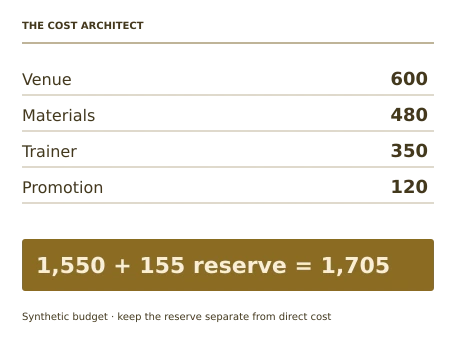
Direct costs total 1550; contingency is 155; planned funding is 1705.
If it fails: If the result differs, check quantity × rate first and ensure contingency was added only once.
Track obligations and payments
Bring your previous output: A reconciled cost baseline
The idea to use
Actual payments, unpaid commitments and forecast future work must be tracked without overlap. A paid deposit is part of a contract commitment, not an extra project cost. Use a remaining-commitment column to avoid counting the whole contract and its payment twice. Record dates separately from amounts so a cash timing issue does not disappear in the total-cost view.
Original practice stage. No additional video or reading assignment is required.
Your 75-minute lab
Assume the venue contract is 600 with a 200 deposit paid, materials of 480 are ordered but unpaid, and trainer/promotion costs are not yet committed. Reconcile paid, committed remaining and uncommitted forecast.
Save: A commitment and payment tracker.
Evidence check
The venue is counted once: 200 paid plus 400 remaining, not 200 plus 600.
If it fails: If the total rises when a bill is paid, inspect whether commitments were reduced consistently.
Forecast a scope change
Bring your previous output: A commitment and payment tracker
The idea to use
A forecast reflects current expectations while the baseline remains the comparison point. If learner count rises, identify which cost drivers change and which stay fixed. An unchanged total can hide an unfunded requirement. Record the decision before quietly spending contingency, and explain whether the original reserve rule is being retained or recalculated in the scenario.
Original practice stage. No additional video or reading assignment is required.
Your 75-minute lab
Increase attendance from 40 to 50 with all other assumptions unchanged. Calculate the direct-cost change and the revised total under the same ten-percent rule.
Save: A change forecast and funding request.
Evidence check
Direct cost becomes 1670 and total 1837; the total increase is 132.
If it fails: If every line changes with attendance, distinguish fixed costs from per-learner costs.
Explain the decision
Bring your previous output: A change forecast and funding request
The idea to use
A sponsor needs the forecast, the reason for movement and the decision required. State assumptions and uncertainty rather than hiding them in a formula sheet. Separate a cost saving from removal of scope: canceling materials may lower cost while making the workshop unusable. A short options table should make that trade-off visible.
Original practice stage. No additional video or reading assignment is required.
Your 45-minute lab
Write a 150-word budget update comparing 40 and 50 learners. Include one scope option, the requested decision and the date by which it is needed.
Save: A sponsor budget note.
Evidence check
Every amount traces to the model and the recommendation preserves the stated learning outcome.
If it fails: If the note only repeats numbers, lead with the decision and the cost driver causing it.
A worked reference to compare
The baseline is 600+480+350+120=1550 direct units and 1705 including the case contingency. In the payment scenario, 200 paid + 880 unpaid commitments + 470 uncommitted forecast = 1550 direct units. At 50 learners, materials become 600, direct costs 1670 and total planned funding 1837.
Compare your reasoning as well as the result. If your answer differs, state the assumption or input that explains the difference. Reference notes are for checking after an attempt; copying them is not evidence of independent work.
Your final project
Your brief
Build the Pine budget pack: estimate bases, baseline, obligations/payment reconciliation, attendance-change forecast and a concise sponsor decision note.
Time box: 2h 30m estimated. Extend it if a gate needs repair.
Hand in these artifacts
- A cost structure with estimate bases
- A reconciled cost baseline
- A commitment and payment tracker
- A change forecast and funding request
- A sponsor budget note
- A short README: outcome, how to inspect or run the work, assumptions and limitations.
- A before-and-after change test and the completed evidence log.
Run a final review
- Use the supplied reference to reconcile the baseline result.
- Choose one relevant input or constraint to change. Write your expected effect before testing it.
- Run the calculation, walkthrough or test again and save the actual result.
- Ask a peer to inspect the evidence, or perform a separate self-review. Label which review you used.
- Score the work using the rubric and repair every critical failure.
Review rubric · 100 points
| Criterion | Points | Evidence to inspect |
|---|---|---|
| Practical outcome and case reasoning | 25 | Build a small project cost baseline, distinguish commitments from payments and update a forecast when scope changes. |
| Five stage checks | 30 | Award 6 points for each stage only when its stated gate is demonstrably met. |
| Traceable evidence | 20 | Artifacts, inputs and calculations or tests are reproducible; synthetic and simulated evidence is labelled. |
| Revision after a changed condition | 15 | Change one input or constraint, predict the effect, test it and record the result. |
| Handoff quality | 10 | A reviewer can find the files, follow the instructions and understand the remaining limitations. |
Completion target: at least 80/100, all five stage gates passed, and every critical issue below corrected. This is a learning benchmark, not an accredited qualification.
Critical issue: Double-counted commitments, unexplained rates or an unapproved change hidden in the baseline prevent completion.
Before you go further
What will I be able to produce?
Build a small project cost baseline, distinguish commitments from payments and update a forecast when scope changes.
Is the whole path free?
Assigned public videos can be watched free. Complete the original case in a text editor, on paper or in a spreadsheet you already have. No paid course, exam or provider certificate is included.
Do I need to finish every source course?
No. Follow the selected assignments at each stage. Source courses provide context, while the original case, labs and final review build the practical result. Extra study is optional.
What counts as completion?
Complete all five stage checks, earn at least 80/100 on the final rubric and correct every critical issue. The model omits tax, financing and statutory reporting. It is a project-planning exercise, not a financial recommendation.
Questions & discussion
Share a useful question or correction. Comments appear after moderation. Please avoid personal or sensitive information.