Coursya learning path 43 · Beginner
The inbox laboratory
Design the message and define the denominator.
Create a permission-based three-email practice sequence, a pre-send QA sheet and a transparent campaign analysis using synthetic data.
Video duration uses the selected lessons only. Reading and practice times are planning estimates; repeat difficult work as needed.
Table of Contents
A clear starting point
Who this is for
Basic writing and percentage calculations. No email platform subscription or real mailing list.
Your practical result
Create a permission-based three-email practice sequence, a pre-send QA sheet and a transparent campaign analysis using synthetic data.
This is campaign planning and analysis, not legal compliance advice, deliverability engineering or a deployed email automation.
Access and cost
Assigned public videos can be watched free. Complete the original case in a text editor, on paper or in a spreadsheet you already have. No paid course, exam or provider certificate is included.
The project pack contains an original workbook, case inputs, an evidence log and reference notes. Some technical paths include starter code and a runnable reference. Read the pack README before starting.
Three-minute readiness check
Answer first, then open each explanation. A missed answer identifies what to revisit; it does not stop you from starting.
Can a purchased address list be assumed to have permission?
No.
What denominator is used for click rate here?
Delivered messages, with unique clickers as the numerator.
Does attribution prove the email caused a purchase?
No.
The case you will work on
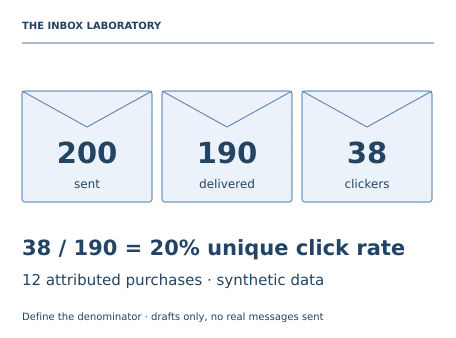
The fictional Fern Learning Club drafts a welcome sequence for people who explicitly requested workshop updates. A synthetic campaign sends 200 messages, delivers 190, records 38 unique recipients clicking and 12 purchases attributed under the stated practice rule. No messages are sent during this project.
| Measure | Synthetic count |
|---|---|
| Sent | 200 |
| Delivered | 190 |
| Unique clickers | 38 |
| Attributed purchases | 12 |
These are supplied synthetic inputs, not observations from a real organization. Label assumptions and any additional data you create.
Keep an evidence trail
Save each stage output in the project folder. In evidence_log.csv, record the decision, the artifact or test that supports it, what failed, and the revision you made.
Your route from learning to evidence
- Stage 1Define audience and permissionA permission and audience brief.50 minutes of original practice
- Stage 2Plan a three-message sequenceA welcome-sequence map.65 minutes of original practice
- Stage 3Draft for clarity and accessibilityThree complete email drafts.100 minutes of original practice
- Stage 4Perform a pre-send reviewA completed draft QA sheet.60 minutes of original practice
- Stage 5Calculate campaign outcomesA reconciled email campaign report.75 minutes of original practice
- Final projectMake the evidence reviewableConnect the five stage outputs and test a change.180 minutes estimated
Progress stays in this browser. Tick a stage only after its evidence check passes. This is a personal checklist, not a certificate.
Why these source courses
The path uses selected material from courses already published on Coursya. The original exercises below connect that material to one practical outcome. Follow only the listed assignments; completing the full source courses is optional.
Free Digital Marketing and E-commerce Course by Google
Google public email lessons cover sequence types, tools and measurement. The drafts and campaign dataset are original Coursya practice.
Access: Free Video
Certificate: Free video viewing; a Google certificate is not included
Learn it, apply it, check it
Work in order. Every stage produces something the next stage uses. Revisit the repair instruction when a check fails.
Define audience and permission
Basic writing and percentage calculations. No email platform subscription or real mailing list.
The idea to use
A useful sequence starts with an audience expectation and a clear permission context. State why the recipient would receive the message, what they requested and how to stop future messages. Use only synthetic addresses in the exercise. Separate transactional service information from promotional content and record any real-world policy or legal checks as a future implementation responsibility.
Watch the selected lessons
Selected video time: 24m. Open this course on Coursya.
Your 50-minute lab
Write the audience brief, signup expectation and suppression rules for unsubscribed or invalid addresses.
Save: A permission and audience brief..
Evidence check
The plan does not assume consent from an unrelated source and includes an opt-out route.
If it fails: Do not import real contacts into a practice file merely to make it look realistic.
Plan a three-message sequence
Bring your previous output: A permission and audience brief.
The idea to use
Each message should have one purpose and a reason to arrive at that point. A welcome message can orient the reader, a second can help choose a workshop and a third can answer a common preparation question. Define timing as a testable plan rather than a universal best practice. Avoid sending repeated urgency claims unsupported by actual availability.
Watch the selected lessons
Selected video time: 24m. Open this course on Coursya.
Your 65-minute lab
Map three messages with trigger, purpose, key question and one main call to action.
Save: A welcome-sequence map..
Evidence check
Every message has a distinct job and the sequence respects the stated signup expectation.
If it fails: If all three messages say buy now, redesign the sequence around useful reader questions.
Draft for clarity and accessibility
Bring your previous output: A welcome-sequence map.
The idea to use
Write a subject that matches the message, a useful opening and a clear link label. Keep essential information in text so an image is not the only way to understand the offer. Include sender identity and an opt-out placeholder in the draft. Platform interface demonstrations may change; the core exercise is the message and its review checklist, not a paid automation setup.
Watch the selected lessons
Selected video time: 29m. Open this course on Coursya.
Your 100-minute lab
Draft all three emails, each 120–180 words. Add plain-text versions and descriptive link labels.
Save: Three complete email drafts..
Evidence check
Subjects match content, links describe the destination and no essential information exists only in an image.
If it fails: Replace vague click here links and false scarcity with a clear, accurate action.
Perform a pre-send review
Bring your previous output: Three complete email drafts.
The idea to use
A pre-send check verifies audience, suppression, sender, links, rendering and fallback text. A draft can be assessed without actually mailing anyone. Use a peer or solo review and record the method honestly. If a real platform is later used, test in the authorized environment and confirm its current settings before scheduling.
Original practice stage. No additional video or reading assignment is required.
Your 60-minute lab
Review the three drafts using the supplied checklist. Record each issue and its correction without sending messages.
Save: A completed draft QA sheet..
Evidence check
The review includes opt-out visibility, link destinations and the intended audience for every message.
If it fails: Do not mark delivery tested when only the text draft was reviewed.
Calculate campaign outcomes
Bring your previous output: A completed draft QA sheet.
The idea to use
Define rates with explicit numerators and denominators. Delivery rate is 190/200=95%; click rate is 38/190=20%; purchases per delivered message are 12/190, about 6.3%. Purchases per clicker are a different 12/38, about 31.6%. These synthetic attribution counts do not establish causality or profit.
Watch the selected lessons
Selected video time: 20m. Open this course on Coursya.
Your 75-minute lab
Create a four-rate table and write a 200-word analysis with one proposed test and one attribution limitation.
Save: A reconciled email campaign report..
Evidence check
All four rates name their denominators and the figures are labeled synthetic.
If it fails: Do not compare click-to-purchase rate with purchase-per-delivery rate as if they were the same metric.
A worked reference to compare
The campaign has 95% delivery and a 20% unique-click rate among delivered messages. Its 12 attributed purchases equal about 6.3% of delivered messages and 31.6% of clickers. The report states those definitions and avoids a causal revenue claim.
Compare your reasoning as well as the result. If your answer differs, state the assumption or input that explains the difference. Reference notes are for checking after an attempt; copying them is not evidence of independent work.
Your final project
Your brief
Deliver the audience brief, sequence map, three drafts, QA sheet and metric report. Add a second synthetic campaign with 180 delivered, 27 clickers and 9 purchases and compare using the same denominators.
Time box: 3h 00m estimated. Extend it if a gate needs repair.
Hand in these artifacts
- A permission and audience brief.
- A welcome-sequence map.
- Three complete email drafts.
- A completed draft QA sheet.
- A reconciled email campaign report.
- A short README: outcome, how to inspect or run the work, assumptions and limitations.
- A before-and-after change test and the completed evidence log.
Run a final review
- Use the supplied reference to reconcile the baseline result.
- Choose one relevant input or constraint to change. Write your expected effect before testing it.
- Run the calculation, walkthrough or test again and save the actual result.
- Ask a peer to inspect the evidence, or perform a separate self-review. Label which review you used.
- Score the work using the rubric and repair every critical failure.
Review rubric · 100 points
| Criterion | Points | Evidence to inspect |
|---|---|---|
| Practical outcome and case reasoning | 25 | Create a permission-based three-email practice sequence, a pre-send QA sheet and a transparent campaign analysis using synthetic data. |
| Five stage checks | 30 | Award 6 points for each stage only when its stated gate is demonstrably met. |
| Traceable evidence | 20 | Artifacts, inputs and calculations or tests are reproducible; synthetic and simulated evidence is labelled. |
| Revision after a changed condition | 15 | Change one input or constraint, predict the effect, test it and record the result. |
| Handoff quality | 10 | A reviewer can find the files, follow the instructions and understand the remaining limitations. |
Completion target: at least 80/100, all five stage gates passed, and every critical issue below corrected. This is a learning benchmark, not an accredited qualification.
Critical issue: No real messages are sent and the analysis uses consistent, explicit denominators without invented attribution evidence.
Before you go further
What will I be able to produce?
Create a permission-based three-email practice sequence, a pre-send QA sheet and a transparent campaign analysis using synthetic data.
Is the whole path free?
Assigned public videos can be watched free. Complete the original case in a text editor, on paper or in a spreadsheet you already have. No paid course, exam or provider certificate is included.
Do I need to finish every source course?
No. Follow the selected assignments at each stage. Source courses provide context, while the original case, labs and final review build the practical result. Extra study is optional.
What counts as completion?
Complete all five stage checks, earn at least 80/100 on the final rubric and correct every critical issue. This is campaign planning and analysis, not legal compliance advice, deliverability engineering or a deployed email automation.
Questions & discussion
Share a useful question or correction. Comments appear after moderation. Please avoid personal or sensitive information.