Coursya learning path 44 · Beginner
The storefront lab
Prove the order economics before opening the store.
Create a small e-commerce concept, product page, checkout test plan and unit-economics worksheet with a measurable pilot decision.
Video duration uses the selected lessons only. Reading and practice times are planning estimates; repeat difficult work as needed.
Table of Contents
A clear starting point
Who this is for
Arithmetic and basic writing. A spreadsheet or paper; no store subscription or payment account.
Your practical result
Create a small e-commerce concept, product page, checkout test plan and unit-economics worksheet with a measurable pilot decision.
This is store planning and a synthetic pilot exercise, not a live shop launch, legal policy set or profit guarantee.
Access and cost
Assigned public videos can be watched free. Complete the original case in a text editor, on paper or in a spreadsheet you already have. No paid course, exam or provider certificate is included.
The project pack contains an original workbook, case inputs, an evidence log and reference notes. Some technical paths include starter code and a runnable reference. Read the pack README before starting.
Three-minute readiness check
Answer first, then open each explanation. A missed answer identifies what to revisit; it does not stop you from starting.
Is revenue the same as contribution?
No. Subtract defined variable costs.
Does an attractive page prove demand?
No.
What makes a pilot measurable?
A stated hypothesis, limit and success/stop criteria.
The case you will work on
The fictional Maple Craft Shop considers a starter craft kit. Price is 30 units, product cost 12, packaging 2, payment/fulfillment allowance 3 and shipping subsidy 4 per order. A pilot has fixed setup cost 90. All amounts are synthetic, not current platform prices.
| Item | Units per order |
|---|---|
| Selling price | 30 |
| Product cost | 12 |
| Packaging | 2 |
| Payment and fulfillment allowance | 3 |
| Shipping subsidy | 4 |
These are supplied synthetic inputs, not observations from a real organization. Label assumptions and any additional data you create.
Keep an evidence trail
Save each stage output in the project folder. In evidence_log.csv, record the decision, the artifact or test that supports it, what failed, and the revision you made.
Your route from learning to evidence
- Stage 1Define the customer and offerA customer and offer brief.60 minutes of original practice
- Stage 2Calculate the order contributionA unit-economics and sensitivity worksheet.75 minutes of original practice
- Stage 3Draft the product and checkout journeyA product page draft and checkout storyboard.100 minutes of original practice
- Stage 4Plan fulfillment and customer communicationA fulfillment and exception plan.70 minutes of original practice
- Stage 5Design a small launch experimentA bounded e-commerce pilot decision brief.75 minutes of original practice
- Final projectMake the evidence reviewableConnect the five stage outputs and test a change.210 minutes estimated
Progress stays in this browser. Tick a stage only after its evidence check passes. This is a personal checklist, not a certificate.
Why these source courses
The path uses selected material from courses already published on Coursya. The original exercises below connect that material to one practical outcome. Follow only the listed assignments; completing the full source courses is optional.
Free Digital Marketing and E-commerce Course by Google
Google public e-commerce lessons supply store, acquisition and customer-experience context; the kit economics and pilot case are original.
Access: Free Video
Certificate: Free video viewing; a Google certificate is not included
Learn it, apply it, check it
Work in order. Every stage produces something the next stage uses. Revisit the repair instruction when a check fails.
Define the customer and offer
Arithmetic and basic writing. A spreadsheet or paper; no store subscription or payment account.
The idea to use
Choose one customer situation and the problem the product addresses. State the kit contents, intended use and exclusions. Treat demand as a hypothesis until evidence exists. A small e-commerce plan becomes easier to test when it avoids a broad catalog and focuses on a specific, clearly described offer.
Watch the selected lessons
- 22. Introduction to e-commerce and online stores37:44
- 37. How to Do Market Research for Your Online Store2:48
Selected video time: 41m. Open this course on Coursya.
Your 60-minute lab
Write the target situation, offer promise and five assumptions requiring evidence.
Save: A customer and offer brief..
Evidence check
The offer names a concrete kit and does not use invented testimonials or demand figures.
If it fails: Replace everyone interested in crafts with a defined use situation.
Calculate the order contribution
Bring your previous output: A customer and offer brief.
The idea to use
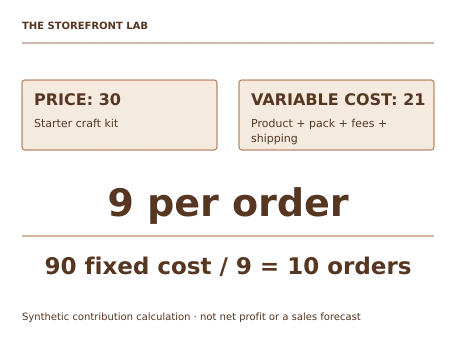
Unit contribution equals selling price minus the defined variable costs. Here costs total 21 and contribution is 9 per order. Covering fixed pilot setup cost of 90 requires ten such orders before any unmodeled costs. This is a simplified contribution calculation, not net profit or a forecast of actual sales.
Original practice stage. No additional video or reading assignment is required.
Your 75-minute lab
Build the worksheet and test shipping subsidy rising from 4 to 7. State which costs are still excluded.
Save: A unit-economics and sensitivity worksheet..
Evidence check
Baseline contribution is 9 and simplified break-even is 10 orders; higher shipping makes contribution 6 and break-even 15.
If it fails: Do not call contribution net profit or omit the assumptions behind break-even.
Draft the product and checkout journey
Bring your previous output: A unit-economics and sensitivity worksheet.
The idea to use
A product page should explain what arrives, suitability, price assumptions, delivery expectations and the next step. A checkout plan needs clear totals and recoverable errors. This exercise uses a mockup and test cases, not a live payment flow. Do not collect payment details or promise operational policies that have not been decided.
Watch the selected lessons
Selected video time: 32m. Open this course on Coursya.
Your 100-minute lab
Draft a product page and sketch a three-step checkout with a review-total screen and an invalid-address recovery state.
Save: A product page draft and checkout storyboard..
Evidence check
The order total is visible before the final action and errors have a recovery route.
If it fails: Avoid hidden charges in the mockup; label unresolved shipping or policy decisions.
Plan fulfillment and customer communication
Bring your previous output: A product page draft and checkout storyboard.
The idea to use
The promise continues after checkout. Map picking, packing, dispatch and the customer update, with owners and exception handling. A stock shortage should trigger a truthful response rather than a false dispatch confirmation. Return and cancellation policies need appropriate real-world review before launch; the learning artifact can identify those decisions without inventing legal terms.
Watch the selected lessons
- 25. Engage customers with an online store17:28
- 26. Introduction to building customer loyalty online31:48
Selected video time: 49m. Open this course on Coursya.
Your 70-minute lab
Create an order workflow and two exception messages for delayed dispatch and unavailable stock.
Save: A fulfillment and exception plan..
Evidence check
Every order state has an owner and messages match the actual state.
If it fails: Do not label an order shipped when only its packing task is complete.
Design a small launch experiment
Bring your previous output: A fulfillment and exception plan.
The idea to use
A pilot needs a hypothesis, limited audience, resource limit and evidence that could change the decision. Separate demand indicators from paid completed orders and record cancellations. Set a spending cap in the plan without actually purchasing ads. Choose a next action based on both demand and contribution rather than a single traffic number.
Watch the selected lessons
Selected video time: 1h 04m. Open this course on Coursya.
Your 75-minute lab
Write a two-week pilot plan with a hypothetical cost cap, tracked events and stop/continue criteria.
Save: A bounded e-commerce pilot decision brief..
Evidence check
The criteria connect completed orders and contribution to the stated assumptions.
If it fails: Do not count page views as proof that the unit economics work.
A worked reference to compare
At the teaching price, contribution is 30−12−2−3−4=9 per order. Ten orders cover the 90-unit fixed setup assumption. If shipping subsidy rises to 7, contribution falls to 6 and the same threshold becomes 15 orders.
Compare your reasoning as well as the result. If your answer differs, state the assumption or input that explains the difference. Reference notes are for checking after an attempt; copying them is not evidence of independent work.
Your final project
Your brief
Deliver the offer brief, economics worksheet, product page, checkout storyboard, fulfillment map and pilot plan. Explain the decision if only eight baseline-contribution orders complete and two more cancel.
Time box: 3h 30m estimated. Extend it if a gate needs repair.
Hand in these artifacts
- A customer and offer brief.
- A unit-economics and sensitivity worksheet.
- A product page draft and checkout storyboard.
- A fulfillment and exception plan.
- A bounded e-commerce pilot decision brief.
- A short README: outcome, how to inspect or run the work, assumptions and limitations.
- A before-and-after change test and the completed evidence log.
Run a final review
- Use the supplied reference to reconcile the baseline result.
- Choose one relevant input or constraint to change. Write your expected effect before testing it.
- Run the calculation, walkthrough or test again and save the actual result.
- Ask a peer to inspect the evidence, or perform a separate self-review. Label which review you used.
- Score the work using the rubric and repair every critical failure.
Review rubric · 100 points
| Criterion | Points | Evidence to inspect |
|---|---|---|
| Practical outcome and case reasoning | 25 | Create a small e-commerce concept, product page, checkout test plan and unit-economics worksheet with a measurable pilot decision. |
| Five stage checks | 30 | Award 6 points for each stage only when its stated gate is demonstrably met. |
| Traceable evidence | 20 | Artifacts, inputs and calculations or tests are reproducible; synthetic and simulated evidence is labelled. |
| Revision after a changed condition | 15 | Change one input or constraint, predict the effect, test it and record the result. |
| Handoff quality | 10 | A reviewer can find the files, follow the instructions and understand the remaining limitations. |
Completion target: at least 80/100, all five stage gates passed, and every critical issue below corrected. This is a learning benchmark, not an accredited qualification.
Critical issue: The worksheet distinguishes revenue, variable contribution and fixed cost, and the mockup does not imply a working payment service.
Before you go further
What will I be able to produce?
Create a small e-commerce concept, product page, checkout test plan and unit-economics worksheet with a measurable pilot decision.
Is the whole path free?
Assigned public videos can be watched free. Complete the original case in a text editor, on paper or in a spreadsheet you already have. No paid course, exam or provider certificate is included.
Do I need to finish every source course?
No. Follow the selected assignments at each stage. Source courses provide context, while the original case, labs and final review build the practical result. Extra study is optional.
What counts as completion?
Complete all five stage checks, earn at least 80/100 on the final rubric and correct every critical issue. This is store planning and a synthetic pilot exercise, not a live shop launch, legal policy set or profit guarantee.
Questions & discussion
Share a useful question or correction. Comments appear after moderation. Please avoid personal or sensitive information.