Path 56 · The capacity loom · Beginner
Schedule against available hours, not wishful totals.
A guided, practical route through team capacity and resource planning.
What you will be able to do
Build a weekly capacity board, identify an overload and compare two feasible responses without hiding unmet work.
Plan about 8h 10m in total. Reading and practice are editorial estimates; video runtimes come from public provider metadata. Your pace will vary.
Table of Contents
Before you begin
Check your starting point
What you need
Basic arithmetic and a spreadsheet or paper grid. Estimates are supplied for practice.
The selected public provider lessons are free to view. The original case can be completed with paper, a text editor or freely available local tools. Paid exams, certificates, subscriptions and optional provider software are not required for this project.
Completing this Coursya path does not award a provider certificate. Any provider assessment, account requirement or credential must be checked separately on its official page.
Three readiness questions
Does equal work mean equal utilization?
No. Availability and task demands differ.
Can spare time always absorb another task?
No. Skills, dependencies and handover effort matter.
Does 100% allocation guarantee delivery?
No. Estimates and unplanned work remain uncertain.
Use a workable pace
At 5 hours per week, allow about 2 weeks. Start with Stage 1, continue in order and reserve 2h for the capstone. If a gate fails, use its repair step before advancing. At another weekly budget, divide 490 estimated minutes by your available weekly minutes and round up.
Keep a small evidence folder. A checked box means you reviewed your output; it is not a certificate or proof that a provider lesson was watched.
The working case
Balanced total, uneven load
The fictional Rowan Team has three contributors. After routine duties and leave, available project capacity is Ada 12 hours, Ben 10 and Chen 8. Proposed assignments require Ada 16, Ben 8 and Chen 6. A 4-hour review task currently assigned to Ada can be performed by Ben or Chen after a 1-hour handover, counted against the receiver.
| Person | Available hours | Assigned hours |
|---|---|---|
| Ada | 12 | 16 |
| Ben | 10 | 8 |
| Chen | 8 | 6 |
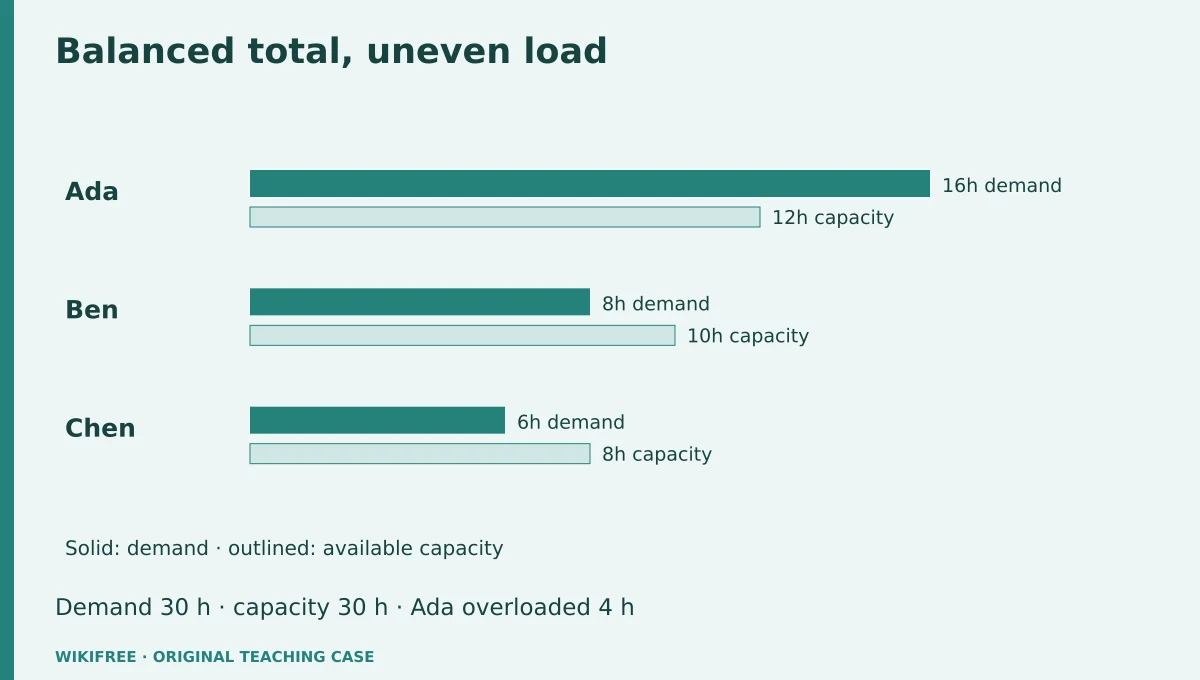
The table and explanations preserve the essential case information when the diagram is unavailable.
Your route
Five outputs, then a final handoff
- 01Define useful capacityWeekly capacity baseline
About 1h 32m including assigned learning and practice. - 02Match tasks to skillsSkill-aware assignment map
About 1h 7m including assigned learning and practice. - 03Measure overloadCapacity calculation sheet
About 1h 14m including assigned learning and practice. - 04Compare realistic responsesTwo feasible response scenarios
About 1h 15m including assigned learning and practice. - 05Review pressure without blameCapacity review and revised decision
About 1h 3m including assigned learning and practice. - FINALCapstone reviewCombine the evidence into one inspectable handoff.
About 2h .
0 of 6 outputs checked. JavaScript adds browser-only progress saving.
The complete lesson and all downloads remain available. Use the printable project workbook to track your progress.
Use the minimum useful source material
The courses behind this route
Free Project Planning Course: Budgets and Risks
The planning lesson supplies project-work context.
Selected material only; this path does not claim completion of the entire provider course.
Management Courses
Managing Workplace Teams: Free Course
Skills and pressure-support lessons ground the people decisions.
Selected material only; this path does not claim completion of the entire provider course.
Free People Management Course: Coaching and Team Leadership
The work-distribution lesson connects assignments with manager responsibility.
Selected material only; this path does not claim completion of the entire provider course.
Course publication and selected public lesson metadata were checked on 13 October 2026. This is not a claim of full video playback, provider-course completion or permanent availability. Recheck the linked source if a lesson changes.
Learn, make, inspect
The five-stage workshop
Define useful capacity
Video 37m · reading budget 0m · original practice about 55m.
Available capacity is the time realistically available for the planned work after known commitments. Keep leave, recurring duties and focused-work assumptions visible. An allocation plan is not a performance ranking. People with different availability can have equally important roles, and the plan should not conceal overtime as free capacity.
Watch these selected lessons
Do the work
Create a capacity ledger explaining the available hours for each person and list two sources of uncertainty.
Save this output
Weekly capacity baseline
Pass the review gate
The board uses 12,10 and 8 available hours rather than a generic 40-hour assumption.
If you need another attempt
Separate total working time from the portion available to this project.
Match tasks to skills
Video 6m · reading budget 0m · original practice about 1h .
A resource plan needs a task-to-skill match as well as an hour total. A person may have spare capacity without the required context or authority. Record who can perform and review each task, and include transition effort. This makes the reason for an assignment reviewable instead of treating contributors as interchangeable hour buckets.
Watch these selected lessons
Do the work
Create a skill and backup matrix for the movable review task. Include the 1-hour handover on the receiving side.
Save this output
Skill-aware assignment map
Pass the review gate
Both receiver options include the handover and an explicit review responsibility.
If you need another attempt
Add the context-transfer cost before declaring that a reassignment solves the overload.
Measure overload
Video 4m · reading budget 0m · original practice about 1h 10m.
Compare assigned work with available capacity for each person before looking at the team total. Here the team has 30 hours available and 30 assigned, yet Ada is 4 hours over. Aggregation hides this constraint. Capacity balance is a planning signal; it does not prove that an individual is working inefficiently.
Watch these selected lessons
Do the work
Calculate load, spare or excess hours and utilization for all three people.
Save this output
Capacity calculation sheet
Pass the review gate
Ada is 4 hours over at 133.3%; Ben and Chen each have 2 spare hours.
If you need another attempt
Inspect person-level constraints when the team total appears balanced.
Compare realistic responses
Video 0m · reading budget 0m · original practice about 1h 15m.
Moving the entire 4-hour task to either colleague also adds 1 hour of handover, exceeding that person’s 2 spare hours. A valid response may reduce scope, move the date, split work where technically possible or obtain approved additional capacity. State the operational consequence of each choice instead of assuming that delegation removes effort.
Original application stage. Use your preceding outputs and the supplied case; there is no additional required provider lesson.
Do the work
Compare deferring the 4-hour task with moving it to Ben and explicitly deferring 3 hours of Ben’s other work.
Save this output
Two feasible response scenarios
Pass the review gate
Both scenarios fit individual capacity and show the work or date that changes.
If you need another attempt
Do not hide the receiver’s 3-hour overload after including handover.
Review pressure without blame
Video 8m · reading budget 0m · original practice about 55m.
A capacity review should surface risks early and invite corrections to estimates. Ask about blocked work, unclear priorities and sustainable commitments. Track changes as planning decisions, not personal failures. A weekly review can compare actual and estimated effort to improve the next plan without using a small sample as a productivity league table.
Watch these selected lessons
Do the work
Write a 15-minute review agenda and revise the board when Ada loses 2 available hours.
Save this output
Capacity review and revised decision
Pass the review gate
The revision shows the new shortfall and records a priority decision rather than invisible overtime.
If you need another attempt
Ask which commitment changes when capacity falls; do not keep every original promise.
Make the result inspectable
Your final project
Submit the baseline, skill matrix, calculations, two feasible alternatives and revised board. Explain the chosen trade-off in a short stakeholder note that does not blame the overloaded contributor.
The ZIP includes synthetic input data, a project workbook, worked reference, evidence log, scoring rubric and case-specific materials. Code projects include source and clearly stated local execution requirements.
Use one consistent rubric
| Criterion | Maximum | Evidence |
|---|---|---|
| Evidence and correctness | 30 | Calculations, source use and results match the supplied case; limitations are honest. |
| Required artifacts | 30 | All five stage outputs and the capstone handoff are present and inspectable. |
| Reasoning and decisions | 20 | Choices, assumptions, alternatives and the case-specific critical condition are explained. |
| Reproducibility | 10 | A reviewer can follow the stated steps and distinguish expected from observed results. |
| Clear communication | 10 | Labels, units, structure and evidence references make the work easy to review. |
Score at least 80/100, supply every required artifact, and satisfy the path-specific critical condition. Rework missing evidence before marking complete.
The critical condition
Every scenario fits individual capacity or explicitly identifies an unresolved shortfall; no hidden overtime is assumed.
Compare with a worked reference
Total demand equals total availability at 30 hours, but Ada has 16/12=133.3% utilization. Ben is 80% and Chen 75%. Moving the 4-hour task adds 1 hour to the receiver, so Ben becomes 13/10 or Chen 11/8. Reassignment alone does not solve the plan.
Know the boundary
This is deterministic weekly planning, not an optimization engine or a measure of employee performance.
Questions before you finish
Do I need to finish every source course?
No. This path names selected lessons or reading sections. Complete the full provider course only if it supports your wider goal. The path does not claim equivalence to that course.
How do I know when to advance?
Use the output and review gate in each stage. If evidence is missing or a result conflicts with the case, follow the repair step and retry before advancing.
Can I do the project without paid software?
The selected public provider lessons are free to view. The original case can be completed with paper, a text editor or freely available local tools. Paid exams, certificates, subscriptions and optional provider software are not required for this project.
What does my checklist prove?
It records your own review in this browser only. It does not verify viewing, skill, a provider credential or a real-world deployment.
What if a lesson or tool changes?
Use the linked course and provider page to inspect current availability. Record the change and revisit the relevant assignment; do not invent a replacement lesson or claim an unavailable activity was completed.
Questions & discussion
Share a useful question or correction. Comments appear after moderation. Please avoid personal or sensitive information.