Path 58 · The responsibility compass · Beginner
Give ownership with a clear decision boundary.
A guided, practical route through delegation and accountability.
What you will be able to do
Design a delegation brief that specifies the result, authority, support, checkpoints and escalation triggers, then test it with two scenarios.
Plan about 7h 5m in total. Reading and practice are editorial estimates; video runtimes come from public provider metadata. Your pace will vary.
Table of Contents
Before you begin
Check your starting point
What you need
Basic team-work experience or the supplied fictional case. Practice requires no management authority over a real person.
The selected public provider lessons are free to view. The original case can be completed with paper, a text editor or freely available local tools. Paid exams, certificates, subscriptions and optional provider software are not required for this project.
Completing this Coursya path does not award a provider certificate. Any provider assessment, account requirement or credential must be checked separately on its official page.
Three readiness questions
Does delegation remove the manager’s responsibility?
No. The result and support still need oversight.
Is do your best a complete brief?
No. The output and authority are unclear.
Should every small choice require escalation?
No. Define meaningful decision boundaries.
Use a workable pace
At 5 hours per week, allow about 2 weeks. Start with Stage 1, continue in order and reserve 2h for the capstone. If a gate fails, use its repair step before advancing. At another weekly budget, divide 425 estimated minutes by your available weekly minutes and round up.
Keep a small evidence folder. A checked box means you reviewed your output; it is not a certificate or proof that a provider lesson was watched.
The working case
Four decision boundaries
Pine Club asks a volunteer to coordinate a 20-seat workshop. The coordinator may choose the room layout and send a draft timetable for review, but cannot commit spending or change the event date. The manager remains responsible for approving those decisions. A late speaker confirmation creates a test of the escalation boundary.
| Decision | Coordinator authority | Escalation |
|---|---|---|
| Room layout | decide | report in weekly check |
| Draft timetable | prepare | manager reviews |
| Spending commitment | not authorized | manager approval |
| Event date | not authorized | sponsor approval |
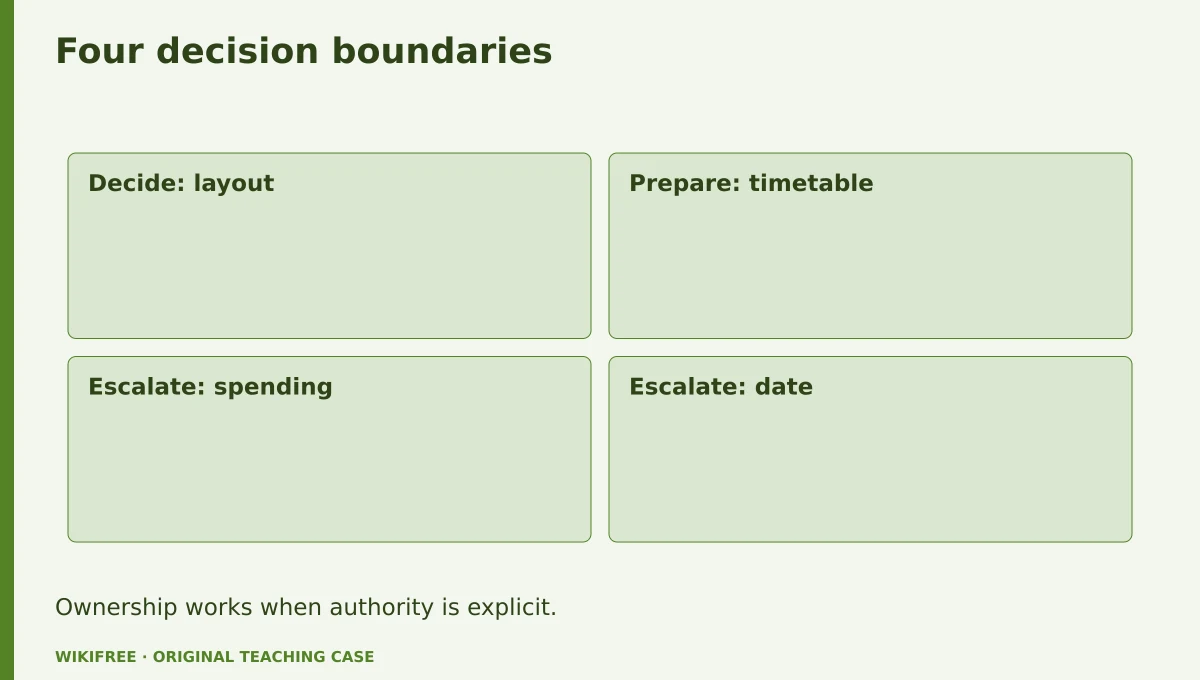
The table and explanations preserve the essential case information when the diagram is unavailable.
Your route
Five outputs, then a final handoff
- 01Define the delegated resultDelegated-result brief
About 54m including assigned learning and practice. - 02Set authority and boundariesDecision-rights table
About 1h 4m including assigned learning and practice. - 03Plan support and checkpointsSupport and checkpoint plan
About 1h 5m including assigned learning and practice. - 04Test a changed conditionTwo decision scenarios
About 1h 5m including assigned learning and practice. - 05Review ownership and learningDelegation review and revised brief
About 59m including assigned learning and practice. - FINALCapstone reviewCombine the evidence into one inspectable handoff.
About 2h .
0 of 6 outputs checked. JavaScript adds browser-only progress saving.
The complete lesson and all downloads remain available. Use the printable project workbook to track your progress.
Use the minimum useful source material
The courses behind this route
Free People Management Course: Coaching and Team Leadership
Selected manager lessons cover clear goals, work distribution, coaching and team learning.
Selected material only; this path does not claim completion of the entire provider course.
Course publication and selected public lesson metadata were checked on 13 October 2026. This is not a claim of full video playback, provider-course completion or permanent availability. Recheck the linked source if a lesson changes.
Learn, make, inspect
The five-stage workshop
Define the delegated result
Video 3m · reading budget 0m · original practice about 50m.
Delegate a result with a clear reason and acceptance conditions rather than a vague pile of tasks. The recipient needs to know what success looks like and which constraints are fixed. A good brief also distinguishes the work they own from decisions that remain elsewhere, so initiative does not become accidental overreach.
Watch these selected lessons
Do the work
Write the workshop outcome and three acceptance checks for the coordinator’s work.
Save this output
Delegated-result brief
Pass the review gate
The brief specifies 20 seats, the timetable review and fixed event-date authority.
If you need another attempt
Replace help with the event with a concrete output the coordinator can own.
Set authority and boundaries
Video 4m · reading budget 0m · original practice about 1h .
Responsibility without authority creates bottlenecks; authority without boundaries creates avoidable risk. State what the person can decide, prepare, recommend and escalate. These are not interchangeable levels. The supplied case allows room-layout decisions but not spending commitments. Make the distinction visible in the same document as the result and due dates.
Watch these selected lessons
Do the work
Turn the four supplied decisions into an authority table and add a speaker-delay escalation.
Save this output
Decision-rights table
Pass the review gate
Spending and date changes require the named approval before commitment.
If you need another attempt
Do not use a single responsible label to conceal different decision rights.
Plan support and checkpoints
Video 4m · reading budget 0m · original practice about 1h .
A checkpoint should help the person succeed without taking every decision back. Ask about progress, obstacles and the next choice rather than demanding constant status messages. Match support to the task and experience, then agree what evidence will be reviewed. Coaching can develop judgment while the manager retains responsibility for timely support.
Watch these selected lessons
Do the work
Create two checkpoints with evidence to bring and coaching questions.
Save this output
Support and checkpoint plan
Pass the review gate
Each checkpoint has a purpose and allows the coordinator to propose the next action.
If you need another attempt
Replace daily approval of every detail with a check of the agreed result and boundaries.
Test a changed condition
Video 0m · reading budget 0m · original practice about 1h 5m.
Scenario testing reveals whether a brief is usable. When the speaker is late, the coordinator can gather options and draft a revised timetable, but changing the event date exceeds the stated authority. Record the escalation with the decision needed, deadline and consequences of delay. Escalation should be a useful request, not a transfer of all thinking upward.
Original application stage. Use your preceding outputs and the supplied case; there is no additional required provider lesson.
Do the work
Write the speaker-delay escalation and a second scenario where room layout changes within the agreed boundary.
Save this output
Two decision scenarios
Pass the review gate
The first requests approval; the second demonstrates an authorized decision without unnecessary escalation.
If you need another attempt
Name the exact decision and deadline instead of saying there is a problem.
Review ownership and learning
Video 3m · reading budget 0m · original practice about 55m.
A delegation review examines both the result and the quality of the working agreement. Ask what was clear, where support arrived late and which decisions can be delegated more fully next time. Avoid taking credit for the recipient’s work or treating one difficulty as proof that delegation never works. Use observed evidence to improve the next brief.
Watch these selected lessons
Do the work
Create a review template and fill a labelled fictional example with one boundary that should be clarified.
Save this output
Delegation review and revised brief
Pass the review gate
The revision changes a specific support or authority condition and preserves accountability.
If you need another attempt
Separate a weakness in the brief from an unsupported judgment about the person.
Make the result inspectable
Your final project
Submit the result brief, authority matrix, checkpoints, two scenarios and revised delegation agreement. Ask a practice reviewer to classify each decision without further explanation.
The ZIP includes synthetic input data, a project workbook, worked reference, evidence log, scoring rubric and case-specific materials. Code projects include source and clearly stated local execution requirements.
Use one consistent rubric
| Criterion | Maximum | Evidence |
|---|---|---|
| Evidence and correctness | 30 | Calculations, source use and results match the supplied case; limitations are honest. |
| Required artifacts | 30 | All five stage outputs and the capstone handoff are present and inspectable. |
| Reasoning and decisions | 20 | Choices, assumptions, alternatives and the case-specific critical condition are explained. |
| Reproducibility | 10 | A reviewer can follow the stated steps and distinguish expected from observed results. |
| Clear communication | 10 | Labels, units, structure and evidence references make the work easy to review. |
Score at least 80/100, supply every required artifact, and satisfy the path-specific critical condition. Rework missing evidence before marking complete.
The critical condition
No scenario grants spending or date-change authority that the brief explicitly withholds.
Compare with a worked reference
The coordinator can select the layout and prepare a timetable. They must not book paid services or move the event date without the named approval. A good delay escalation contains the available options, the decision deadline and the consequence of waiting; it does not merely say please handle this.
Know the boundary
This is a delegation-design exercise, not a replacement for real organizational authority or employment procedures.
Questions before you finish
Do I need to finish every source course?
No. This path names selected lessons or reading sections. Complete the full provider course only if it supports your wider goal. The path does not claim equivalence to that course.
How do I know when to advance?
Use the output and review gate in each stage. If evidence is missing or a result conflicts with the case, follow the repair step and retry before advancing.
Can I do the project without paid software?
The selected public provider lessons are free to view. The original case can be completed with paper, a text editor or freely available local tools. Paid exams, certificates, subscriptions and optional provider software are not required for this project.
What does my checklist prove?
It records your own review in this browser only. It does not verify viewing, skill, a provider credential or a real-world deployment.
What if a lesson or tool changes?
Use the linked course and provider page to inspect current availability. Record the change and revisit the relevant assignment; do not invent a replacement lesson or claim an unavailable activity was completed.
Questions & discussion
Share a useful question or correction. Comments appear after moderation. Please avoid personal or sensitive information.