Path 70 · The question laboratory · Beginner
Ask something an answer can actually resolve.
A guided, practical route through survey design for product decisions.
What you will be able to do
Design a short, neutral survey with a sampling note, a pilot protocol and a coded analysis plan.
Plan about 8h 43m in total. Reading and practice are editorial estimates; video runtimes come from public provider metadata. Your pace will vary.
Table of Contents
Before you begin
Check your starting point
What you need
Basic research vocabulary. Use a document or free form tool; no participants need to be contacted.
The selected public provider lessons are free to view. The original case can be completed with paper, a text editor or freely available local tools. Paid exams, certificates, subscriptions and optional provider software are not required for this project.
Completing this Coursya path does not award a provider certificate. Any provider assessment, account requirement or credential must be checked separately on its official page.
Three readiness questions
Is Why is our excellent form easy? neutral?
No. It leads the respondent and presumes success.
Can three volunteers represent every user?
No.
Should a non-user be forced to rate the booking flow?
No. Use a screening or not-applicable route.
Use a workable pace
At 5 hours per week, allow about 2 weeks. Start with Stage 1, continue in order and reserve 2h for the capstone. If a gate fails, use its repair step before advancing. At another weekly budget, divide 523 estimated minutes by your available weekly minutes and round up.
Keep a small evidence folder. A checked box means you reviewed your output; it is not a certificate or proof that a provider lesson was watched.
The working case
The survey route
A fictional library wants to understand why people abandon room booking. The team proposes five survey items and a pilot with three volunteers. This path creates the instrument and protocol only: the supplied example responses are synthetic and must not be described as collected evidence.
| Synthetic response | Attempted booking | Main obstacle |
|---|---|---|
| A | yes | unclear availability |
| B | yes | too many fields |
| C | no | not applicable |
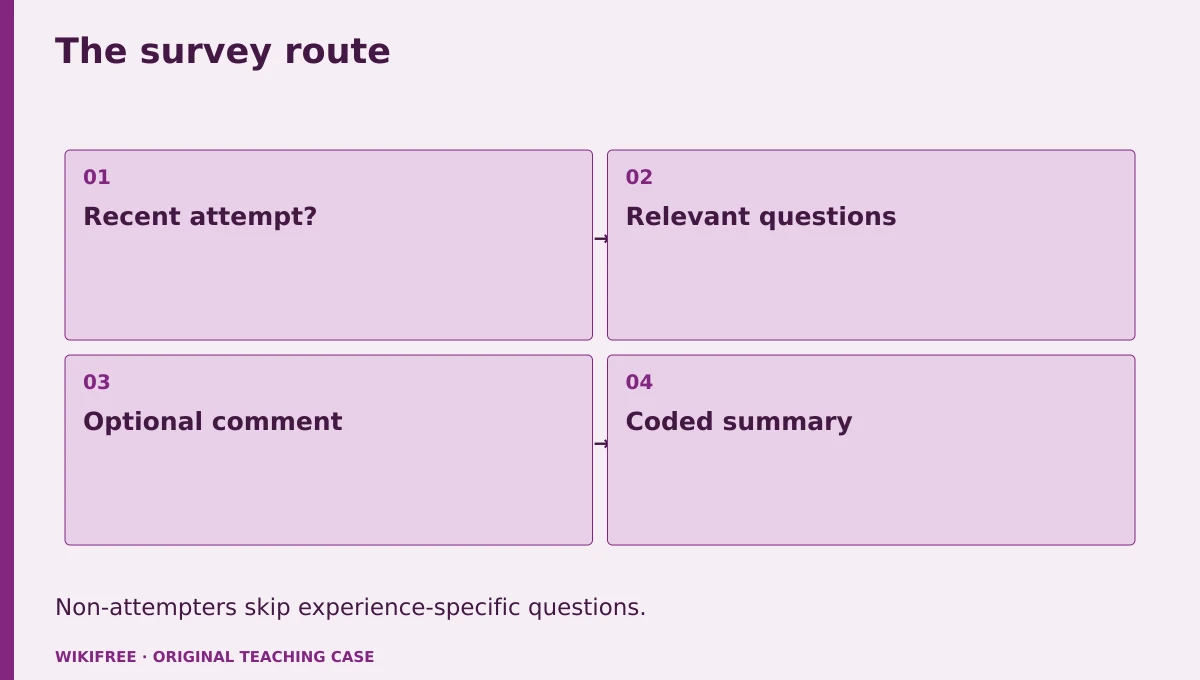
The table and explanations preserve the essential case information when the diagram is unavailable.
Your route
Five outputs, then a final handoff
- 01Specify the research decisionResearch brief
About 1h 18m including assigned learning and practice. - 02Draft neutral itemsFive-item survey
About 1h 52m including assigned learning and practice. - 03Plan the pilotPilot protocol
About 1h including assigned learning and practice. - 04Create the analysis rulesCodebook and sample summary
About 1h 15m including assigned learning and practice. - 05Prepare a decision-ready readoutResearch handoff
About 1h 18m including assigned learning and practice. - FINALCapstone reviewCombine the evidence into one inspectable handoff.
About 2h .
0 of 6 outputs checked. JavaScript adds browser-only progress saving.
The complete lesson and all downloads remain available. Use the printable project workbook to track your progress.
Use the minimum useful source material
The courses behind this route
Free UX Design Course: Research to Prototypes by Google
Existing Google UX research, empathy and research-sharing lessons provide the foundation; the survey instrument and analysis rules are original.
Selected material only; this path does not claim completion of the entire provider course.
Course publication and selected public lesson metadata were checked on 13 October 2026. This is not a claim of full video playback, provider-course completion or permanent availability. Recheck the linked source if a lesson changes.
Learn, make, inspect
The five-stage workshop
Specify the research decision
Video 23m · reading budget 0m · original practice about 55m.
Write the decision and the uncertainty before drafting questions. A survey can describe reported experiences but cannot directly observe why every user abandoned a flow. Consider who is missing from the sample. The case needs recent booking attempts, not general opinions about the library.
Watch these selected lessons
- What is UX Research?23:00
Do the work
Define the target group, recall period and decision the answers will inform.
Save this output
Research brief
Pass the review gate
The target group and the excluded population are explicit.
If you need another attempt
Replace broad satisfaction goals with a specific information need.
Draft neutral items
Video 37m · reading budget 0m · original practice about 1h 15m.
Ask one thing at a time, use plain language and offer balanced response options. Avoid double-barreled questions, assumed behavior and forced certainty. An optional open response can reveal an overlooked issue, but it needs a plan for review. Do not collect identifying information that the decision does not require.
Watch these selected lessons
Do the work
Draft five items: screening, recent outcome, obstacle, clarity rating and optional comment.
Save this output
Five-item survey
Pass the review gate
Each item maps to the decision and includes a suitable not-applicable route.
If you need another attempt
Split questions that contain two distinct judgments.
Plan the pilot
Video 0m · reading budget 0m · original practice about 1h .
A pilot tests comprehension and routing, not the size of a market. Ask participants to explain how they interpreted an item and watch for missing answer options. Record the wording version and changes. In this preparation exercise, write the protocol without claiming that anyone participated.
Original application stage. Use your preceding outputs and the supplied case; there is no additional required provider lesson.
Do the work
Create a three-person pilot script, consent wording and observation sheet.
Save this output
Pilot protocol
Pass the review gate
The protocol distinguishes planned sessions from completed sessions.
If you need another attempt
Remove invented participant quotations or completion counts.
Create the analysis rules
Video 0m · reading budget 0m · original practice about 1h 15m.
Define how answers will be coded before seeing a result. Keep skipped, not applicable and missing answers distinct. Report the denominator used for each summary. The tiny synthetic example can demonstrate the mechanics, but it does not establish prevalence or confidence intervals for a real population.
Original application stage. Use your preceding outputs and the supplied case; there is no additional required provider lesson.
Do the work
Code the three synthetic rows and calculate obstacles among the two booking attempters.
Save this output
Codebook and sample summary
Pass the review gate
Each named obstacle is 1 of 2 attempters; the non-attempter is excluded from that denominator.
If you need another attempt
Keep the screening rule visible in the analysis table.
Prepare a decision-ready readout
Video 22m · reading budget 0m · original practice about 55m.
A research readout should show the instrument, sample limitations, findings and the decision they can support. Separate a pattern worth investigating from a statistically supported generalization. Include conflicting observations rather than selecting only convenient comments. For this case, the readout is a template with a clearly labeled synthetic demonstration.
Watch these selected lessons
Do the work
Write the readout template and a rule for revising the survey after the pilot.
Save this output
Research handoff
Pass the review gate
Every demonstration figure is labeled synthetic and no real user finding is claimed.
If you need another attempt
Put the evidence status next to the chart or quotation area.
Make the result inspectable
Your final project
Deliver the brief, five-item survey, routing map, pilot protocol, codebook and readout template. Include a revision log explaining how you would repair one ambiguous item.
The ZIP includes synthetic input data, a project workbook, worked reference, evidence log, scoring rubric and case-specific materials. Code projects include source and clearly stated local execution requirements.
Use one consistent rubric
| Criterion | Maximum | Evidence |
|---|---|---|
| Evidence and correctness | 30 | Calculations, source use and results match the supplied case; limitations are honest. |
| Required artifacts | 30 | All five stage outputs and the capstone handoff are present and inspectable. |
| Reasoning and decisions | 20 | Choices, assumptions, alternatives and the case-specific critical condition are explained. |
| Reproducibility | 10 | A reviewer can follow the stated steps and distinguish expected from observed results. |
| Clear communication | 10 | Labels, units, structure and evidence references make the work easy to review. |
Score at least 80/100, supply every required artifact, and satisfy the path-specific critical condition. Rework missing evidence before marking complete.
The critical condition
No synthetic response is represented as real research, and every percentage states its eligible denominator.
Compare with a worked reference
Of the three synthetic rows, two report a booking attempt. Each of their two obstacle categories appears once, so each is 50% of those two attempters. It would be misleading to call either obstacle a proven problem for half of all library users.
Know the boundary
This prepares a small descriptive study; it does not establish a representative sample or complete participant research.
Questions before you finish
Do I need to finish every source course?
No. This path names selected lessons or reading sections. Complete the full provider course only if it supports your wider goal. The path does not claim equivalence to that course.
How do I know when to advance?
Use the output and review gate in each stage. If evidence is missing or a result conflicts with the case, follow the repair step and retry before advancing.
Can I do the project without paid software?
The selected public provider lessons are free to view. The original case can be completed with paper, a text editor or freely available local tools. Paid exams, certificates, subscriptions and optional provider software are not required for this project.
What does my checklist prove?
It records your own review in this browser only. It does not verify viewing, skill, a provider credential or a real-world deployment.
What if a lesson or tool changes?
Use the linked course and provider page to inspect current availability. Record the change and revisit the relevant assignment; do not invent a replacement lesson or claim an unavailable activity was completed.
Questions & discussion
Share a useful question or correction. Comments appear after moderation. Please avoid personal or sensitive information.