Path 72 · The distance atlas · Intermediate
A cluster is a pattern, not a person.
A guided, practical route through clustering and segmentation.
What you will be able to do
Run a small deterministic k-means example, explain scaling and initialization, and document why clusters need interpretation.
Plan about 9h 50m in total. Reading and practice are editorial estimates; video runtimes come from public provider metadata. Your pace will vary.
Table of Contents
Before you begin
Check your starting point
What you need
Basic Python and coordinate geometry. Only synthetic two-dimensional points are used.
The selected public provider lessons are free to view. The original case can be completed with paper, a text editor or freely available local tools. Paid exams, certificates, subscriptions and optional provider software are not required for this project.
Completing this Coursya path does not award a provider certificate. Any provider assessment, account requirement or credential must be checked separately on its official page.
Three readiness questions
Does clustering use a supplied class label?
Not in this example.
Can feature scale change distance?
Yes.
Is a cluster name a discovered fact?
No. It is an interpretation that needs support.
Use a workable pace
At 5 hours per week, allow about 2 weeks. Start with Stage 1, continue in order and reserve 2h 30m for the capstone. If a gate fails, use its repair step before advancing. At another weekly budget, divide 590 estimated minutes by your available weekly minutes and round up.
Keep a small evidence folder. A checked box means you reviewed your output; it is not a certificate or proof that a provider lesson was watched.
The working case
Two compact groups in six points
Six fictional service locations have two already standardized teaching coordinates. Start k-means with centers at A=(0,0) and D=(8,8). Use squared Euclidean distance, assign ties to cluster 1 and stop when assignments no longer change. Coordinates are abstract, not demographic attributes.
| Point | x | y |
|---|---|---|
| A | 0 | 0 |
| B | 0 | 2 |
| C | 2 | 0 |
| D | 8 | 8 |
| E | 8 | 10 |
| F | 10 | 8 |
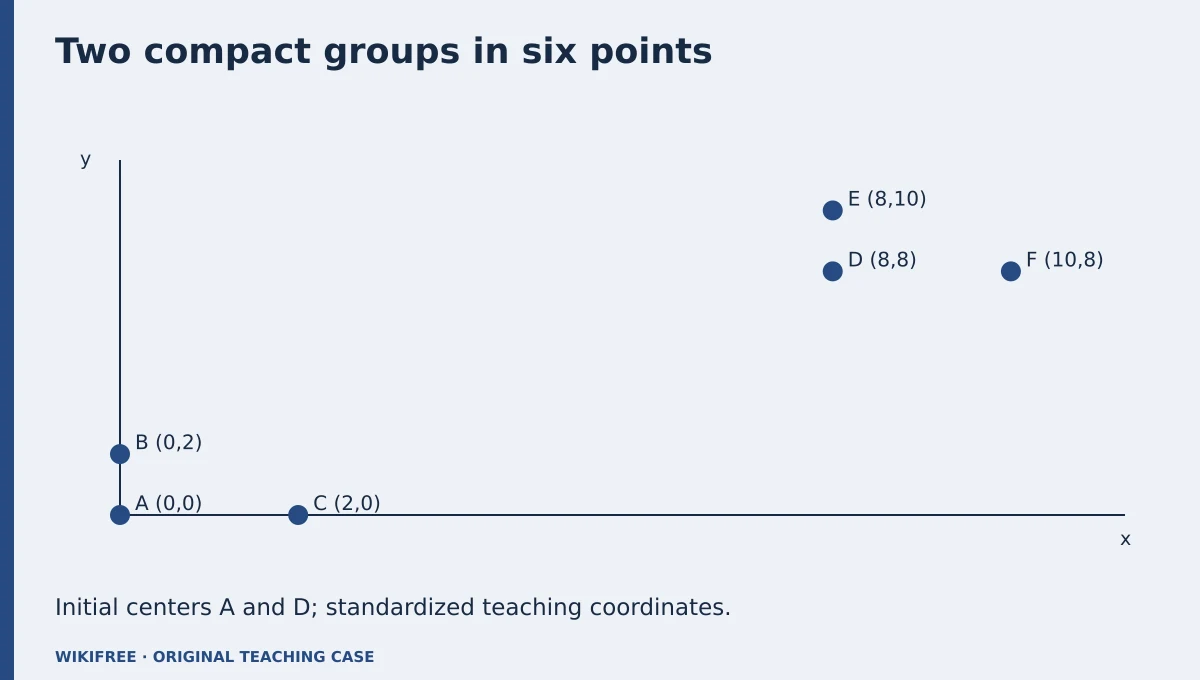
The table and explanations preserve the essential case information when the diagram is unavailable.
Your route
Five outputs, then a final handoff
- 01Choose a meaningful representationRepresentation note
About 1h 30m including assigned learning and practice. - 02Perform one assignment stepIteration table
About 1h 50m including assigned learning and practice. - 03Implement a reproducible runClustering run record
About 1h 30m including assigned learning and practice. - 04Challenge the solutionModel-choice note
About 1h 40m including assigned learning and practice. - 05Create an interpretable handoffReproducible report
About 50m including assigned learning and practice. - FINALCapstone reviewCombine the evidence into one inspectable handoff.
About 2h 30m.
0 of 6 outputs checked. JavaScript adds browser-only progress saving.
The complete lesson and all downloads remain available. Use the printable project workbook to track your progress.
Use the minimum useful source material
The courses behind this route
Google Introduction to Clustering: Free Machine Learning Course
Google’s published clustering course covers representation, k-means mechanics and evaluation.
Selected material only; this path does not claim completion of the entire provider course.
Course publication and selected public lesson metadata were checked on 13 October 2026. This is not a claim of full video playback, provider-course completion or permanent availability. Recheck the linked source if a lesson changes.
Learn, make, inspect
The five-stage workshop
Choose a meaningful representation
Video 0m · reading budget 35m · original practice about 55m.
Distance reflects the chosen features and their scale. A large numerical range can dominate another feature even when it is not more relevant. Define what the coordinates represent and what was standardized. This synthetic case isolates the mechanics; real segmentation requires a defensible representation and attention to possible harms.
Assigned reading
Google Introduction to Clustering: Free Machine Learning Course: Clustering workflow and data preparation.
Use the named provider navigation sections. Editorial reading budget for the named public material; not a verified completion duration
Do the work
Write the feature and scaling contract and plot the six points.
Save this output
Representation note
Pass the review gate
The note does not infer real customer traits from abstract coordinates.
If you need another attempt
Label interpretation separately from numerical input.
Perform one assignment step
Video 0m · reading budget 40m · original practice about 1h 10m.
Assign each point to the nearest current center using the declared distance. Then recompute each center as the mean of its assigned points. Keep assignment and update as separate steps so the process is inspectable. Empty clusters require an explicit handling policy; this starting case does not produce one.
Assigned reading
Google Introduction to Clustering: Free Machine Learning Course: K-means: what k-means is and calculating similarity.
Use the named provider navigation sections. Editorial reading budget for the named public material; not a verified completion duration
Do the work
Calculate the first assignments and updated centers by hand.
Save this output
Iteration table
Pass the review gate
A/B/C join cluster 1 and D/E/F cluster 2; centers become (2/3,2/3) and (26/3,26/3).
If you need another attempt
Square differences before summing and do not round centers prematurely.
Implement a reproducible run
Video 0m · reading budget 0m · original practice about 1h 30m.
Fix initial centers and the tie rule for a deterministic exercise. Include a maximum iteration count to prevent accidental endless loops. Record the final assignments, centers and within-cluster sum of squares. A successful run on six points demonstrates the implementation, not the suitability of k-means for every dataset.
Original application stage. Use your preceding outputs and the supplied case; there is no additional required provider lesson.
Do the work
Run the supplied pure-Python reference and inspect its stopping rule.
Save this output
Clustering run record
Pass the review gate
The final within-cluster sum of squares is 32/3, about 10.667.
If you need another attempt
Recompute distances to the final centers rather than the initial ones.
Challenge the solution
Video 0m · reading budget 35m · original practice about 1h 5m.
A clustering result depends on k, initialization, scaling and geometry. Compact numerical groups do not necessarily answer the business question. Compare a one-cluster baseline and consider an outlier. State the limitations instead of using a visually neat split as proof that two natural categories exist.
Assigned reading
Google Introduction to Clustering: Free Machine Learning Course: K-means: evaluating results and advantages and disadvantages.
Use the named provider navigation sections. Editorial reading budget for the named public material; not a verified completion duration
Do the work
Compare k=1 with k=2 and describe what an outlier could change.
Save this output
Model-choice note
Pass the review gate
The note treats two clusters as a chosen model, not ground truth.
If you need another attempt
Add a task-based reason for using the grouping.
Create an interpretable handoff
Video 0m · reading budget 0m · original practice about 50m.
A handoff should preserve the feature definitions, algorithm choices and uncertainty about interpretation. Avoid assigning people consequential labels from a toy cluster result. Name groups neutrally until supported evidence justifies a more meaningful description. Keep the raw points and the run settings available for reproduction.
Original application stage. Use your preceding outputs and the supplied case; there is no additional required provider lesson.
Do the work
Write a short segmentation report using neutral cluster names.
Save this output
Reproducible report
Pass the review gate
Every group statement can be traced to supplied coordinates.
If you need another attempt
Remove labels that imply unmeasured behavior or value.
Make the result inspectable
Your final project
Deliver the scatterplot, manual iteration, Python run, k comparison and interpretation note. Add a seventh point and document how the changed input affects the result.
The ZIP includes synthetic input data, a project workbook, worked reference, evidence log, scoring rubric and case-specific materials. Code projects include source and clearly stated local execution requirements.
Use one consistent rubric
| Criterion | Maximum | Evidence |
|---|---|---|
| Evidence and correctness | 30 | Calculations, source use and results match the supplied case; limitations are honest. |
| Required artifacts | 30 | All five stage outputs and the capstone handoff are present and inspectable. |
| Reasoning and decisions | 20 | Choices, assumptions, alternatives and the case-specific critical condition are explained. |
| Reproducibility | 10 | A reviewer can follow the stated steps and distinguish expected from observed results. |
| Clear communication | 10 | Labels, units, structure and evidence references make the work easy to review. |
Score at least 80/100, supply every required artifact, and satisfy the path-specific critical condition. Rework missing evidence before marking complete.
The critical condition
Initialization, scale and distance are recorded and no cluster interpretation exceeds the synthetic evidence.
Compare with a worked reference
The first cluster center is (2/3,2/3); its squared-distance total is 16/3. The second is a translation of the same shape and also contributes 16/3, so total SSE is 32/3. A one-cluster center at (14/3,14/3) gives SSE 608/3.
Know the boundary
This is a tiny deterministic demonstration, not validated customer segmentation or a production ML service.
Questions before you finish
Do I need to finish every source course?
No. This path names selected lessons or reading sections. Complete the full provider course only if it supports your wider goal. The path does not claim equivalence to that course.
How do I know when to advance?
Use the output and review gate in each stage. If evidence is missing or a result conflicts with the case, follow the repair step and retry before advancing.
Can I do the project without paid software?
The selected public provider lessons are free to view. The original case can be completed with paper, a text editor or freely available local tools. Paid exams, certificates, subscriptions and optional provider software are not required for this project.
What does my checklist prove?
It records your own review in this browser only. It does not verify viewing, skill, a provider credential or a real-world deployment.
What if a lesson or tool changes?
Use the linked course and provider page to inspect current availability. Record the change and revisit the relevant assignment; do not invent a replacement lesson or claim an unavailable activity was completed.
Questions & discussion
Share a useful question or correction. Comments appear after moderation. Please avoid personal or sensitive information.