Path 86 · The reliability ledger · Intermediate
Turn a target into a measurable budget.
A guided, practical route through site reliability objectives.
What you will be able to do
Define a request-based SLI and SLO, calculate an error budget and write an incident-review rule for a synthetic service.
Plan about 7h 33m in total. Reading and practice are editorial estimates; video runtimes come from public provider metadata. Your pace will vary.
Table of Contents
Before you begin
Check your starting point
What you need
Percentages and basic service concepts. No monitoring account or live service is required.
The selected public provider lessons are free to view. The original case can be completed with paper, a text editor or freely available local tools. Paid exams, certificates, subscriptions and optional provider software are not required for this project.
Completing this Coursya path does not award a provider certificate. Any provider assessment, account requirement or credential must be checked separately on its official page.
Three readiness questions
Is an SLO the same as a contractual SLA?
No.
What is the allowed failure count here?
100 requests.
Does a request-based budget equal downtime minutes?
Not without additional assumptions.
Use a workable pace
At 5 hours per week, allow about 2 weeks. Start with Stage 1, continue in order and reserve 2h for the capstone. If a gate fails, use its repair step before advancing. At another weekly budget, divide 453 estimated minutes by your available weekly minutes and round up.
Keep a small evidence folder. A checked box means you reviewed your output; it is not a certificate or proof that a provider lesson was watched.
The working case
The 100-request error budget
A fictional library API serves 100,000 eligible requests in a 30-day window. Its objective is 99.9% successful requests. The sample contains 80 failed requests. Success is defined by a documented response rule; excluded health checks are not in the denominator.
| Measure | Value |
|---|---|
| Eligible requests | 100000 |
| SLO percent | 99.9 |
| Failed requests | 80 |
| Window days | 30 |
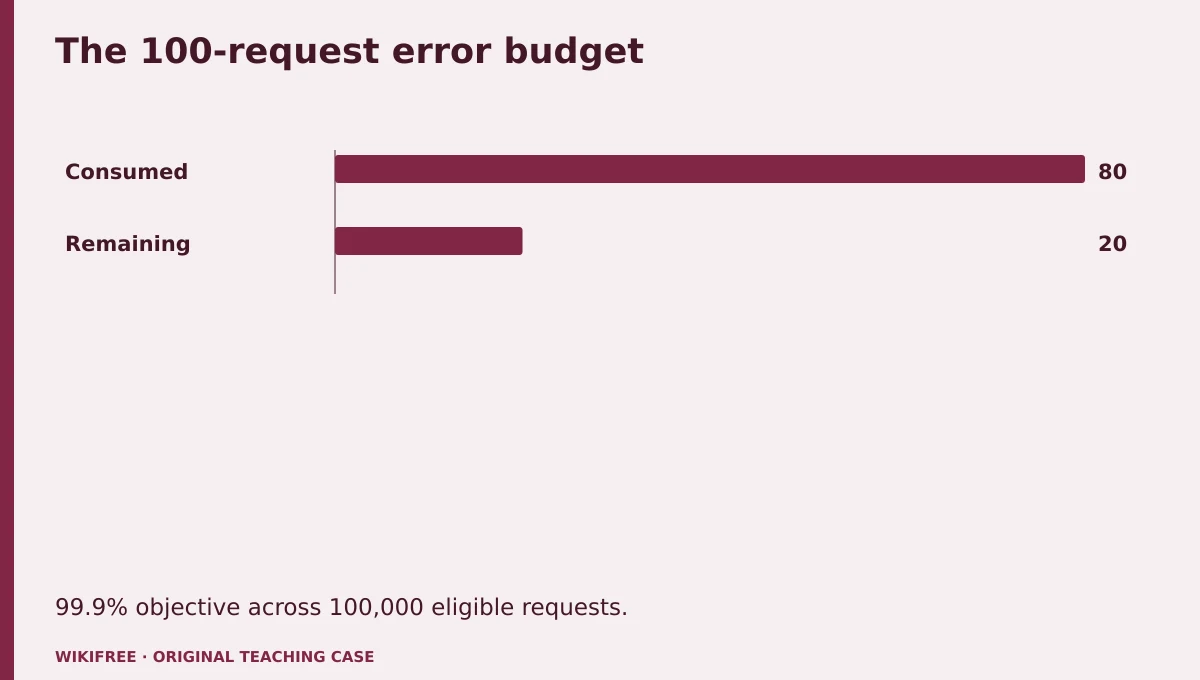
The table and explanations preserve the essential case information when the diagram is unavailable.
Your route
Five outputs, then a final handoff
- 01Choose a user-facing measureSLI specification
About 1h 9m including assigned learning and practice. - 02Calculate the objective and budgetBudget sheet
About 1h 10m including assigned learning and practice. - 03Define a review responseBudget policy
About 1h 9m including assigned learning and practice. - 04Avoid misleading alertsAlert design note
About 1h 10m including assigned learning and practice. - 05Write the reliability reviewReliability report
About 55m including assigned learning and practice. - FINALCapstone reviewCombine the evidence into one inspectable handoff.
About 2h .
0 of 6 outputs checked. JavaScript adds browser-only progress saving.
The complete lesson and all downloads remain available. Use the printable project workbook to track your progress.
Use the minimum useful source material
The courses behind this route
IBM
Free DevOps Course: CI/CD, SRE and Infrastructure as Code
The published IBM SRE and golden-signals lessons support reliability objectives; Google’s SRE workbook provides supplementary SLO guidance.
Selected material only; this path does not claim completion of the entire provider course.
Course publication and selected public lesson metadata were checked on 13 October 2026. This is not a claim of full video playback, provider-course completion or permanent availability. Recheck the linked source if a lesson changes.
Learn, make, inspect
The five-stage workshop
Choose a user-facing measure
Video 14m · reading budget 0m · original practice about 55m.
An SLI needs a population, event and measurement rule. Choose something related to the user experience rather than a convenient internal count. Define eligible requests and success consistently. The case uses a request-based ratio, so translating it directly into minutes of downtime would change the measurement model.
Watch these selected lessons
Do the work
Write the SLI definition and exclusions.
Save this output
SLI specification
Pass the review gate
The denominator is eligible requests, not every log entry.
If you need another attempt
Explain every exclusion and keep it stable across the window.
Calculate the objective and budget
Video 0m · reading budget 0m · original practice about 1h 10m.
The allowed bad-event fraction is one minus the objective. Multiply it by eligible requests to obtain the budget for this sample window. The actual success rate and budget consumption answer related but different questions. Keep the units visible and avoid rounding before the final calculation.
Original application stage. Use your preceding outputs and the supplied case; there is no additional required provider lesson.
Do the work
Calculate actual success, allowed failures and remaining budget.
Save this output
Budget sheet
Pass the review gate
Success is 99.92%; budget is 100; 80 are consumed and 20 remain.
If you need another attempt
Use 0.001, not 0.1, as the allowed failure fraction.
Define a review response
Video 8m · reading budget 0m · original practice about 1h .
An error-budget policy connects reliability evidence with a decision process. It should describe who reviews risk, what work may be prioritized and how exceptions are recorded. A policy is not an automatic ban on every change. This fictional exercise does not authorize operations on any real service.
Watch these selected lessons
Do the work
Draft a review rule for budget exhaustion and a documented exception route.
Save this output
Budget policy
Pass the review gate
The policy identifies an owner and evidence, not just a red status.
If you need another attempt
Replace vague be more careful instructions with a specific review action.
Avoid misleading alerts
Video 0m · reading budget 0m · original practice about 1h 10m.
An alert needs enough traffic and a useful time window. A single failure in a tiny sample can create a dramatic rate without justifying the same response as a sustained incident. This path does not derive a full burn-rate alert system; it asks for a proportionate evaluation plan and an explicit data-sufficiency rule.
Original application stage. Use your preceding outputs and the supplied case; there is no additional required provider lesson.
Do the work
Compare 1 failure in 10 requests with 1,000 in 10,000 and describe the context needed.
Save this output
Alert design note
Pass the review gate
The note distinguishes equal 10% rates from very different event volumes.
If you need another attempt
Show counts beside rates and state the response context.
Write the reliability review
Video 0m · reading budget 0m · original practice about 55m.
A reliability review combines the measured objective, budget state, incidents and improvement actions. Avoid claiming the service is reliable in every dimension because one ratio passes. Latency, data correctness and availability may need separate measures. The supplied case contains no live monitoring evidence.
Original application stage. Use your preceding outputs and the supplied case; there is no additional required provider lesson.
Do the work
Write a one-page monthly review and two next measurement questions.
Save this output
Reliability report
Pass the review gate
The report limits its conclusion to the supplied request-success measure.
If you need another attempt
Name at least one user-experience dimension not measured.
Make the result inspectable
Your final project
Deliver the SLI contract, budget calculation, policy, alert note and review. Recalculate with 120 failures and explain the policy response without inventing a live incident.
The ZIP includes synthetic input data, a project workbook, worked reference, evidence log, scoring rubric and case-specific materials. Code projects include source and clearly stated local execution requirements.
Use one consistent rubric
| Criterion | Maximum | Evidence |
|---|---|---|
| Evidence and correctness | 30 | Calculations, source use and results match the supplied case; limitations are honest. |
| Required artifacts | 30 | All five stage outputs and the capstone handoff are present and inspectable. |
| Reasoning and decisions | 20 | Choices, assumptions, alternatives and the case-specific critical condition are explained. |
| Reproducibility | 10 | A reviewer can follow the stated steps and distinguish expected from observed results. |
| Clear communication | 10 | Labels, units, structure and evidence references make the work easy to review. |
Score at least 80/100, supply every required artifact, and satisfy the path-specific critical condition. Rework missing evidence before marking complete.
The critical condition
Request ratios are not silently converted to downtime, and the denominator remains explicit.
Compare with a worked reference
Allowed failures are 100,000 × (1 − 0.999) = 100. Actual success is 99,920 / 100,000 = 99.92%. The case consumes 80% of its error budget and leaves 20 failed requests of allowance for the same fixed window and population.
Know the boundary
This is an SLO design and calculation exercise, not a monitored production service or contractual availability guarantee.
Questions before you finish
Do I need to finish every source course?
No. This path names selected lessons or reading sections. Complete the full provider course only if it supports your wider goal. The path does not claim equivalence to that course.
How do I know when to advance?
Use the output and review gate in each stage. If evidence is missing or a result conflicts with the case, follow the repair step and retry before advancing.
Can I do the project without paid software?
The selected public provider lessons are free to view. The original case can be completed with paper, a text editor or freely available local tools. Paid exams, certificates, subscriptions and optional provider software are not required for this project.
What does my checklist prove?
It records your own review in this browser only. It does not verify viewing, skill, a provider credential or a real-world deployment.
What if a lesson or tool changes?
Use the linked course and provider page to inspect current availability. Record the change and revisit the relevant assignment; do not invent a replacement lesson or claim an unavailable activity was completed.
Questions & discussion
Share a useful question or correction. Comments appear after moderation. Please avoid personal or sensitive information.