Path 88 · The trust-boundary map · Intermediate
Describe what can go wrong and why.
A guided, practical route through threat modeling.
What you will be able to do
Create a defensive threat model for a fictional document-upload workflow with assets, trust boundaries and prioritized mitigations.
Plan about 9h 8m in total. Reading and practice are editorial estimates; video runtimes come from public provider metadata. Your pace will vary.
Table of Contents
Before you begin
Check your starting point
What you need
Basic web application concepts. The exercise is a paper review and does not probe any real system.
The selected public provider lessons are free to view. The original case can be completed with paper, a text editor or freely available local tools. Paid exams, certificates, subscriptions and optional provider software are not required for this project.
Completing this Coursya path does not award a provider certificate. Any provider assessment, account requirement or credential must be checked separately on its official page.
Three readiness questions
Is an authenticated user authorized for every file?
No.
Does a threat model prove the system is secure?
No.
Where does a trust boundary matter?
Where data or authority crosses between differently trusted components.
Use a workable pace
At 5 hours per week, allow about 2 weeks. Start with Stage 1, continue in order and reserve 2h for the capstone. If a gate fails, use its repair step before advancing. At another weekly budget, divide 548 estimated minutes by your available weekly minutes and round up.
Keep a small evidence folder. A checked box means you reviewed your output; it is not a certificate or proof that a provider lesson was watched.
The working case
Approval is a trust boundary
A fictional workshop portal lets an authenticated organizer upload a PDF and a reviewer approve it before public download. The design has a browser, application, private file store and public download endpoint. The exercise evaluates the design only; no exploit or live scan is performed.
| Asset | Required property |
|---|---|
| Draft document | private before approval |
| Published file | integrity and correct version |
| Organizer account | authorized access |
| Review record | traceable approval |
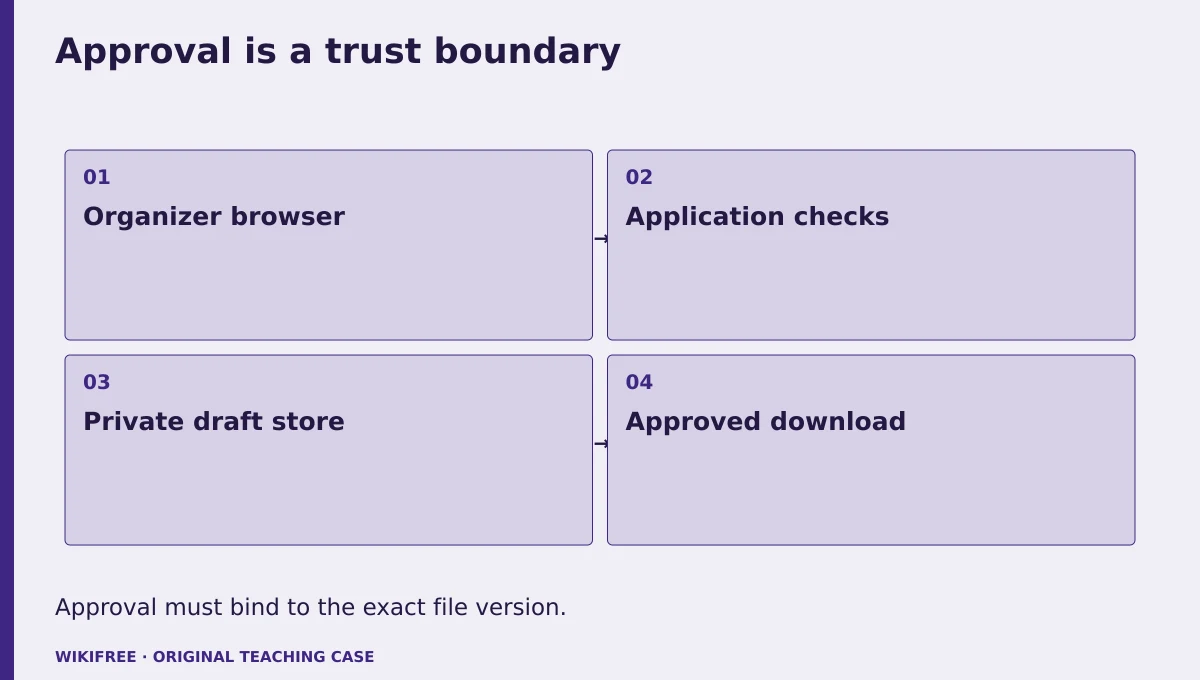
The table and explanations preserve the essential case information when the diagram is unavailable.
Your route
Five outputs, then a final handoff
- 01Define assets and boundariesData-flow model
About 1h 31m including assigned learning and practice. - 02Examine identity and authorityAccess assumptions
About 1h 42m including assigned learning and practice. - 03Identify concrete failure scenariosThreat register
About 1h 52m including assigned learning and practice. - 04Prioritize proportionate controlsMitigation plan
About 1h 10m including assigned learning and practice. - 05Review residual riskThreat-model handoff
About 55m including assigned learning and practice. - FINALCapstone reviewCombine the evidence into one inspectable handoff.
About 2h .
0 of 6 outputs checked. JavaScript adds browser-only progress saving.
The complete lesson and all downloads remain available. Use the printable project workbook to track your progress.
Use the minimum useful source material
The courses behind this route
IBM
Free Cybersecurity Architecture Course: Identity to Response
The published IBM architecture course covers principles, identity, application security and data security used in the review.
Selected material only; this path does not claim completion of the entire provider course.
Course publication and selected public lesson metadata were checked on 13 October 2026. This is not a claim of full video playback, provider-course completion or permanent availability. Recheck the linked source if a lesson changes.
Learn, make, inspect
The five-stage workshop
Define assets and boundaries
Video 30m · reading budget 0m · original practice about 1h .
Start with the intended workflow and the assets that matter. Draw data flows and trust boundaries without assuming every component is equally trusted. Confidentiality, integrity and availability help frame consequences. Keep the model specific enough that a reviewer can trace a threat to an actual flow.
Watch these selected lessons
- Cybersecurity Architecture: Five Principles to Follow (and One to Avoid)17:34
- Cybersecurity Architecture: Fundamentals of Confidentiality, Integrity, and Availability12:34
Do the work
Draw the four components and mark draft versus public data.
Save this output
Data-flow model
Pass the review gate
The private store is not treated as a public download directory.
If you need another attempt
Label each arrow with data and direction.
Examine identity and authority
Video 31m · reading budget 0m · original practice about 1h 10m.
Authentication establishes an identity; authorization decides whether that identity may perform an action on a resource. Check upload, review and download separately. A role name alone does not prove enforcement. The case should include a question about whether one organizer can access another organizer’s draft.
Watch these selected lessons
Do the work
Create an action-by-role matrix and three authorization questions.
Save this output
Access assumptions
Pass the review gate
Every sensitive action has a server-side authorization requirement.
If you need another attempt
Avoid relying on a hidden button as the access control.
Identify concrete failure scenarios
Video 31m · reading budget 0m · original practice about 1h 20m.
Write threats as a cause, an affected asset and a consequence. Examples include unapproved draft exposure, file-type confusion and replacement of an approved version. Keep the review defensive: describe the condition to prevent and evidence to request, without attempting attacks against a real portal.
Watch these selected lessons
- Cybersecurity Architecture: Application Security16:36
- Cybersecurity Architecture: Data Security14:48
Do the work
Record six threats tied to the diagram and existing or proposed controls.
Save this output
Threat register
Pass the review gate
Each threat references a component or flow and a specific consequence.
If you need another attempt
Replace generic hackers may attack statements with a bounded failure scenario.
Prioritize proportionate controls
Video 0m · reading budget 0m · original practice about 1h 10m.
Prioritization combines impact, plausible exposure and uncertainty. Scores can organize discussion but should not imply precision unsupported by evidence. Assign owners and verification methods to mitigations. Distinguish a proposed control from one confirmed implemented and tested.
Original application stage. Use your preceding outputs and the supplied case; there is no additional required provider lesson.
Do the work
Prioritize three threats and write acceptance evidence for each mitigation.
Save this output
Mitigation plan
Pass the review gate
No proposed control is marked verified.
If you need another attempt
Add a status and evidence link field to every control.
Review residual risk
Video 0m · reading budget 0m · original practice about 55m.
A threat model is a living design artifact. Record assumptions, open questions and the changes that would trigger review. A new public-sharing feature can alter the boundary even if the code change is small. The handoff should make unresolved risk visible rather than ending with an unsupported secure verdict.
Original application stage. Use your preceding outputs and the supplied case; there is no additional required provider lesson.
Do the work
Write a review summary and triggers for re-evaluation.
Save this output
Threat-model handoff
Pass the review gate
The summary distinguishes design review from security testing.
If you need another attempt
List the unverified assumptions beside the recommendation.
Make the result inspectable
Your final project
Deliver the data-flow diagram, asset list, access matrix, six threats, three prioritized mitigations and review triggers. Add a public-share-link feature in a copy and identify which boundaries change.
The ZIP includes synthetic input data, a project workbook, worked reference, evidence log, scoring rubric and case-specific materials. Code projects include source and clearly stated local execution requirements.
Use one consistent rubric
| Criterion | Maximum | Evidence |
|---|---|---|
| Evidence and correctness | 30 | Calculations, source use and results match the supplied case; limitations are honest. |
| Required artifacts | 30 | All five stage outputs and the capstone handoff are present and inspectable. |
| Reasoning and decisions | 20 | Choices, assumptions, alternatives and the case-specific critical condition are explained. |
| Reproducibility | 10 | A reviewer can follow the stated steps and distinguish expected from observed results. |
| Clear communication | 10 | Labels, units, structure and evidence references make the work easy to review. |
Score at least 80/100, supply every required artifact, and satisfy the path-specific critical condition. Rework missing evidence before marking complete.
The critical condition
The exercise stays within fictional defensive design and never claims that proposed controls were tested.
Compare with a worked reference
Draft confidentiality requires more than authentication: the application must authorize the requester for the specific draft, and the storage path must not bypass that decision. Approval must bind to a particular file version so later replacement cannot inherit stale approval.
Know the boundary
This is a design threat model, not a penetration test, compliance certification or security guarantee.
Questions before you finish
Do I need to finish every source course?
No. This path names selected lessons or reading sections. Complete the full provider course only if it supports your wider goal. The path does not claim equivalence to that course.
How do I know when to advance?
Use the output and review gate in each stage. If evidence is missing or a result conflicts with the case, follow the repair step and retry before advancing.
Can I do the project without paid software?
The selected public provider lessons are free to view. The original case can be completed with paper, a text editor or freely available local tools. Paid exams, certificates, subscriptions and optional provider software are not required for this project.
What does my checklist prove?
It records your own review in this browser only. It does not verify viewing, skill, a provider credential or a real-world deployment.
What if a lesson or tool changes?
Use the linked course and provider page to inspect current availability. Record the change and revisit the relevant assignment; do not invent a replacement lesson or claim an unavailable activity was completed.
Questions & discussion
Share a useful question or correction. Comments appear after moderation. Please avoid personal or sensitive information.