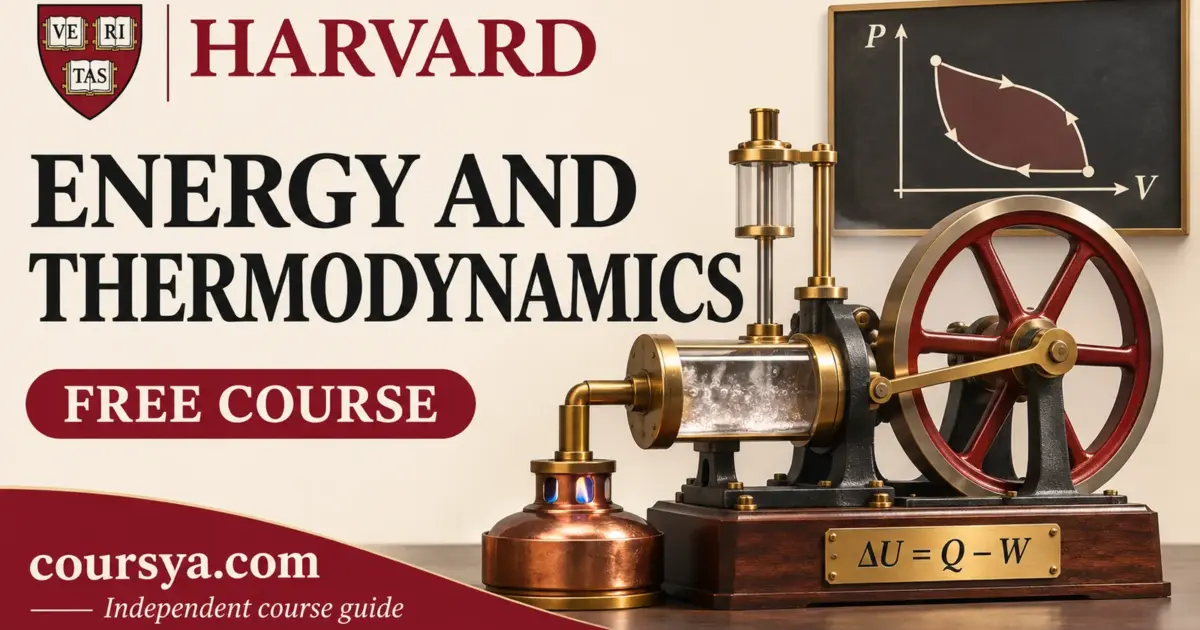
This course introduces energy through molecular structure, physical processes and thermodynamic reasoning. It connects the meanings of energy and power with atoms, bonds, heat and work. The learning goal is a usable conceptual foundation for later chemistry and energy courses rather than a collection of isolated technical terms.
Quick answer: Energy and Thermodynamics is a beginner-level Harvard course taught in English. A free learning route is listed by the provider.
Independent guide by the Coursya Editorial Team. Sources reviewed .
+ Course guide contents
Course facts at a glance
| Official course name | Energy and Thermodynamics |
|---|---|
| Provider / school | Harvard School of Engineering and Applied Sciences |
| Learning platform | edX |
| Instructors listed by Harvard | James G. Anderson |
| Instruction language | English |
| Level | Introductory |
| Length / pace | 10 weeks long |
| Weekly study estimate | 4 – 8 hours per week |
| Free route | Free audit; optional paid certificate |
| Certificate / credit | Verified certificate not included in free audit; paid upgrade may be available |
What you will learn and the skills you can build
- Distinguish energy quantities from power.
- Use units consistently in scientific comparisons.
- Relate molecular ideas to energy changes.
- Explain heat, work and thermodynamic reasoning.
Who should take this course?
Learners entering chemistry, environmental science or energy studies who want a structured starting point.
Preparation and entry knowledge
Refresh basic algebra, unit conversions and scientific notation. Keep a units sheet and test whether both sides of a calculation describe compatible quantities.
The preparation advice in this guide is Coursya’s recommendation. Check the current provider page for formal prerequisites, required software, readings or equipment before enrolling.
Is the course free, and what about the certificate?
Harvard lists this course with a free audit option. On the enrollment platform, look for the audit or free-learning route and read what it includes before selecting a paid upgrade. Audit access can be time-limited and may exclude graded assessments or other paid-track features.
The free audit route does not include a verified certificate. An optional paid upgrade may provide a certificate and assessed work under the provider’s current rules. Check the live enrollment page for the fee, deadlines and included features; this guide does not promise a free certificate.
How to study this course effectively
- Check the platform’s free-access window and required tools before making a study schedule.
- For each unit, connect a key idea with a worked example. Reproduce the reasoning or calculation, then change one assumption and explain what changes.
- Keep a short error log: the initial mistake, why it happened and the check that would detect it next time.
- Finish with an independent artifact that explains your method, assumptions and limitations. Use the exercise below as a starting point, not as a replacement for official coursework.
Independent practice: turn learning into a useful result
Prepare an energy-accounting worksheet for a fictional heating process. Define the system boundary, list known quantities and label every unit. Explain what is included and excluded from the calculation. Change one assumption and describe how the conclusion changes. Your main output is a transparent reasoning process, not an unsupported claim about a real device.
This is an original Coursya practice suggestion, not an official Harvard assignment, assessment or certificate requirement.
A mistake to avoid
A system boundary changes what is counted. State whether you are discussing a component, an entire device or a larger supply chain.
What to study before and after this course
These are optional study-path recommendations from Coursya, not an official Harvard sequence. Choose the preparation you need and the next step that fits your goal; you do not need to complete every linked course.
Useful preparation
- Data Analysis: Basic Probability and Statistics — Preparation focus: count outcomes systematically.
Possible next steps
- Entropy and Equilibria — Next learning focus: explain entropy within a thermodynamic model.
- Electrochemistry — Next learning focus: explain oxidation and reduction in a reaction.
Frequently asked questions
Is Energy and Thermodynamics free?
Harvard lists this course with a free audit option. On the enrollment platform, look for the audit or free-learning route and read what it includes before selecting a paid upgrade. Audit access can be time-limited and may exclude graded assessments or other paid-track features.
Does the free route include a certificate?
The free audit route does not include a verified certificate. An optional paid upgrade may provide a certificate and assessed work under the provider’s current rules. Check the live enrollment page for the fee, deadlines and included features; this guide does not promise a free certificate.
How long should I allow?
10 weeks long. 4 – 8 hours per week. Treat the stated length as a planning guide; prior knowledge and practice time affect your own pace.
Should this come before electrochemistry?
It is a useful foundation. Entropy and Equilibria can then deepen the thermodynamic ideas used in electrochemical reasoning.
Main instruction language: English