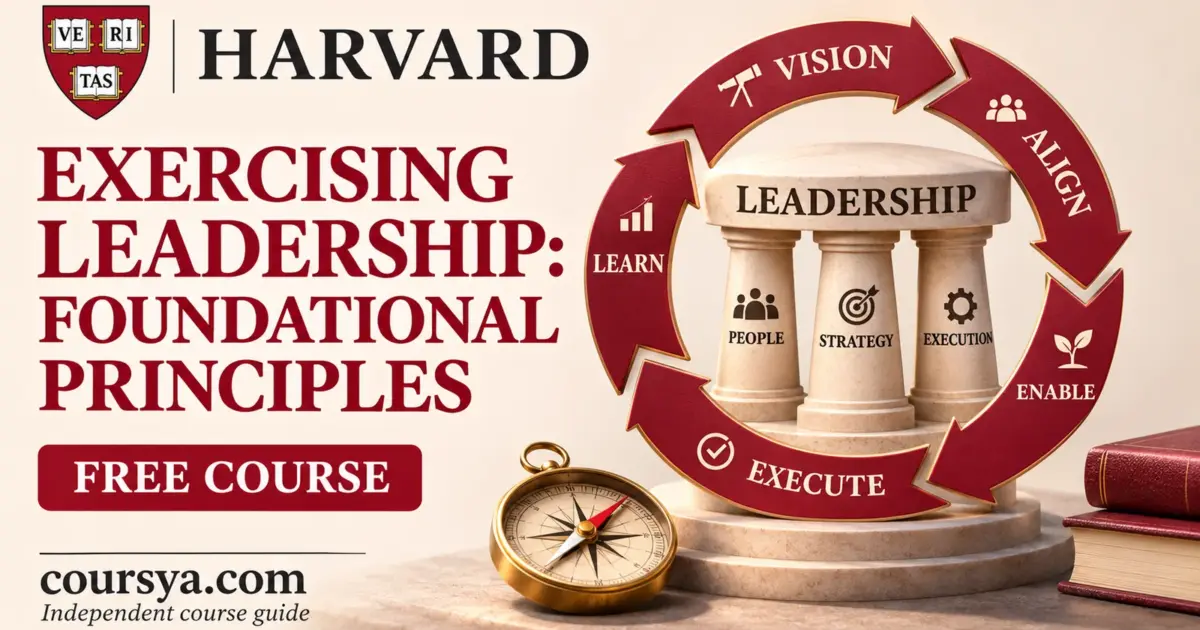
Exercising Leadership introduces ways to approach complex challenges involving people, authority and change. Its official outline includes stakeholder perspectives, trust and conflict. It is especially useful when a problem cannot be solved simply by issuing a clearer instruction or applying a familiar technical procedure.
Quick answer: Exercising Leadership: Foundational Principles is a beginner-level Harvard course taught in English. A free learning route is listed by the provider.
Independent guide by the Coursya Editorial Team. Sources reviewed .
+ Course guide contents
Course facts at a glance
| Official course name | Exercising Leadership: Foundational Principles |
|---|---|
| Provider / school | Harvard Kennedy School |
| Learning platform | edX |
| Instructors listed by Harvard | Ronald Heifetz |
| Instruction language | English |
| Level | Introductory |
| Length / pace | 5 days long |
| Weekly study estimate | 2 – 3 hours per week |
| Free route | Free audit; optional paid certificate |
| Certificate / credit | Verified certificate not included in free audit; paid upgrade may be available |
What you will learn and the skills you can build
- Break a complex challenge into clearer components.
- Distinguish formal authority from leadership work.
- Consider conflicting stakeholder perspectives.
- Plan a thoughtful response to resistance and change.
Who should take this course?
Project managers, team leaders and professionals who need to mobilize others without assuming that job title alone creates commitment.
Preparation and entry knowledge
Bring one low-stakes organizational challenge. Describe the observable problem and the affected groups before deciding why people are resisting or what they should do.
The preparation advice in this guide is Coursya’s recommendation. Check the current provider page for formal prerequisites, required software, readings or equipment before enrolling.
Is the course free, and what about the certificate?
Harvard lists this course with a free audit option. On the enrollment platform, look for the audit or free-learning route and read what it includes before selecting a paid upgrade. Audit access can be time-limited and may exclude graded assessments or other paid-track features.
The free audit route does not include a verified certificate. An optional paid upgrade may provide a certificate and assessed work under the provider’s current rules. Check the live enrollment page for the fee, deadlines and included features; this guide does not promise a free certificate.
How to study this course effectively
- Check the current syllabus, reading requirements and any time limit on free access. Reserve time for reflection as well as watching lessons.
- For each unit, identify the main claim, its supporting evidence and a question you still cannot answer.
- Compare at least two examples before applying an idea to a new situation. Keep historical facts, interpretations and your own judgments distinct.
- Create a short explanation or analysis for another learner. Use the independent exercise below to test whether you can apply an idea rather than simply repeat terminology.
Independent practice: turn learning into a useful result
Create a stakeholder-learning map for a fictional change initiative. Record what each group values, what it may lose and what you do not yet understand. Design a small conversation or experiment that could test an assumption. Define the signal you would look for before expanding the intervention. Treat this as inquiry rather than a script for forcing agreement.
This is an original Coursya practice suggestion, not an official Harvard assignment, assessment or certificate requirement.
A mistake to avoid
Disagreement is information, not automatic evidence of poor attitude. Investigate the concerns and constraints behind it.
What to study before and after this course
These are optional study-path recommendations from Coursya, not an official Harvard sequence. Choose the preparation you need and the next step that fits your goal; you do not need to complete every linked course.
Useful preparation
- Structure and Function of Argument: Introduction to Critical Thinking — Preparation focus: map a claim and its supporting reasons.
Possible next steps
- Leadership for Purposeful Change: Creating Public Value — Next learning focus: define the public value an initiative seeks.
- Remote Work Revolution for Everyone — Next learning focus: identify common coordination problems in remote work.
- Leaders of Learning Essentials — Next learning focus: articulate a personal theory of learning.
Frequently asked questions
Is Exercising Leadership: Foundational Principles free?
Harvard lists this course with a free audit option. On the enrollment platform, look for the audit or free-learning route and read what it includes before selecting a paid upgrade. Audit access can be time-limited and may exclude graded assessments or other paid-track features.
Does the free route include a certificate?
The free audit route does not include a verified certificate. An optional paid upgrade may provide a certificate and assessed work under the provider’s current rules. Check the live enrollment page for the fee, deadlines and included features; this guide does not promise a free certificate.
How long should I allow?
5 days long. 2 – 3 hours per week. Treat the stated length as a planning guide; prior knowledge and practice time affect your own pace.
Do I need a management title?
No. The course’s leadership ideas can help people analyze collective challenges even when they do not hold formal authority.
Main instruction language: English
Learner reviews
Tell other learners what you actually tried. Reviews are moderated and may come from learners who have started or completed the course.
No published learner reviews yet.
Sign in to write a reviewQuestions still belong in the discussion below. Review and ranking rules.