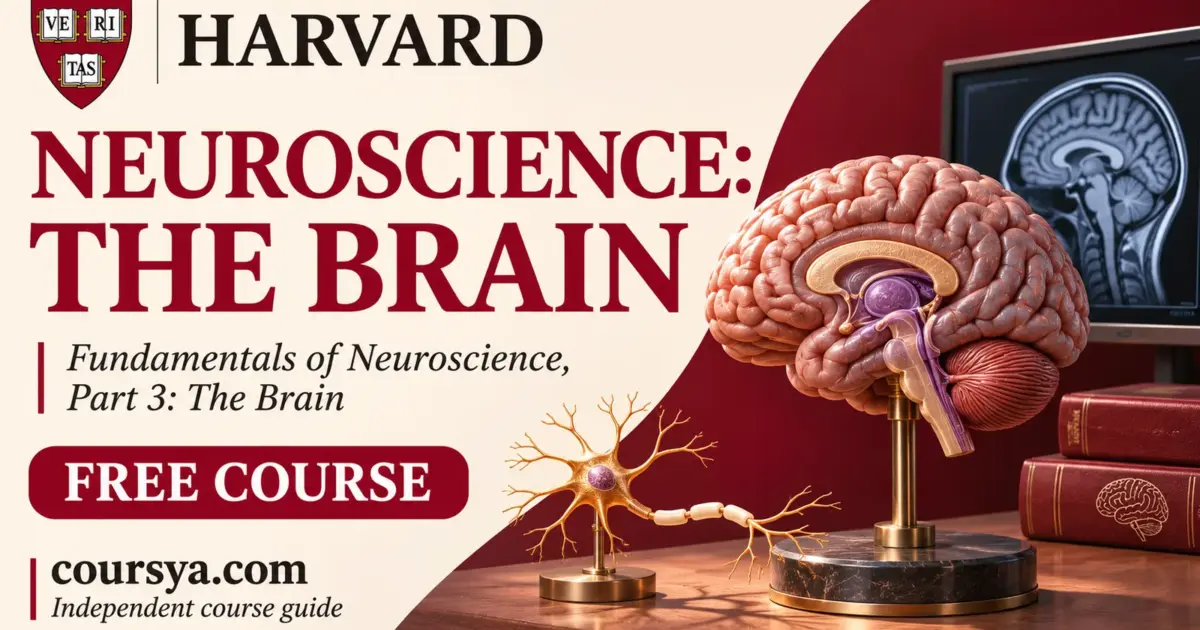
The Brain examines how functional systems contribute to perception, movement and other essential processes. It is the third course in Harvard’s neuroscience sequence, moving from cellular foundations toward larger interacting systems. Interactive materials help learners connect an anatomical description with a functional question.
Quick answer: Fundamentals of Neuroscience, Part 3: The Brain is a beginner-level Harvard course taught in English. A free learning route is listed by the provider.
Independent guide by the Coursya Editorial Team. Sources reviewed .
+ Course guide contents
Course facts at a glance
| Official course name | Fundamentals of Neuroscience, Part 3: The Brain |
|---|---|
| Provider / school | Harvard Faculty of Arts & Sciences |
| Learning platform | edX |
| Instructors listed by Harvard | David Cox |
| Instruction language | English |
| Level | Introductory |
| Length / pace | Not specified in the reviewed course listing; check the current outline |
| Weekly study estimate | 3 – 5 hours per week |
| Free route | Free audit; optional paid certificate |
| Certificate / credit | Verified certificate not included in free audit; paid upgrade may be available |
What you will learn and the skills you can build
- Identify broad functional areas of the brain.
- Connect sensory input with perception.
- Describe how motor systems coordinate activity.
- Explain why brain functions depend on interacting systems.
Who should take this course?
Science learners who have begun studying neurons and networks and want a broader systems perspective.
Preparation and entry knowledge
Review the earlier neuroscience material, including neurons and networks. A simple vocabulary of cells, signaling and anatomical orientation will make the larger-system explanations easier to follow.
The preparation advice in this guide is Coursya’s recommendation. Check the current provider page for formal prerequisites, required software, readings or equipment before enrolling.
Is the course free, and what about the certificate?
Harvard lists this course with a free audit option. On the enrollment platform, look for the audit or free-learning route and read what it includes before selecting a paid upgrade. Audit access can be time-limited and may exclude graded assessments or other paid-track features.
The free audit route does not include a verified certificate. An optional paid upgrade may provide a certificate and assessed work under the provider’s current rules. Check the live enrollment page for the fee, deadlines and included features; this guide does not promise a free certificate.
How to study this course effectively
- Check the platform’s free-access window and required tools before making a study schedule.
- For each unit, connect a key idea with a worked example. Reproduce the reasoning or calculation, then change one assumption and explain what changes.
- Keep a short error log: the initial mistake, why it happened and the check that would detect it next time.
- Finish with an independent artifact that explains your method, assumptions and limitations. Use the exercise below as a starting point, not as a replacement for official coursework.
Independent practice: turn learning into a useful result
Create a learning map for a familiar action such as noticing and reaching for an object. Mark the broad stages of sensory information, interpretation and movement without pretending that the process is strictly linear. Add questions about feedback and interaction. Revise the map as the course complicates your initial explanation.
This is an original Coursya practice suggestion, not an official Harvard assignment, assessment or certificate requirement.
A mistake to avoid
Avoid assigning a complex behavior to one isolated brain location. Course diagrams are useful simplifications of interacting systems.
What to study before and after this course
These are optional study-path recommendations from Coursya, not an official Harvard sequence. Choose the preparation you need and the next step that fits your goal; you do not need to complete every linked course.
Useful preparation
- Fundamentals of Neuroscience, Part 1: The Electrical Properties of the Neuron — Preparation focus: explain basic ideas of bioelectricity.
- Cell Biology: Mitochondria — Preparation focus: connect cellular organization with function.
Possible next steps
- Quantitative Methods for Biology — Next learning focus: write and interpret introductory MATLAB code.
- Stem Cell Medicine: Parkinson's Disease — Next learning focus: explain the biological rationale discussed in the course.
Frequently asked questions
Is Fundamentals of Neuroscience, Part 3: The Brain free?
Harvard lists this course with a free audit option. On the enrollment platform, look for the audit or free-learning route and read what it includes before selecting a paid upgrade. Audit access can be time-limited and may exclude graded assessments or other paid-track features.
Does the free route include a certificate?
The free audit route does not include a verified certificate. An optional paid upgrade may provide a certificate and assessed work under the provider’s current rules. Check the live enrollment page for the fee, deadlines and included features; this guide does not promise a free certificate.
How long should I allow?
Not specified in the reviewed course listing; check the current outline. 3 – 5 hours per week. Treat the stated length as a planning guide; prior knowledge and practice time affect your own pace.
Can I take Part 3 without the earlier material?
You can review the provider’s entry guidance, but studying neurons and networks first is a more coherent route for most beginners.
Main instruction language: English