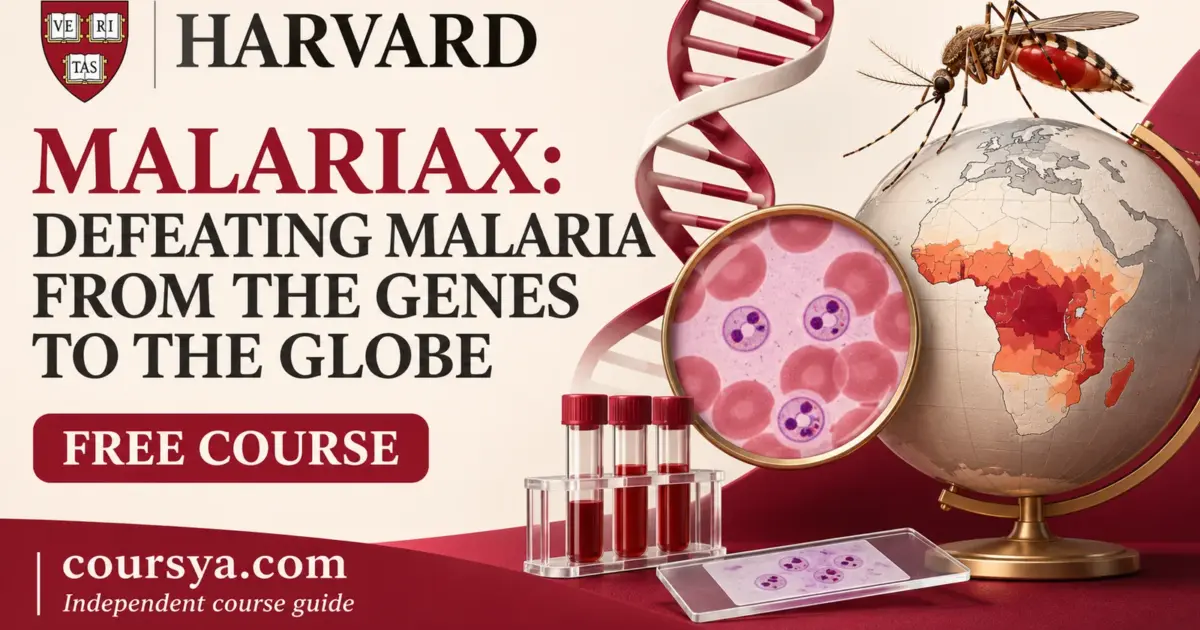
MalariaX connects parasite and vector biology with epidemiology, data and the organization of malaria programs. It treats disease control as a multidisciplinary challenge shaped by scientific and social conditions. The course supports analysis of programs and evidence rather than offering individualized prevention or treatment advice.
Quick answer: MalariaX: Defeating Malaria from the Genes to the Globe is an intermediate-level Harvard course taught in English. A free learning route is listed by the provider.
Independent guide by the Coursya Editorial Team. Sources reviewed .
+ Course guide contents
Course facts at a glance
| Official course name | MalariaX: Defeating Malaria from the Genes to the Globe |
|---|---|
| Provider / school | Harvard T.H. Chan School of Public Health |
| Learning platform | edX |
| Instructors listed by Harvard | Marcia Castro, Flaminia Catteruccia, Michael R. Reich, Marcel Tanner, Sarah Volkman, Dyann F. Wirth |
| Instruction language | English |
| Level | Intermediate |
| Length / pace | 11 weeks long |
| Weekly study estimate | 3 – 5 hours per week |
| Free route | Free audit; optional paid certificate |
| Certificate / credit | Verified certificate not included in free audit; paid upgrade may be available |
What you will learn and the skills you can build
- Connect biological concepts with malaria-control questions.
- Interpret the role of surveillance and data.
- Compare intervention choices within a setting.
- Recognize resource and implementation constraints.
Who should take this course?
Public-health and life-science learners with foundational knowledge who want to understand the wider malaria-control system.
Preparation and entry knowledge
Review basic epidemiology, biology and statistical reasoning. Use current health-authority guidance for real-world clinical or travel questions rather than course examples.
The preparation advice in this guide is Coursya’s recommendation. Check the current provider page for formal prerequisites, required software, readings or equipment before enrolling.
Is the course free, and what about the certificate?
Harvard lists this course with a free audit option. On the enrollment platform, look for the audit or free-learning route and read what it includes before selecting a paid upgrade. Audit access can be time-limited and may exclude graded assessments or other paid-track features.
The free audit route does not include a verified certificate. An optional paid upgrade may provide a certificate and assessed work under the provider’s current rules. Check the live enrollment page for the fee, deadlines and included features; this guide does not promise a free certificate.
How to study this course effectively
- Check the current syllabus, reading requirements and any time limit on free access. Reserve time for reflection as well as watching lessons.
- For each unit, identify the main claim, its supporting evidence and a question you still cannot answer.
- Compare at least two examples before applying an idea to a new situation. Keep historical facts, interpretations and your own judgments distinct.
- Create a short explanation or analysis for another learner. Use the independent exercise below to test whether you can apply an idea rather than simply repeat terminology.
Independent practice: turn learning into a useful result
Create a planning brief for a fictional surveillance program. State the decision the data should inform, the population covered and the possible gaps in observation. Compare two ways of allocating limited analytical resources and identify what evidence would help choose between them. Keep the exercise conceptual and do not infer an individual’s health risk.
This is an original Coursya practice suggestion, not an official Harvard assignment, assessment or certificate requirement.
A mistake to avoid
A method that works in one setting may perform differently where biology, services or reporting conditions differ. State the context behind every comparison.
What to study before and after this course
These are optional study-path recommendations from Coursya, not an official Harvard sequence. Choose the preparation you need and the next step that fits your goal; you do not need to complete every linked course.
Useful preparation
- Global Health Case Studies from a Biosocial Perspective — Preparation focus: frame a health problem beyond its biological mechanism.
- Quantitative Methods for Biology — Preparation focus: write and interpret introductory MATLAB code.
Possible next steps
- Pathogen Genomics for Epidemiology: Interpretation — Next learning focus: interpret common representations of pathogen genomic data.
- Sequencing Strategies for Pathogen Genomics — Next learning focus: compare broad sequencing-library strategies.
- Strengthening Community Health Worker Programs — Next learning focus: identify core components of a community health program.
Frequently asked questions
Is MalariaX: Defeating Malaria from the Genes to the Globe free?
Harvard lists this course with a free audit option. On the enrollment platform, look for the audit or free-learning route and read what it includes before selecting a paid upgrade. Audit access can be time-limited and may exclude graded assessments or other paid-track features.
Does the free route include a certificate?
The free audit route does not include a verified certificate. An optional paid upgrade may provide a certificate and assessed work under the provider’s current rules. Check the live enrollment page for the fee, deadlines and included features; this guide does not promise a free certificate.
How long should I allow?
11 weeks long. 3 – 5 hours per week. Treat the stated length as a planning guide; prior knowledge and practice time affect your own pace.
Does this course provide personal malaria treatment advice?
No. It is educational and program-oriented. Individual prevention and treatment questions require current professional medical advice.
Main instruction language: English