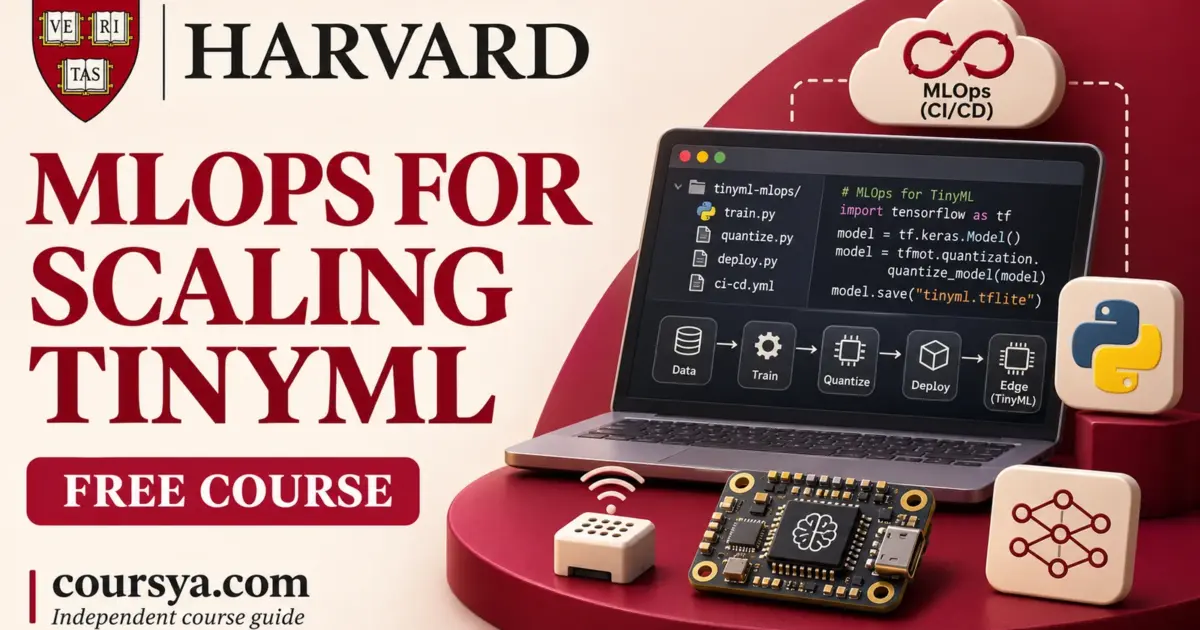
MLOps for Scaling TinyML examines what changes when a small machine-learning application moves beyond a proof of concept. It introduces operational thinking about deployment, feedback and lifecycle automation. The focus is understanding a repeatable process and its responsibilities rather than assuming a successful model demonstration is a finished product.
Quick answer: MLOps for Scaling TinyML is a beginner-level Harvard course taught in English. A free learning route is listed by the provider.
Independent guide by the Coursya Editorial Team. Sources reviewed .
+ Course guide contents
Course facts at a glance
| Official course name | MLOps for Scaling TinyML |
|---|---|
| Provider / school | Harvard School of Engineering and Applied Sciences |
| Learning platform | edX |
| Instructors listed by Harvard | Larissa Suzaki, Vijay Janapa Reddi |
| Instruction language | English |
| Level | Introductory |
| Length / pace | 7 weeks long |
| Weekly study estimate | No separate weekly estimate confirmed; allow extra time for practice |
| Free route | Free audit; optional paid certificate |
| Certificate / credit | Verified certificate not included in free audit; paid upgrade may be available |
What you will learn and the skills you can build
- Connect a model with its operational lifecycle.
- Identify responsibilities around deployment and monitoring.
- Recognize useful automation and platform features.
- Analyze the challenges of scaling small-device applications.
Who should take this course?
Machine-learning practitioners, technical product teams and learners who have already explored an embedded-AI application.
Preparation and entry knowledge
Understand a basic training-and-inference workflow and the intended use of the model. Applications of TinyML provides a more concrete starting point than operations vocabulary alone.
The preparation advice in this guide is Coursya’s recommendation. Check the current provider page for formal prerequisites, required software, readings or equipment before enrolling.
Is the course free, and what about the certificate?
Harvard lists this course with a free audit option. On the enrollment platform, look for the audit or free-learning route and read what it includes before selecting a paid upgrade. Audit access can be time-limited and may exclude graded assessments or other paid-track features.
The free audit route does not include a verified certificate. An optional paid upgrade may provide a certificate and assessed work under the provider’s current rules. Check the live enrollment page for the fee, deadlines and included features; this guide does not promise a free certificate.
How to study this course effectively
- Check the platform’s free-access window and required tools before making a study schedule.
- For each unit, connect a key idea with a worked example. Reproduce the reasoning or calculation, then change one assumption and explain what changes.
- Keep a short error log: the initial mistake, why it happened and the check that would detect it next time.
- Finish with an independent artifact that explains your method, assumptions and limitations. Use the exercise below as a starting point, not as a replacement for official coursework.
Independent practice: turn learning into a useful result
Draw a lifecycle map for a hypothetical sensor model. Mark where data enters, how a version is evaluated, who approves deployment and how unexpected behavior is noticed. Define a rollback decision and the evidence needed to make it. Keep the plan small enough that every responsibility has a clear owner.
This is an original Coursya practice suggestion, not an official Harvard assignment, assessment or certificate requirement.
A mistake to avoid
Automation can repeat a weak process faster. Establish checks and ownership before deciding which steps to automate.
What to study before and after this course
These are optional study-path recommendations from Coursya, not an official Harvard sequence. Choose the preparation you need and the next step that fits your goal; you do not need to complete every linked course.
Useful preparation
- Applications of TinyML — Preparation focus: interpret keyword-spotting and visual-trigger use cases.
- Machine Learning and AI with Python — Preparation focus: build and compare supervised-learning models.
Possible next steps
- CS50's Introduction to Cybersecurity — Next learning focus: recognize common account and social-engineering risks.
- Technology Entrepreneurship: Lab to Market — Next learning focus: connect a technology with a specific use case.
Frequently asked questions
Is MLOps for Scaling TinyML free?
Harvard lists this course with a free audit option. On the enrollment platform, look for the audit or free-learning route and read what it includes before selecting a paid upgrade. Audit access can be time-limited and may exclude graded assessments or other paid-track features.
Does the free route include a certificate?
The free audit route does not include a verified certificate. An optional paid upgrade may provide a certificate and assessed work under the provider’s current rules. Check the live enrollment page for the fee, deadlines and included features; this guide does not promise a free certificate.
How long should I allow?
7 weeks long. Treat the stated length as a planning guide; prior knowledge and practice time affect your own pace.
Is this only about choosing an MLOps platform?
No. Platform features support the work, but the central questions include process, feedback, responsibility and the needs of the application.
Main instruction language: English
Learner reviews
Tell other learners what you actually tried. Reviews are moderated and may come from learners who have started or completed the course.
No published learner reviews yet.
Sign in to write a reviewQuestions still belong in the discussion below. Review and ranking rules.