The Coursya library
Free Online Courses
Explore free study options. Check the provider, prerequisites, and certificate details before you begin.
Course results
3458 courses
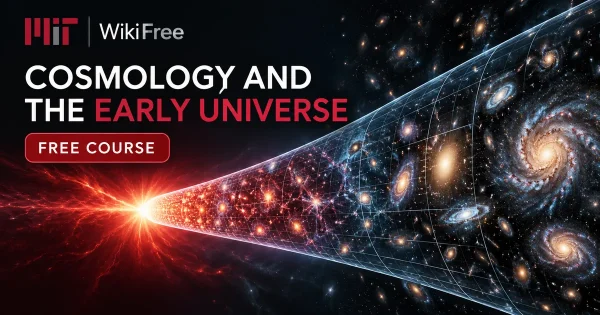
MIT Free Video
Study the early universe through expansion, thermal history and inflation. MIT lectures connect cosmological models with the physical reasoning used to describe large-scale evolution.
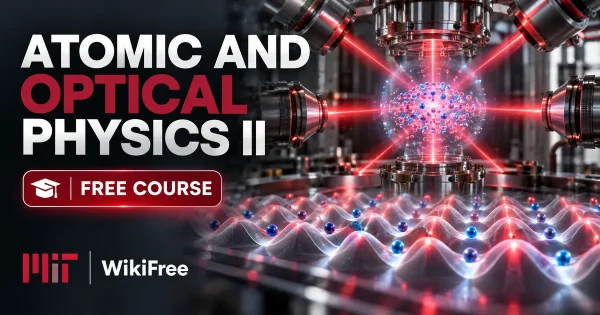
MIT Free Video
Continue atomic and optical physics with precision measurement, light-matter dynamics and trapped-ion examples. The lectures develop quantitative models used to understand coherent control and quantum experiments.
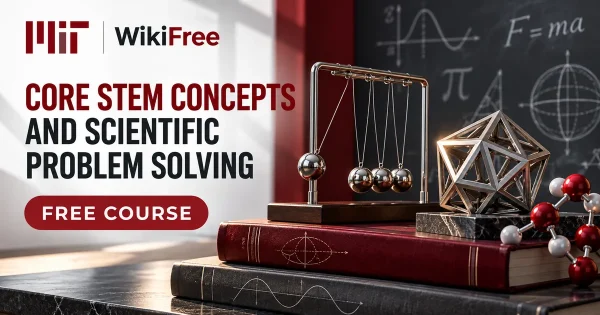
MIT Free Video
Review a varied collection of core STEM ideas through focused explanations. Topics range from mechanics and equilibrium to modeling and communication, making this a cross-disciplinary concept collection.
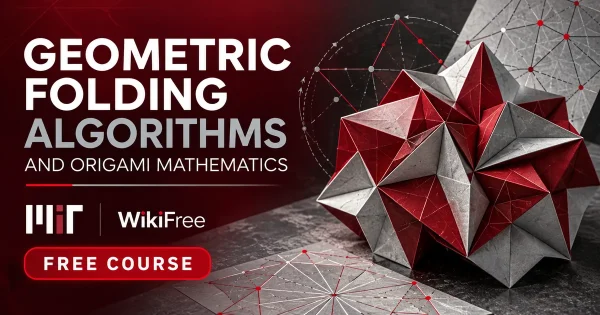
MIT Free Video
Explore algorithms and geometry through linkages, origami, rigidity and unfolding. The lectures connect physical folding questions with mathematical proofs and computational problems.
MIT Free Video
Investigate how neural systems process vision and hearing. Lectures connect adaptation, color, eye movements and auditory responses with methods for understanding sensory computation.
MIT Free Video
Study photovoltaic devices through light absorption, charge transport, extraction and advanced solar-cell concepts. The lectures connect semiconductor physics with the losses and design choices that shape performance.
MIT Free Video
Explore algorithms used to study genomes, RNA and protein networks. MIT lectures connect computational methods with biological questions about sequence, structure and interaction.
MIT Free Video
Develop atomic and optical physics through resonance, atomic structure, light-matter interactions and spectral line broadening. The course emphasizes the physical models behind experimental observations.
MIT Free Video
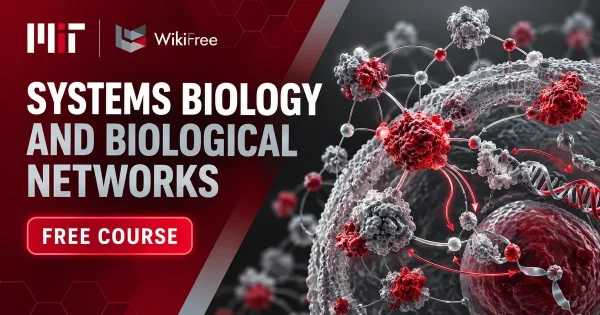
Investigate biological systems through network motifs, feedback, robustness and adaptation. The lectures connect simplified mathematical models with patterns found in cells and developing organisms.
MIT Free Video
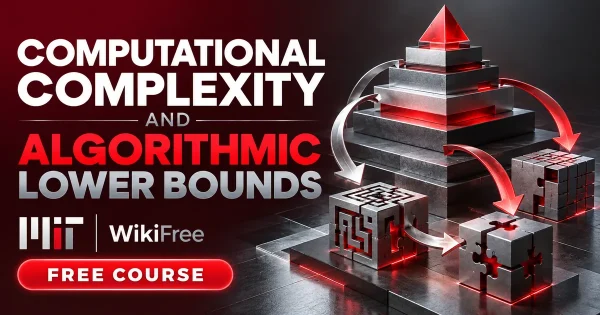
Study the limits of efficient computation through reductions, satisfiability and hardness of approximation. MIT lectures connect formal complexity classes with examples of difficult algorithmic problems.

MIT Free Video
Examine sustainability within supply-chain decisions through reverse logistics, carbon footprints, life-cycle analysis and stakeholder engagement. These selected lectures focus on evaluating consequences across a product's wider system.
MIT Free Video
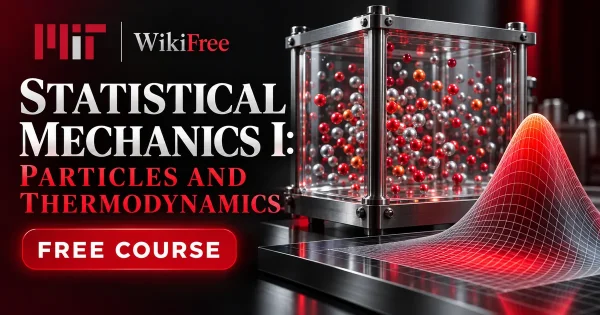
Develop statistical mechanics from thermodynamics and kinetic theory toward classical ensembles and interacting particles. The lectures connect microscopic models with macroscopic physical behavior.