The Coursya library
Free Online Courses
Explore free study options. Check the provider, prerequisites, and certificate details before you begin.
Course results
3458 courses

MIT Free Video
Study vibrations and waves through oscillation, wave equations, Fourier ideas and electromagnetic examples. MIT lectures and supporting recordings connect physical intuition with mathematical models.
MIT Free Video
Practice computational thinking by solving puzzles in Python. The course uses constrained, concrete problems to develop algorithmic reasoning and show how a solution becomes a program.
MIT Free Video
Explore advanced topics in cognitive robotics through path planning, localization, image classification and tree search. This selected lecture sequence focuses on autonomous decision-making techniques.
MIT Free Video
Study the planning and operation of public transportation. MIT lectures connect short-range planning, performance models and traffic priority with the practical constraints of urban transit systems.
MIT Free Video
Learn how statistical models support practical decisions using the Analytics Edge materials. The videos combine R demonstrations with regression and case studies involving health, costs and other…
MIT Free Video
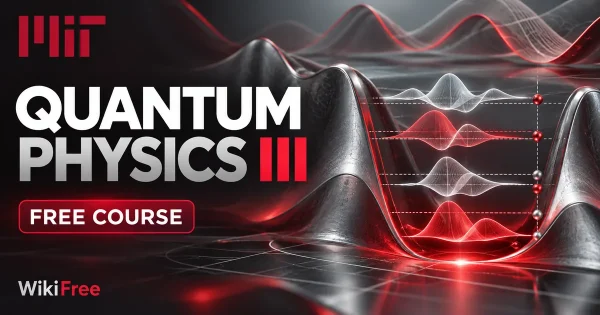
Continue advanced quantum-mechanics study through perturbation theory, semiclassical approximations, atom-light interactions and molecular examples. The short lessons break demanding derivations into focused parts.
MIT Free Video
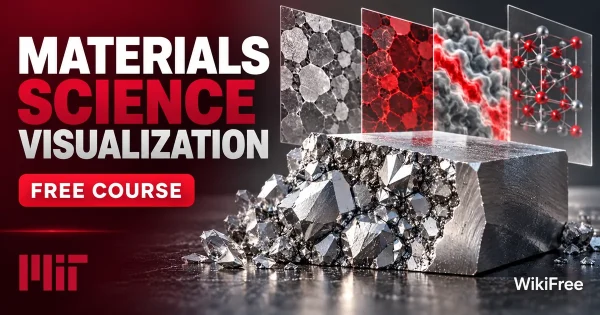
Explore materials-science concepts through student-created visualizations and computational demonstrations. Examples include diffraction, quantum evolution, Brillouin zones and stress representations; this is a case-study collection.
MIT Free Video
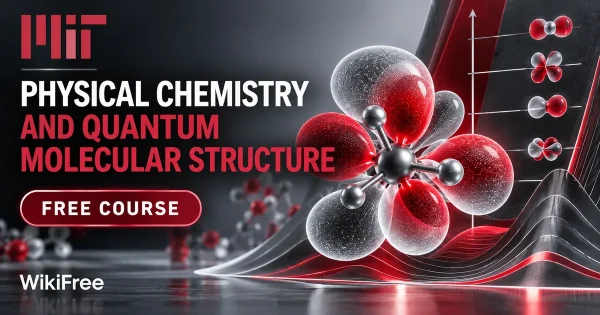
Connect quantum mechanics with molecular structure and spectroscopy. The lectures develop wave-mechanical ideas and the use of light and electronic-structure models to investigate molecules.
MIT Free Video
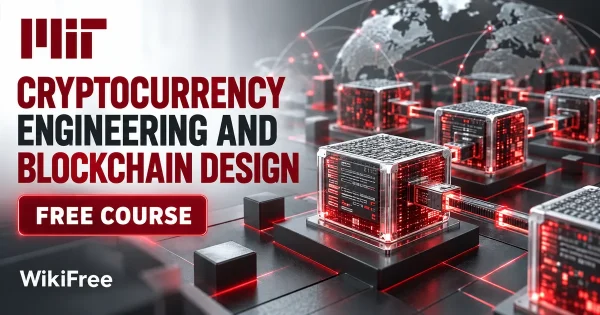
Study the engineering foundations of cryptocurrencies through signatures, hashes, wallets, transactions and privacy mechanisms. The lectures focus on protocol design and technical trade-offs, not investment selection.
MIT Free Video
Investigate how innovation depends on organizations, policy and economic conditions. The course examines growth, manufacturing, collaboration and energy-technology transitions through a systems perspective.

MIT Free Video
Follow the construction of a computer from information and electronic devices to logic and programmable datapaths. Short lessons connect hardware components with the behavior of computational systems.
MIT Free Video
Study matrix techniques that support data science and machine learning. The lectures connect norms, singular values, low-rank structure and neural networks with practical mathematical reasoning.