The Coursya library
Free Online Courses
Explore free study options. Check the provider, prerequisites, and certificate details before you begin.
Course results
5264 courses

Study advanced proof systems in cryptography, including interactive proofs, sum-check, zero knowledge and the Fiat-Shamir paradigm. The lectures emphasize rigorous constructions and security reasoning.

Explore facilitation as a form of public-sector leadership. The sessions use concepts, hypothetical situations and practical microskills to examine how leaders support productive collective work.
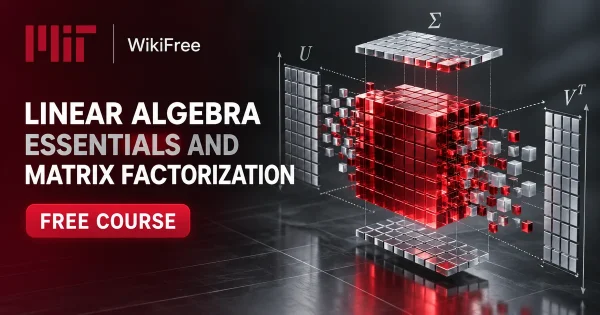
Build a visual overview of linear algebra through matrices, fundamental subspaces, eigenvectors and least squares. These focused lessons offer a compact conceptual path rather than a full…
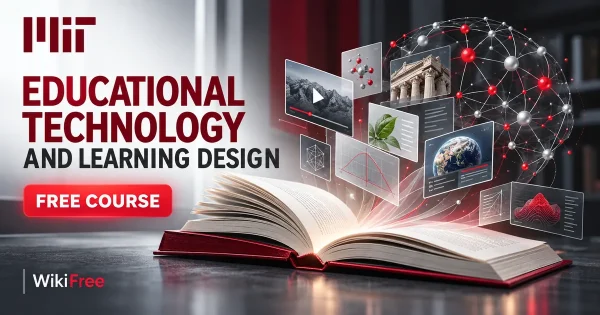
Evaluate educational technology through ideas about learning. The lectures discuss cognitive load, intelligent tutoring, learning games and assessment, helping you question whether a tool supports a meaningful…

Study the discrete mathematics behind computer science. The course connects logic and proof techniques with sums, modular arithmetic, graphs, trees and counting methods.
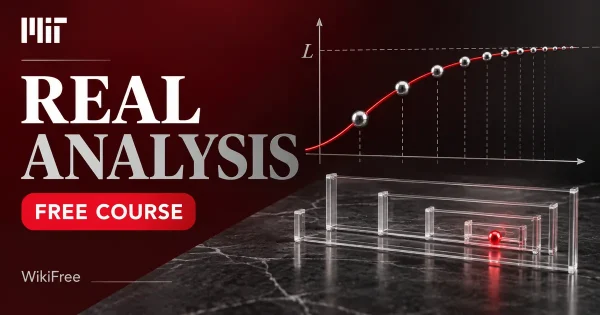
Move from intuitive calculus toward rigorous analysis. The lectures develop real-number properties, convergence, continuity, differentiation and uniform convergence through definitions and mathematical proofs.

Examine how a technical idea moves from a laboratory toward practical use. Short MIT Innovation Teams videos focus on uncertainty, available resources, problem selection and testing assumptions.

Use computational representations to investigate musical structure. The videos introduce music21, hierarchical organization, plotting and algorithmic approaches to music, connecting Python programming with music-theory questions.

Understand how buildings can share ground-source heating and cooling infrastructure. The sessions discuss geothermal networks, heat pumps, implementation experience and the social questions surrounding thermal-energy transitions.

Explore advanced connections between projection theory, incidence geometry, additive combinatorics and random walks. The emphasis is on mathematical arguments and research-level techniques, not introductory geometry.
Build a toolkit for discrete problem solving through counting, concentration inequalities, optimization and coding. MIT lectures show how relatively simple mathematical ideas support more demanding arguments.
Study mathematical tools used to represent financial uncertainty. The lectures combine probability, regression, portfolio analysis and volatility modeling within an academic treatment of quantitative finance.