The Coursya library
Chemistry Courses
Explore free study options. Check the provider, prerequisites, and certificate details before you begin.
Course results
24 courses
Yale Free Video
Organic chemistry becomes more coherent when structures and mechanisms are tied to evidence. This free Yale course introduces the ideas used to explain bonding, molecular shape and…
MIT Free Video
Connect thermodynamics and chemical kinetics through an undergraduate physical-chemistry lecture sequence. The course develops ways to reason about energy, equilibrium and rates of chemical change.
MIT Free Video
Explore selected advanced lectures on quantum mechanics in a molecular setting. The short collection supports deeper study of the mathematical ideas used in physical chemistry.
MIT Free Video
Observe chemistry laboratory techniques through a selected demonstration sequence. The videos support understanding of experimental practice; equipment, supervised training and laboratory access are not included.
MIT Free Video
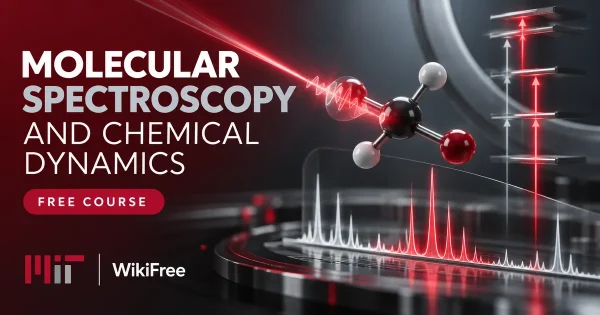
Study small-molecule spectroscopy and chemical dynamics through MIT's advanced lecture sequence. The course connects molecular energy structure with the interpretation of spectroscopic observations.
MIT Free Video
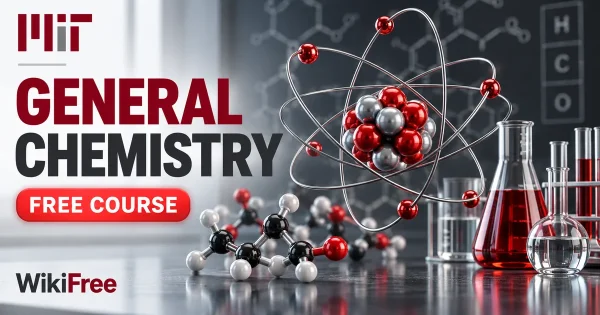
Build a foundation in chemistry through atomic structure, bonding, thermodynamics and electrochemistry. MIT lectures connect microscopic explanations with observable chemical behavior and quantitative reasoning.
MIT Free Video
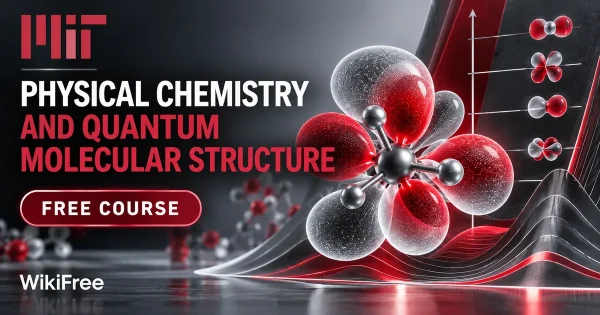
Connect quantum mechanics with molecular structure and spectroscopy. The lectures develop wave-mechanical ideas and the use of light and electronic-structure models to investigate molecules.
MIT Free Video
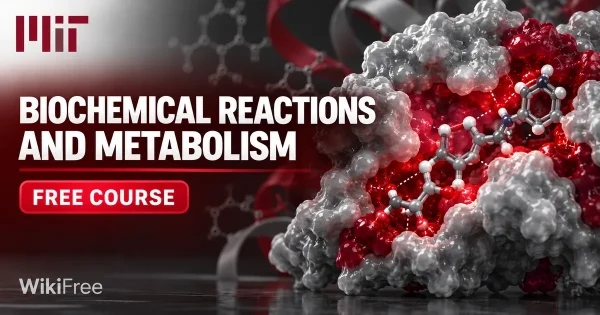
Review the chemical logic of biochemical reactions through carbonyl chemistry, redox balance and metabolic examples. The focused videos connect reaction mechanisms with biological function.
MIT Free Video
Review selected biochemistry lectures on carbohydrates, membranes and metabolism. The available videos connect glycolysis, lipid oxidation, photosynthesis and nitrogen metabolism rather than presenting every class in the…
MIT Free Video
Connect chemistry with the behavior of solid materials. MIT lectures examine bonding, phases, diffraction and solutions, using material properties to give chemical principles an engineering context.
MIT Free Video
Study advanced biological chemistry through protein folding, experimental methods, cholesterol metabolism and molecular interactions. Lectures and recitations connect biochemical mechanisms with methods used to investigate them.
MIT Free Video
Learn how chemists reason about measurements and experimental results. Selected lectures discuss error analysis, chemical transformations and instrumental interpretation; laboratory participation is not included.