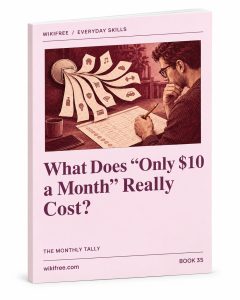
A large percentage on a label answers only one question. Your decision also depends on the original price, quantity, extra charges and whether you wanted the item. Use the same unit and a realistic basket before calling one offer cheaper.
Calculate everyday discounts, compare unit prices and check the cash total at checkout.
Who this ebook is for
Everyday shoppers comparing offers at a shelf or checkout. The guide uses everyday situations, practical wording and short exercises that you can adapt to your own circumstances.
What you will learn
- Calculate the amount off. Convert the percentage to a decimal and multiply by the stated original price. Subtract the result from that price.
- Use the same quantity. Divide the price by volume, weight or count in the same unit. For products with different concentration or use rates, compare a usable dose or serving when that information is credible.
- Apply successive discounts in order. Two discounts applied successively work on different bases. Multiply by the proportion remaining after each reduction.
- Test a multi-buy against actual use. Work out how many items you need and whether the extra units will be used in time. Compare the total you would spend under each realistic choice, including any minimum quantity.
- Bring fees into the checkout total. Delivery, required add-ons and applicable taxes can change the final comparison. Use the amount actually payable under the same assumptions.
A shelf decision you can explain
You need around 900 g of a product. A 1 kg pack is $8 with 15% off. Two 500 g packs are $3.60 each.
For the large pack, 15% of $8 is $1.20. The selling price is $6.80.
Two small packs cost $7.20 for the same total quantity. The large pack is $0.40 cheaper under these terms.
Your conclusion names the same quantity, the actual total and the assumption that matters.
Put the guide into practice
Choose one situation you expect to face soon. Work through the relevant example, then use the worksheet to write a response or plan you can realistically follow. The prompts include:
- The two options and actual quantities
- The relevant starting and selling prices
- Fees, usable units and final totals
- My choice and the assumption behind it
About the PDF download
The English-language PDF has 19 pages: 16 content pages, a cover and two advertisement pages. It includes 12 fillable worksheet fields. Use a PDF reader that supports forms to type and save your responses, or print the pages and write by hand.
A templates advertisement follows content page 5, and a Coursera Plus advertisement follows content page 15. Each advertisement image is fully clickable. These are promotional links and Coursya may earn a commission from a purchase. A purchase is optional.
Frequently asked questions
Who is this ebook for?
Everyday shoppers comparing offers at a shelf or checkout. Calculate everyday discounts, compare unit prices and check the cash total at checkout.
How can I use the worksheets?
The PDF includes 12 fillable fields for your own notes and decisions. Open it in a reader that supports PDF forms, save a copy after entering your responses and reopen that copy to check your work. The worksheets can also be printed.
What is included in the free download?
One complete English-language PDF with 16 content pages, illustrated explanations, examples and practice activities. The 19-page file also includes its cover and two linked advertisements. You can read and use the guide without buying anything.