Learn by building
Free Guided Projects
Put a skill into practice with a focused, guided task. Explore projects in AI, data, programming, databases and cloud computing. Check the preparation, provider access and certificate details on each project page.
Looking for a broader syllabus? Browse courses or explore our learning paths.
328 free guided projects
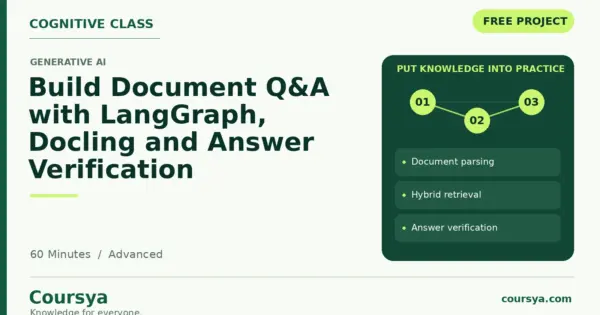
Cognitive Class Guided project
Create a document workflow that combines retrieval, answer generation and checking. Explore how a verification stage can send a weak answer back for another attempt.
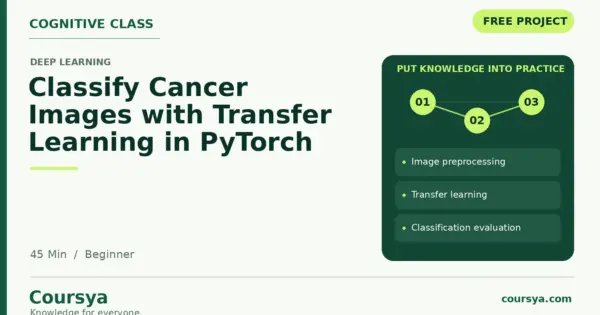
Cognitive Class Guided project
Use a medical-image example to practise transfer learning and image preparation. Study the model-development process without presenting the resulting prototype as a clinical diagnostic tool.
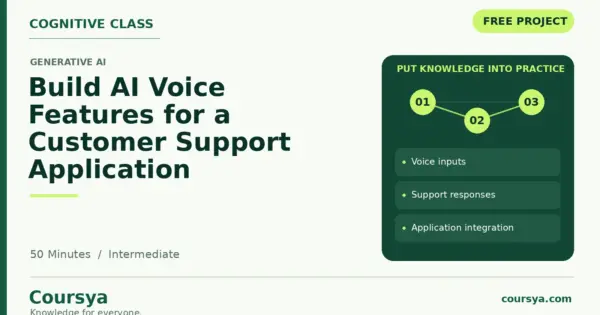
Cognitive Class Guided project
Explore voice interaction as part of a support workflow. Connect speech-oriented services with an application that accepts customer requests and produces useful responses.
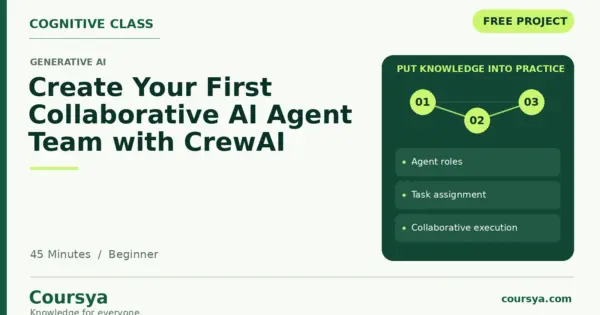
Cognitive Class Guided project
Explore how specialised agents can share a task through defined roles and responsibilities. Build a small CrewAI workflow and inspect how work moves between its participants.
Cognitive Class Guided project
Build a small agent loop that alternates between reasoning about a task and taking an action. Inspect the components that higher-level agent frameworks normally hide.
Cognitive Class Guided project
Explore how a pretrained text model can be used through the Caikit framework. Connect model-serving concepts with a concrete sentiment-analysis task.
Cognitive Class Guided project
Explore trading-algorithm logic using historical cryptocurrency data. Focus on implementing and evaluating a research workflow rather than interpreting a simulation as a promise of returns.
Cognitive Class Guided project
Combine a recommendation task with a Django application. Explore how data, recommendation logic and a web interface fit together in a practical software project.
Cognitive Class Guided project
Build an MCP server that makes writing-related tools available to an agent. Explore the boundary between tool definitions, agent decisions and the application's user-facing response.
Cognitive Class Guided project
Build an image-recognition example around a simple visual distinction. Practise preparing images and examining the behaviour of a trained classifier.
Cognitive Class Guided project
Explore reusable ways to organise an AI workflow rather than treating it as a single prompt. Examine how nodes, state and control flow support different agent behaviours.
Cognitive Class Guided project
Create a document assistant that retrieves relevant passages before generating a response. Explore how document preparation, retrieval and conversational context work together.
Cognitive Class Guided project
Coordinate a click-through-rate modelling workflow using specialised agents. Explore how a graph-based design separates stages and makes the overall process easier to inspect.
Cognitive Class Guided project
Explore collaborative AI agents using a simulated healthcare assistant. Focus on agent roles and message exchange while keeping generated medical responses clearly within an educational demonstration.
Cognitive Class Guided project
Build the connection between a language model's request and an actual software function. Practise defining tools and inspecting the results returned to an AI workflow.
Cognitive Class Guided project
Explore a defensive monitoring workflow that combines statistical patterns with explicit rules. Consider how the two approaches contribute different evidence when assessing suspicious activity.
Cognitive Class Guided project
Explore how additional inference effort and structured prompting affect language-model performance. Compare candidate answers and verification methods on reasoning-oriented tasks.
Cognitive Class Guided project
Work through a compact neural-network workflow with PyTorch. Explore model training and evaluation, then save learned parameters so the model can be used again for inference.
Cognitive Class Guided project
Compare the experience of writing and running a first program in several languages and a markup example. Focus on syntax, execution and the shared goal of producing…
Cognitive Class Guided project
Build a small repository workflow from account setup through file changes and branches. Learn how a separate branch helps organise changes before they reach the main version.
Cognitive Class Guided project
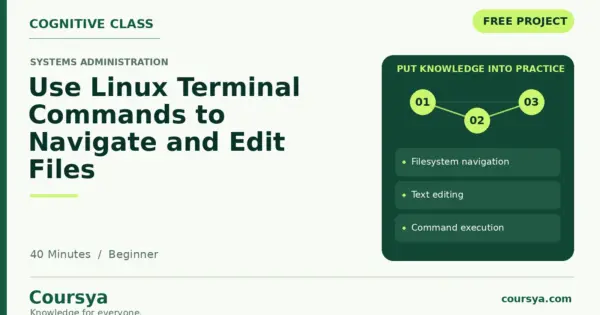
Become more comfortable working in a Linux terminal. Explore directories, manage files, edit text and run commands in the supplied practice environment.
Cognitive Class Guided project
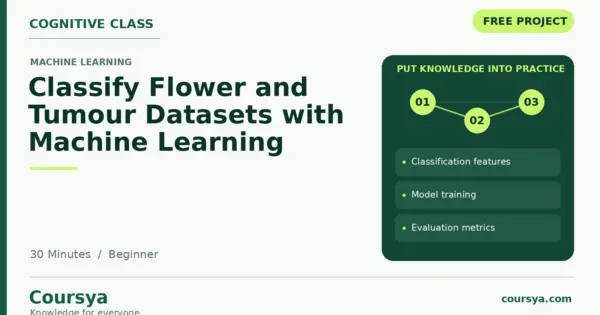
Practise supervised classification with labelled example datasets. Examine how features and evaluation choices affect the distinction between classes in a learning exercise.
Cognitive Class Guided project
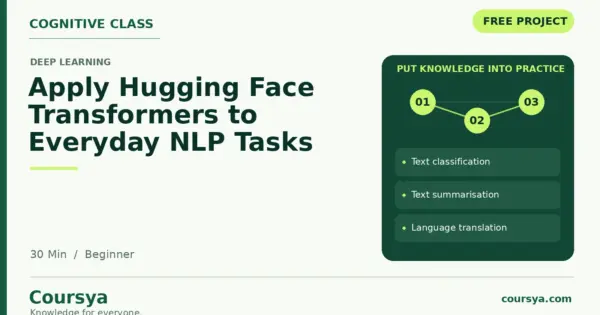
Explore pretrained transformer models through several text-processing applications. Compare the inputs and outputs of tasks such as classification, summarisation and translation.
Cognitive Class Guided project
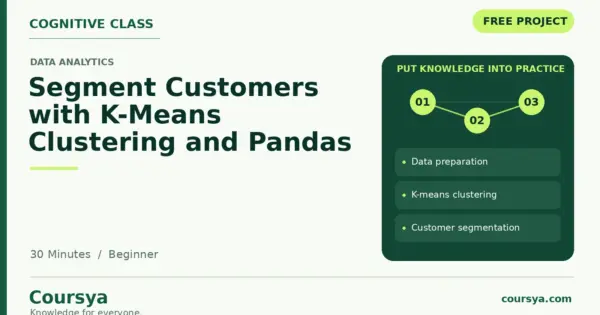
Group customer records into clusters and interpret the resulting patterns. Practise preparing data, fitting K-means and visualising cluster centres in a business-analysis example.