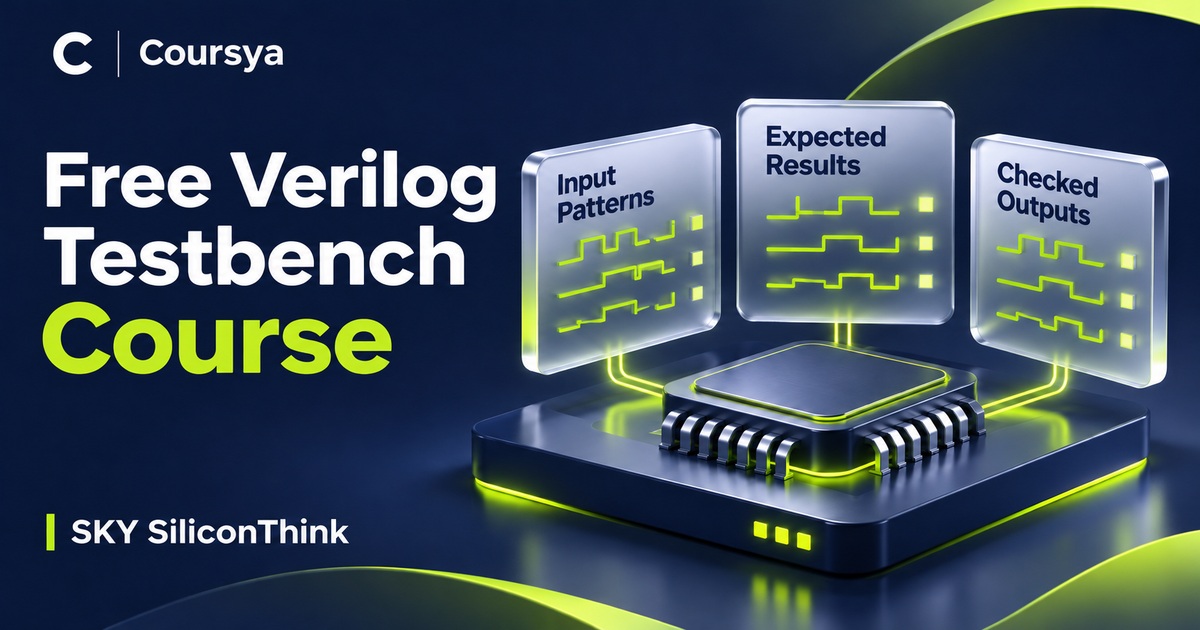
Listed as Free on Udemy when checked on 19 November 2026. No coupon or subscription trial is required for the listed lessons. Enrollment needs a Udemy account; availability can change.
About this course
Writing a module is only part of learning digital design. You also need a way to supply inputs, decide what the outputs should be, and notice when the implementation behaves differently. This free course from SKY SiliconThink introduces that testing perspective alongside reusable Verilog routines and ideas for organizing larger designs.
The course is P2-S5 within a wider IC and FPGA series. Its public curriculum lists four sections and seven timed lectures: functions and tasks, simulation execution, testbench structure, parameters and generate constructs, design organization, and a closing promotion. It is a focused learning segment for someone with basic digital-logic knowledge and some C or C++ familiarity.
| Official course | VLSI/FPGA Design P2-S5: Verilog for Design and Verification |
|---|---|
| Created by | SKY SiliconThink |
| Platform | Udemy |
| Language | English |
| Level | Beginner |
| Listed duration | 97 minutes; 7 lectures across 4 sections |
| Completion terms | Not included with a new free enrollment |
What you’ll learn
Explore how functions and tasks organize reusable behavior, follow a task-based testbench example, and consider the relationship between stimulus, a reference model, and a checker. Study blocking and non-blocking assignments in the context of simulation execution, then examine parameterized structures and the separation of datapath from control. These topics support more deliberate RTL experiments and clearer test organization.
Skills you’ll gain
- Verilog functions and tasks
- Testbench organization
- Stimulus planning
- Reference-model comparisons
- Simulation timing reasoning
- Parameterized design structure
Separate the test from the design
A useful testbench has a purpose beyond producing an attractive waveform. Start by identifying the design under test, the inputs it receives, and the outputs you will examine. Keep the expected behavior understandable enough to review independently. If the reference model repeats exactly the same mistaken reasoning as the implementation, agreement between them can be misleading.
The lesson example uses tasks to organize stimulus and comparisons for sequence detection. That is a useful setting for thinking about order, repeated inputs, and boundary conditions. When extending a similar example yourself, name each test according to the behavior it checks. A short, reproducible failure is often easier to investigate than a long run with no explanation of which expectation was broken.
Functions and tasks provide different ways to collect repeated operations. A function is useful for a calculation that returns a result without consuming simulation time; a task can organize a sequence that includes timing controls. The course uses traditional Verilog syntax. Treat its introductory distinctions in that context rather than assuming they describe every feature available in SystemVerilog.
Understand when values change
Simulation involves concurrent processes, so the order in which source blocks appear on a page is not a reliable execution schedule. Blocking and non-blocking assignments express different update behavior. When studying a clocked example, distinguish the value used to evaluate an expression from the time at which the destination changes.
This distinction matters on the testbench side too. Decide when to drive inputs and when to sample outputs relative to the clock and scheduled updates. A test that observes a signal too early can report a failure caused by the test itself. Conversely, a convenient observation time should not conceal a real discrepancy from the intended design behavior.
Simulator configuration also matters. Current Verilator documentation distinguishes timing-enabled operation from modes that ignore or reject certain timing controls. Check the options and language version used for your own experiment instead of assuming that an older demonstration runs identically under every installation. The course does not make a production verification or universal compatibility guarantee.
Build structure with parameters
Parameters and generate constructs help describe related designs without manually duplicating each instance. A key distinction is that generate decisions are resolved during elaboration, when the design structure is established. They are not a substitute for an input-controlled choice that must change during simulation or in operating hardware.
The short large-design lesson introduces datapath and control organization. As a study habit, identify which part transforms or stores data and which part decides when an operation happens. This separation can make interfaces easier to explain. It does not, by itself, demonstrate that a complex block has met timing, passed verification, or been implemented on a device.
Make a compact test plan
For an independent exercise, choose a small sequence detector and write a table of input sequences and expected detection points. Include the target sequence, a near miss, a repeated sequence, and a reset between partial matches. State whether overlapping matches are allowed before writing the checker. This is an editorial practice suggestion, not a supplied solution or a tested course assignment.
The listing names a complex-sequence-detection exercise, but its instructions and solution are not publicly exposed here. It also includes a promotion for a separate DMA project. Neither should be treated as a completed project delivered by the seven visible lectures. The wider series description covers additional architectures and buses beyond this section.
The lessons are in English, with subtitles recommended by the instructor. Recorded course access is currently free; hardware, separate projects, and any external software costs are distinct. Use the material to improve the questions you ask of a design, then build confidence through your own carefully checked examples.
Check simulator timing options: Official Verilator language and timing support guidance.
Related courses for your next step
- Compare another hardware description languageFree VHDL Digital Circuits Course
Explore gates, adders and state machines using VHDL and Quartus.
Intermediate
- Extend your verification studiesFree SystemVerilog SOC Verification Course
Explore a broader introduction to testbench organization and verification.
Intermediate
Frequently asked questions
How long are the visible lessons?
The seven displayed lecture durations add to about 97 minutes. The page header reports 1 hour 52 minutes, so the listing contains a duration discrepancy. The exercise title has no visible duration; no extra teaching time is assumed for it.
Is the full sequence-detection assignment included in this review?
Only its public title was available. Its instructions, resources, and solution were not reviewed, and access to those materials is not promised. The suggested test-plan activity in this article is independent.
Does this replace a complete verification methodology course?
No. It introduces testbench components, timing reasoning, and reusable Verilog constructs. It does not promise UVM training, exhaustive coverage, a certificate, or a production-ready verification environment.
Questions & discussion
Share a useful question or correction. Comments appear after moderation. Please avoid personal or sensitive information.