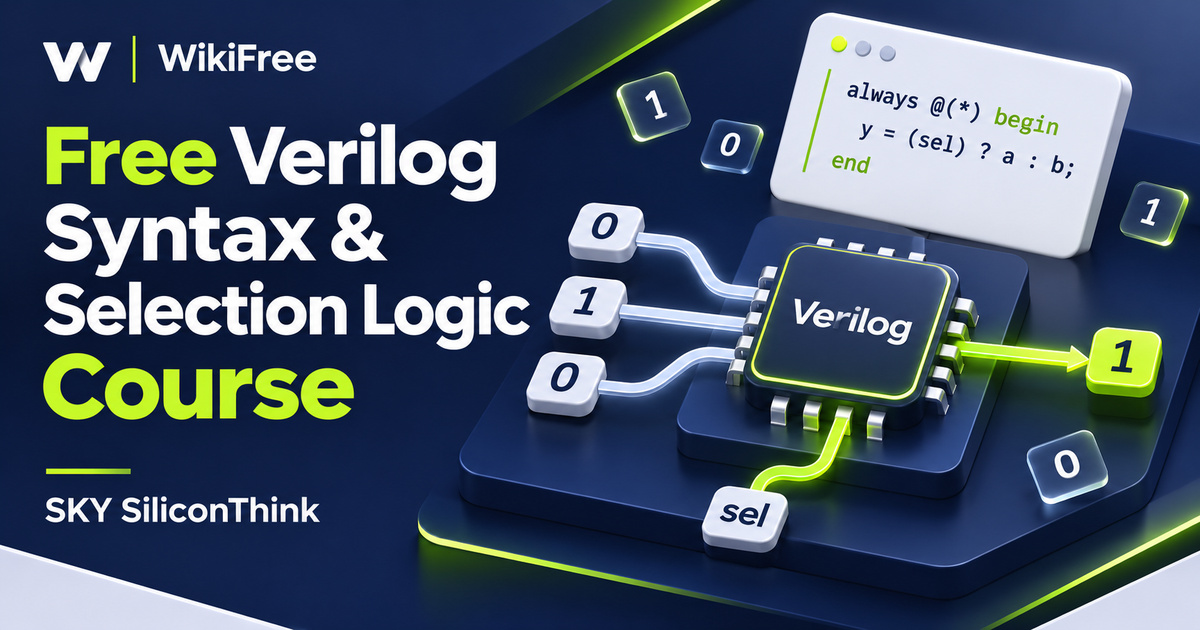
Listed as Free on Udemy when checked on 9 November 2026. No coupon or subscription trial is required for the listed lessons. Enrollment needs a Udemy account; availability can change.
About this course
A short hardware description can hide several important decisions: how wide a value is, whether it is signed, which input takes priority, and what an output does when no condition matches. This free Verilog course from SKY SiliconThink offers a focused place to study those decisions through declarations, operators, multiplexers, decoders, and sign extension.
The course is section P2-S3 of a larger digital IC and FPGA series. Its five listed videos total about one hour and fifty-five minutes, including an introduction and a short promotion for a separate DMA project. The substantial teaching concentrates on syntax and selection logic. Treat it as a targeted next step after an introduction to RTL, rather than a complete FPGA design program.
| Official course | VLSI/FPGA Design P2-S3: Verilog for Design and Verification |
|---|---|
| Created by | SKY SiliconThink |
| Platform | Udemy |
| Language | English |
| Level | Beginner |
| Listed duration | 114 minutes; 5 lectures across 1 section |
| Completion terms | Not included with a new free enrollment |
What you’ll learn
Explore declarations and operators, distinguish the roles of nets and variables, and follow examples involving vectors, arrays, concatenation, and bit selection. Study how if/else and case statements express selection behavior, then connect that reasoning to multiplexers, decoders, sign extension, and one-hot inputs. The aim is to relate source notation to the behavior you expect from a circuit.
Skills you’ll gain
- Verilog declarations
- Bit-width reasoning
- Selection logic
- Multiplexer modeling
- Signed-value interpretation
- Decoder analysis
Read expressions as hardware decisions
Knowing a symbol is only the beginning. When reviewing an expression, write down the width of each operand and the width of the destination before deciding what the result means. A value that fits one signal may lose information when assigned to a smaller one. Concatenation and bit selection are useful because they make the intended arrangement of bits visible, but they still require careful sizing.
Signedness deserves its own check. Extending a signed two’s-complement value can require copying its sign bit; extending an unsigned value generally involves adding zeros. The same bit pattern can represent different numbers under those interpretations. Do not assume that every wider assignment will preserve the number you had in mind, especially when expressions mix signed and unsigned operands.
Verilator’s width diagnostics provide useful feedback when practicing this reasoning. Its documentation discusses resizing values, selecting narrower portions, and explicitly widening expressions. A warning is a reason to inspect the intended relationship between signals. Simply hiding it does not explain the design or make a mistaken assumption correct.
Give every selection a clear meaning
An if/else chain asks a sequence of questions. The first satisfied condition determines the selected branch, so order matters when conditions overlap. A case statement offers another way to describe alternatives, but writing one does not automatically establish that all inputs are covered or that every output receives an assignment.
For combinational logic, check every output across every relevant path. An omitted assignment can preserve an earlier value and lead to unintended storage. A default branch helps express otherwise-unhandled inputs only when it assigns the outputs that need defined behavior. Think about invalid selections as deliberately as normal selections.
The public lesson summary also mentions full_case and parallel_case synthesis directives. These deserve caution rather than automatic adoption. Quartus documentation warns that assumptions conveyed by those directives can produce differences between functional simulation and synthesized behavior. Prefer clearly expressed, complete logic and verify any assumptions about mutually exclusive inputs; a one-hot expectation should not hide what happens when multiple bits are active.
Try a small selection exercise
As an independent practice activity, sketch a selector with four possible data inputs. List the select values, the expected output for each value, and the behavior you want for an invalid or unknown selection. Then compare how you would express the choices with an if/else chain and a case statement. Mark any place where branch order changes your interpretation.
Next, write down a small negative two’s-complement number and extend its representation on paper using both sign extension and zero extension. Compare the meanings rather than only the bit strings. These are editorial practice suggestions, not promised course assignments or a tested reference implementation. If you later simulate your own examples, compare the results against your written expectations and investigate discrepancies.
Choose the right starting point
Basic digital-logic knowledge and some C or C++ familiarity are the stated prerequisites. The lessons are in English, and the instructor recommends subtitles to help with speech clarity. This is introductory Verilog material, but it is more useful when terms such as gates, signals, and binary values are already familiar.
The recorded lessons are free to access through the listed course offer. Separate projects, commercial tools, and FPGA hardware are not included promises. Broader references to state machines, FIFOs, buses, and large projects describe the surrounding series; they should not be mistaken for the delivered syllabus of this particular section.
Review width diagnostics: Official Verilator guidance on expression widths and diagnostics.
Related courses for your next step
- Compare another hardware description languageFree VHDL Digital Circuits Course
Explore gates, adders and state machines using VHDL and Quartus.
Intermediate
- Extend your verification studiesFree SystemVerilog SOC Verification Course
Explore a broader introduction to testbench organization and verification.
Intermediate
Frequently asked questions
Is this the same course as the earlier Verilog logic section?
No. The introduction and closing promotion overlap, but the central lessons here address declarations, operators, selection statements, sign extension, and one-hot decoding. The earlier section focuses on initial models and simulation examples.
Do I need an FPGA board to begin?
You can begin by studying syntax, drawing selection tables, and reasoning about bits. Hardware and any separate software setup remain your responsibility; the listing does not promise a supplied board or complete hardware laboratory.
Does this include the advertised DMA project or a certificate?
The last video promotes a separate DMA project. This short section does not promise that full project, a qualification, or a certificate. Check the current enrollment offer for access details.
Questions & discussion
Share a useful question or correction. Comments appear after moderation. Please avoid personal or sensitive information.