Path 60 · The adoption bridge · Beginner
A launch date is not evidence of adoption.
A guided, practical route through change adoption planning.
What you will be able to do
Build an adoption plan with role-based support, a pilot, observable usage measures and a response to resistance grounded in actual barriers.
Plan about 7h 13m in total. Reading and practice are editorial estimates; video runtimes come from public provider metadata. Your pace will vary.
Table of Contents
Before you begin
Check your starting point
What you need
Basic team-work knowledge. No cloud account, paid deployment or employee monitoring is needed for the original exercise.
The selected public provider lessons are free to view. The original case can be completed with paper, a text editor or freely available local tools. Paid exams, certificates, subscriptions and optional provider software are not required for this project.
Completing this Coursya path does not award a provider certificate. Any provider assessment, account requirement or credential must be checked separately on its official page.
Three readiness questions
Does login prove successful adoption?
No. It shows access, not correct use.
Is resistance always unwillingness?
No. Capability, workload or workflow barriers may explain it.
Should a pilot have a decision rule?
Yes. State what evidence would justify expansion or revision.
Use a workable pace
At 5 hours per week, allow about 2 weeks. Start with Stage 1, continue in order and reserve 2h for the capstone. If a gate fails, use its repair step before advancing. At another weekly budget, divide 433 estimated minutes by your available weekly minutes and round up.
Keep a small evidence folder. A checked box means you reviewed your output; it is not a certificate or proof that a provider lesson was watched.
The working case
Access is not adoption
The fictional Elm Support Team is replacing a shared inbox with a request board. Twelve staff are expected to use the board. In a supplied pilot, nine log in, seven submit a request and five complete the new handoff correctly. The team must distinguish access, activity and successful use before declaring the change adopted.
| Pilot measure | People |
|---|---|
| Expected participants | 12 |
| Logged in | 9 |
| Submitted request | 7 |
| Completed handoff correctly | 5 |
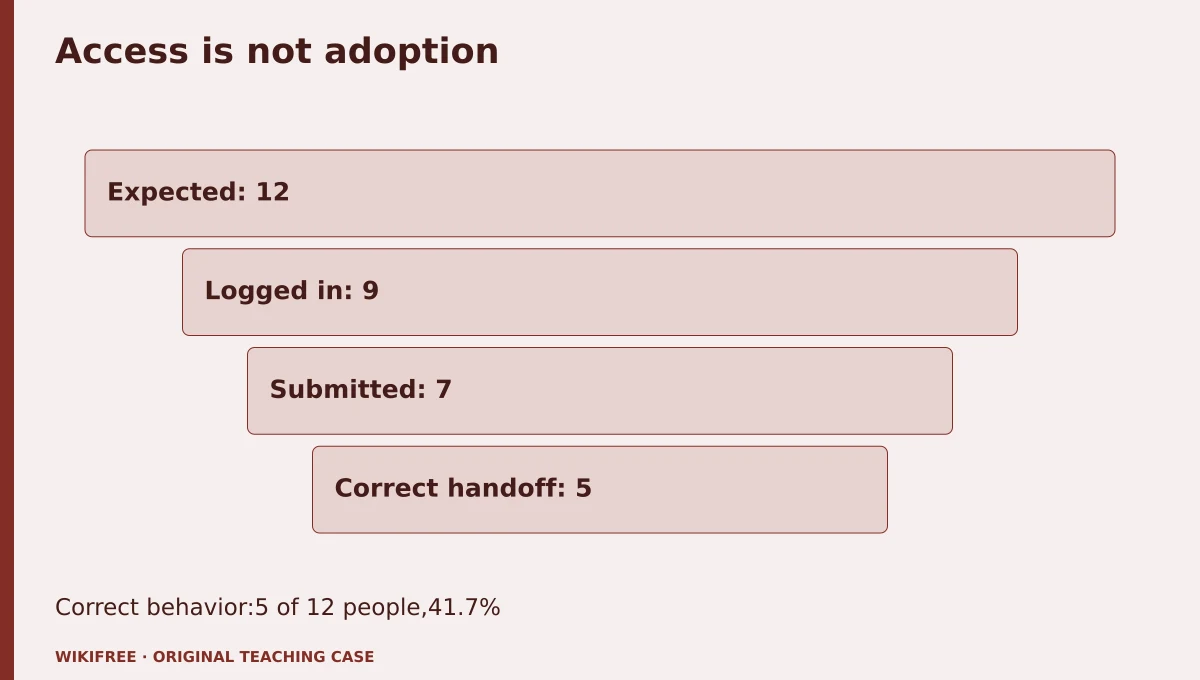
The table and explanations preserve the essential case information when the diagram is unavailable.
Your route
Five outputs, then a final handoff
- 01Define the behavior that changesRole-based change map
About 58m including assigned learning and practice. - 02Find barriers and supportAdoption support pack
About 1h 4m including assigned learning and practice. - 03Design a bounded pilotPilot plan and measurement definitions
About 1h 5m including assigned learning and practice. - 04Interpret the adoption funnelAdoption funnel and diagnostic questions
About 1h 5m including assigned learning and practice. - 05Revise and sustainAdoption revision and sustainment plan
About 1h 2m including assigned learning and practice. - FINALCapstone reviewCombine the evidence into one inspectable handoff.
About 2h .
0 of 6 outputs checked. JavaScript adds browser-only progress saving.
The complete lesson and all downloads remain available. Use the printable project workbook to track your progress.
Use the minimum useful source material
The courses behind this route
Management Courses
Managing Workplace Teams: Free Course
Published team-change and team-learning lessons support the people side of adoption.
Selected material only; this path does not claim completion of the entire provider course.
Free People Management Course: Coaching and Team Leadership
The manager-support lesson helps distinguish practical assistance from a launch announcement.
Selected material only; this path does not claim completion of the entire provider course.
Course publication and selected public lesson metadata were checked on 13 October 2026. This is not a claim of full video playback, provider-course completion or permanent availability. Recheck the linked source if a lesson changes.
Learn, make, inspect
The five-stage workshop
Define the behavior that changes
Video 7m · reading budget 0m · original practice about 50m.
A change plan starts with the work people will do differently. State the current and intended behavior for each role and explain why the change matters. Announcing a tool is not the same as describing a useful new workflow. Identify what stops, what starts and which existing practice remains valuable.
Watch these selected lessons
Do the work
Write current-to-future behaviors for requesters, triage staff and the handoff owner.
Save this output
Role-based change map
Pass the review gate
Each role has a concrete behavior and a reason for the change.
If you need another attempt
Replace adopt the platform with the specific action needed in the work process.
Find barriers and support
Video 4m · reading budget 0m · original practice about 1h .
Support should address the barrier rather than assume a motivation problem. A person may lack access, confidence, time or a clear rule for exceptions. Ask what makes the new behavior difficult and offer proportionate help. Use the smallest useful support artifact so staff can find it during the task, not only during training.
Watch these selected lessons
Do the work
Create a barrier/support table and a one-page handoff job aid with an exception route.
Save this output
Adoption support pack
Pass the review gate
The pack distinguishes access, skill and process barriers and names a support owner.
If you need another attempt
Do not prescribe another training session when the actual barrier is missing access.
Design a bounded pilot
Video 0m · reading budget 0m · original practice about 1h 5m.
A pilot tests a change under stated conditions before broader commitment. Define participants, duration, support and success measures in advance. Collect only the work evidence needed for the learning question and label synthetic records honestly. The original exercise is a planning simulation, not a live rollout or permission to monitor employees.
Original application stage. Use your preceding outputs and the supplied case; there is no additional required provider lesson.
Do the work
Write a two-week pilot plan with a correct-handoff definition and an expansion or revise rule.
Save this output
Pilot plan and measurement definitions
Pass the review gate
The rule uses correct handoffs rather than login count alone.
If you need another attempt
Specify what a reviewer would inspect to decide that a handoff was correct.
Interpret the adoption funnel
Video 0m · reading budget 0m · original practice about 1h 5m.
Different measures answer different questions. Nine of twelve log in, but only five of twelve complete the target behavior correctly. That is 75% access activity and 41.7% correct completion in the supplied sample. Inspect where the process breaks before deciding whether communications, access, instructions or workflow design should change.
Original application stage. Use your preceding outputs and the supplied case; there is no additional required provider lesson.
Do the work
Calculate each step as a proportion of 12 and the conversion from submitted request to correct handoff.
Save this output
Adoption funnel and diagnostic questions
Pass the review gate
Rates are 75%,58.3%,41.7%; correct handoffs among submitters are 5/7=71.4%.
If you need another attempt
Keep the denominator beside the percentage so measures are not confused.
Revise and sustain
Video 6m · reading budget 0m · original practice about 55m.
An adoption review should feed into the next support decision. Preserve practices that help, revise the observed bottleneck and assign ownership after the pilot. A new workflow may need reinforcement and exceptions, not a one-time launch message. Record what you changed and how the next review will tell whether it helped.
Watch these selected lessons
Do the work
Write a review memo proposing one improvement at the handoff step and a follow-up measure.
Save this output
Adoption revision and sustainment plan
Pass the review gate
The proposed change addresses evidence from the funnel and keeps its result unclaimed until checked.
If you need another attempt
Do not announce full adoption while fewer than half the pilot group completes the target behavior.
Make the result inspectable
Your final project
Deliver the role map, barrier/support pack, pilot protocol, calculations and revision memo. Add a scenario where all 12 log in but correct handoffs remain five, and explain why the success decision should not change.
The ZIP includes synthetic input data, a project workbook, worked reference, evidence log, scoring rubric and case-specific materials. Code projects include source and clearly stated local execution requirements.
Use one consistent rubric
| Criterion | Maximum | Evidence |
|---|---|---|
| Evidence and correctness | 30 | Calculations, source use and results match the supplied case; limitations are honest. |
| Required artifacts | 30 | All five stage outputs and the capstone handoff are present and inspectable. |
| Reasoning and decisions | 20 | Choices, assumptions, alternatives and the case-specific critical condition are explained. |
| Reproducibility | 10 | A reviewer can follow the stated steps and distinguish expected from observed results. |
| Clear communication | 10 | Labels, units, structure and evidence references make the work easy to review. |
Score at least 80/100, supply every required artifact, and satisfy the path-specific critical condition. Rework missing evidence before marking complete.
The critical condition
Successful adoption is tied to the defined work behavior, and no unobserved rollout result is invented.
Compare with a worked reference
The pilot shows 9/12=75% login,7/12=58.3% request submission and 5/12=41.7% correct handoff. Among submitters,5/7=71.4% complete the handoff correctly. These measures suggest where to investigate; they do not identify a cause without more evidence.
Know the boundary
This is a small team adoption plan, not a live cloud migration or a claim that one change model fits every organization.
Questions before you finish
Do I need to finish every source course?
No. This path names selected lessons or reading sections. Complete the full provider course only if it supports your wider goal. The path does not claim equivalence to that course.
How do I know when to advance?
Use the output and review gate in each stage. If evidence is missing or a result conflicts with the case, follow the repair step and retry before advancing.
Can I do the project without paid software?
The selected public provider lessons are free to view. The original case can be completed with paper, a text editor or freely available local tools. Paid exams, certificates, subscriptions and optional provider software are not required for this project.
What does my checklist prove?
It records your own review in this browser only. It does not verify viewing, skill, a provider credential or a real-world deployment.
What if a lesson or tool changes?
Use the linked course and provider page to inspect current availability. Record the change and revisit the relevant assignment; do not invent a replacement lesson or claim an unavailable activity was completed.
Questions & discussion
Share a useful question or correction. Comments appear after moderation. Please avoid personal or sensitive information.