Path 71 · The confusion-matrix lab · Intermediate
Count the errors that the headline hides.
A guided, practical route through classification evaluation.
What you will be able to do
Evaluate a binary classifier with a confusion matrix, precision, recall and a decision-cost comparison.
Plan about 8h 15m in total. Reading and practice are editorial estimates; video runtimes come from public provider metadata. Your pace will vary.
Table of Contents
Before you begin
Check your starting point
What you need
Basic Python and fractions. The supplied labels are synthetic and require no model training or paid API.
The selected public provider lessons are free to view. The original case can be completed with paper, a text editor or freely available local tools. Paid exams, certificates, subscriptions and optional provider software are not required for this project.
Completing this Coursya path does not award a provider certificate. Any provider assessment, account requirement or credential must be checked separately on its official page.
Three readiness questions
Does accuracy alone describe the error trade-off?
No.
What is recall?
TP divided by TP plus FN.
Can a threshold choice be made without considering costs?
It can be arbitrary; the decision context matters.
Use a workable pace
At 5 hours per week, allow about 2 weeks. Start with Stage 1, continue in order and reserve 2h for the capstone. If a gate fails, use its repair step before advancing. At another weekly budget, divide 495 estimated minutes by your available weekly minutes and round up.
Keep a small evidence folder. A checked box means you reviewed your output; it is not a certificate or proof that a provider lesson was watched.
The working case
Candidate A: the four outcomes
A fictional system flags help requests for manual review. On a labeled sample of 100 requests it produces 18 true positives, 12 false positives, 6 false negatives and 64 true negatives. A second candidate produces 22, 20, 2 and 56 respectively. No classifier is deployed by this exercise.
| Candidate | TP | FP | FN | TN |
|---|---|---|---|---|
| A | 18 | 12 | 6 | 64 |
| B | 22 | 20 | 2 | 56 |
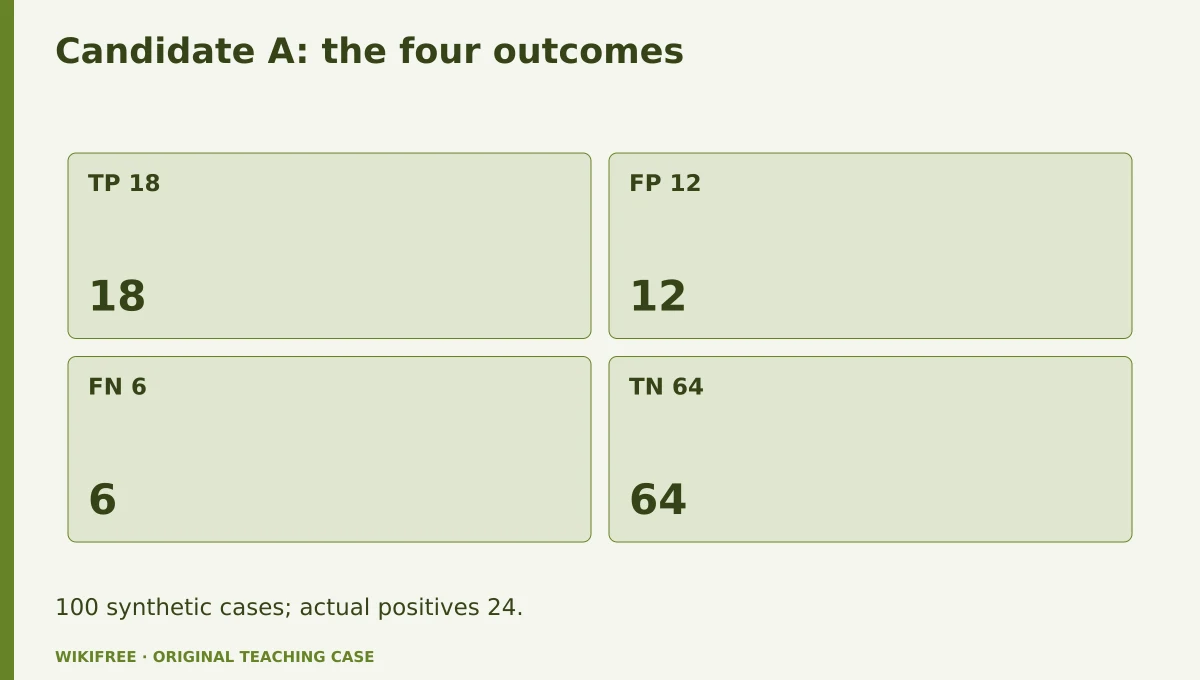
The table and explanations preserve the essential case information when the diagram is unavailable.
Your route
Five outputs, then a final handoff
- 01Define the positive classEvaluation contract
About 1h 25m including assigned learning and practice. - 02Calculate complementary metricsMetric table
About 1h 50m including assigned learning and practice. - 03Compare decision costsCost comparison
About 1h 5m including assigned learning and practice. - 04Inspect uncertainty and slicesEvaluation extension plan
About 1h including assigned learning and practice. - 05Write a bounded recommendationDecision report
About 55m including assigned learning and practice. - FINALCapstone reviewCombine the evidence into one inspectable handoff.
About 2h .
0 of 6 outputs checked. JavaScript adds browser-only progress saving.
The complete lesson and all downloads remain available. Use the printable project workbook to track your progress.
Use the minimum useful source material
The courses behind this route
Machine Learning Crash Course
The published Google ML Crash Course has public classification material covering the exact metrics used here.
Selected material only; this path does not claim completion of the entire provider course.
Course publication and selected public lesson metadata were checked on 13 October 2026. This is not a claim of full video playback, provider-course completion or permanent availability. Recheck the linked source if a lesson changes.
Learn, make, inspect
The five-stage workshop
Define the positive class
Video 0m · reading budget 35m · original practice about 50m.
Positive means the condition your evaluation counts as the target, not a favorable outcome. Define the target and label source before counting errors. Keep a held-out evaluation sample separate from training decisions. This exercise starts with aggregate counts, so it cannot inspect individual label quality or data leakage.
Assigned reading
Machine Learning Crash Course: Classification: thresholds and the confusion matrix.
Use the named provider navigation sections. Editorial reading budget for the named public material; not a verified completion duration
Do the work
Write the positive-class definition and reconstruct each 2 × 2 matrix.
Save this output
Evaluation contract
Pass the review gate
Both matrices contain 100 cases and 24 actual positives.
If you need another attempt
Sum by actual class before interpreting predictions.
Calculate complementary metrics
Video 0m · reading budget 40m · original practice about 1h 10m.
Precision asks how many flagged cases are true positives; recall asks how many actual positives are found. Their denominators differ. A zero denominator needs an explicit policy rather than a silent division failure. Report counts alongside rates to keep the sample size visible.
Assigned reading
Machine Learning Crash Course: Classification: accuracy, recall, precision and related metrics.
Use the named provider navigation sections. Editorial reading budget for the named public material; not a verified completion duration
Do the work
Calculate accuracy, precision, recall and F1 for candidate A.
Save this output
Metric table
Pass the review gate
A has accuracy 82%, precision 60%, recall 75% and F1 about 66.67%.
If you need another attempt
Write each fraction using the four cell counts.
Compare decision costs
Video 0m · reading budget 0m · original practice about 1h 5m.
A cost model translates the trade-off into the case objective. Here assign 1 review unit to each false positive and 5 missed-case units to each false negative. These are hypothetical teaching costs, not universal weights. Do not add costs for correct predictions unless the model defines them.
Original application stage. Use your preceding outputs and the supplied case; there is no additional required provider lesson.
Do the work
Calculate error cost for both candidates and compare with accuracy.
Save this output
Cost comparison
Pass the review gate
A costs 42 units; B costs 30 even though B accuracy is 78%.
If you need another attempt
Keep the cost assumptions next to the recommendation.
Inspect uncertainty and slices
Video 0m · reading budget 0m · original practice about 1h .
Aggregate metrics can hide weak performance on a subgroup or changed data. This tiny sample does not establish long-run reliability. Specify useful slices and minimum evidence before comparison, while avoiding conclusions about groups for which no counts exist. A repeated evaluation needs consistent definitions and versioned labels.
Original application stage. Use your preceding outputs and the supplied case; there is no additional required provider lesson.
Do the work
Draft a slice-evaluation table with no invented slice results.
Save this output
Evaluation extension plan
Pass the review gate
Every unmeasured slice is marked not evaluated.
If you need another attempt
Replace guessed subgroup values with a data request.
Write a bounded recommendation
Video 0m · reading budget 0m · original practice about 55m.
A model choice is conditional on the objective, label quality and evaluation sample. State which candidate is preferable under the supplied cost rule and what would trigger reconsideration. Distinguish the evaluated candidate from any production decision; the exercise provides no deployment, human review capacity or monitoring evidence.
Original application stage. Use your preceding outputs and the supplied case; there is no additional required provider lesson.
Do the work
Write a one-page evaluation report with a cost-sensitivity question.
Save this output
Decision report
Pass the review gate
The report recommends B only under the stated case costs.
If you need another attempt
Add the assumptions that would make the recommendation change.
Make the result inspectable
Your final project
Deliver the matrices, metric calculator, cost comparison, zero-denominator policy and bounded report. Test a no-positive-prediction case and explain the chosen output for undefined precision.
The ZIP includes synthetic input data, a project workbook, worked reference, evidence log, scoring rubric and case-specific materials. Code projects include source and clearly stated local execution requirements.
Use one consistent rubric
| Criterion | Maximum | Evidence |
|---|---|---|
| Evidence and correctness | 30 | Calculations, source use and results match the supplied case; limitations are honest. |
| Required artifacts | 30 | All five stage outputs and the capstone handoff are present and inspectable. |
| Reasoning and decisions | 20 | Choices, assumptions, alternatives and the case-specific critical condition are explained. |
| Reproducibility | 10 | A reviewer can follow the stated steps and distinguish expected from observed results. |
| Clear communication | 10 | Labels, units, structure and evidence references make the work easy to review. |
Score at least 80/100, supply every required artifact, and satisfy the path-specific critical condition. Rework missing evidence before marking complete.
The critical condition
Metric denominators and the positive class are explicit; no unmeasured slice or deployment outcome is claimed.
Compare with a worked reference
Candidate A: precision 18/30 = 60%, recall 18/24 = 75%, F1 = 36/54 ≈ 66.67%. Its error cost is 12 + 5×6 = 42. Candidate B costs 20 + 5×2 = 30. Lower accuracy does not automatically mean worse utility under this cost rule.
Know the boundary
This evaluates supplied counts, not a trained or deployed model, and does not establish causal fairness.
Questions before you finish
Do I need to finish every source course?
No. This path names selected lessons or reading sections. Complete the full provider course only if it supports your wider goal. The path does not claim equivalence to that course.
How do I know when to advance?
Use the output and review gate in each stage. If evidence is missing or a result conflicts with the case, follow the repair step and retry before advancing.
Can I do the project without paid software?
The selected public provider lessons are free to view. The original case can be completed with paper, a text editor or freely available local tools. Paid exams, certificates, subscriptions and optional provider software are not required for this project.
What does my checklist prove?
It records your own review in this browser only. It does not verify viewing, skill, a provider credential or a real-world deployment.
What if a lesson or tool changes?
Use the linked course and provider page to inspect current availability. Record the change and revisit the relevant assignment; do not invent a replacement lesson or claim an unavailable activity was completed.
Questions & discussion
Share a useful question or correction. Comments appear after moderation. Please avoid personal or sensitive information.