Coursya learning path 42 · Beginner
The editorial newsroom
Build an editorial system around a useful question.
Create a four-week content plan, one original anchor article, two adaptations and a measurement brief for a small educational project.
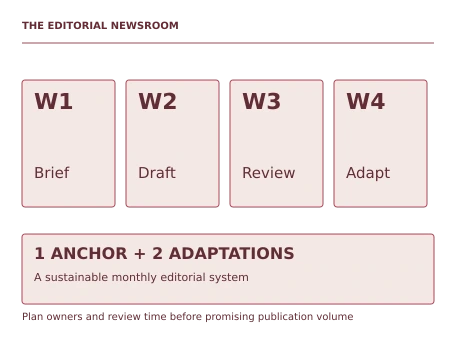
Video duration uses the selected lessons only. Reading and practice times are planning estimates; repeat difficult work as needed.
Table of Contents
A clear starting point
Who this is for
Basic English writing. A free HubSpot Academy account is needed to access assigned academy lessons; a text editor or spreadsheet is sufficient for practice.
Your practical result
Create a four-week content plan, one original anchor article, two adaptations and a measurement brief for a small educational project.
Only selected academy lessons are assigned; completing this Coursya project does not itself earn the provider certification or represent completion of the full academy course.
Access and cost
HubSpot Academy offers free course access with an account. The full course is listed as 14 lessons and 8h 23m; this path assigns selected lessons totaling 3h 24m plus selected public Google videos. Provider certification requirements are separate.
The project pack contains an original workbook, case inputs, an evidence log and reference notes. Some technical paths include starter code and a runnable reference. Read the pack README before starting.
Three-minute readiness check
Answer first, then open each explanation. A missed answer identifies what to revisit; it does not stop you from starting.
Is every channel copy identical?
No. Adapt format and context while preserving the useful idea.
Is publishing volume the same as impact?
No.
Can you invent customer quotes for a story?
No. Use clearly labeled fictional examples or real permissioned evidence.
The case you will work on
The fictional Oak Skills Club wants to help adults choose a first weekend learning project. Its audience needs a realistic outcome, time estimate and a low-cost way to begin. The team can produce one substantial article and two small adaptations per month.
| Constraint | Planning consequence |
|---|---|
| One anchor article | Choose a reusable core question |
| Two adaptations | Use distinct formats for distinct contexts |
| Four-week cycle | Assign owners and review dates |
| Small team | Keep the plan within capacity |
These are supplied synthetic inputs, not observations from a real organization. Label assumptions and any additional data you create.
Keep an evidence trail
Save each stage output in the project folder. In evidence_log.csv, record the decision, the artifact or test that supports it, what failed, and the revision you made.
Your route from learning to evidence
- Stage 1Choose an audience storyAn audience and story brief.60 minutes of original practice
- Stage 2Create a sustainable editorial planA capacity-aware editorial calendar.80 minutes of original practice
- Stage 3Write the anchor articleAn original anchor article.120 minutes of original practice
- Stage 4Adapt without duplicating blindlyTwo purposeful content adaptations.80 minutes of original practice
- Stage 5Define a useful reviewA content measurement and iteration brief.60 minutes of original practice
- Final projectMake the evidence reviewableConnect the five stage outputs and test a change.240 minutes estimated
Progress stays in this browser. Tick a stage only after its evidence check passes. This is a personal checklist, not a certificate.
Why these source courses
The path uses selected material from courses already published on Coursya. The original exercises below connect that material to one practical outcome. Follow only the listed assignments; completing the full source courses is optional.
HubSpot
Free Content Marketing Certification Course from HubSpot
HubSpot Academy supplies selected storytelling, planning, writing and repurposing lessons; free account access is required.
Access: Free official learning route. Account and tool requirements are explained in the article.
Certificate: Free HubSpot Academy certification, badge and certificate after completing the course requirements and passing the exam. No degree/credit or guaranteed search/traffic outcome.
Free Digital Marketing and E-commerce Course by Google
Two public Google lessons support measurement and communicating results.
Access: Free Video
Certificate: Free video viewing; a Google certificate is not included
Learn it, apply it, check it
Work in order. Every stage produces something the next stage uses. Revisit the repair instruction when a check fails.
Choose an audience story
Basic English writing. A free HubSpot Academy account is needed to access assigned academy lessons; a text editor or spreadsheet is sufficient for practice.
The idea to use
A useful content story connects a reader problem, a practical change and credible evidence. Our fictional club should show how a small project can produce a tangible result without promising a career transformation. Identify the audience situation and the question the anchor article will resolve. Keep invented examples visibly fictional.
Watch with a purpose
Course introduction and business storytelling lessons
40 minutes · Sum of provider-listed lesson durations. Open the provider resource.
Your 60-minute lab
Write the audience brief, central question and a short story outline with an honest outcome.
Save: An audience and story brief..
Evidence check
The promised result is achievable within the planned project and contains no invented testimonial.
If it fails: Replace vague inspiration with a concrete task the reader can complete.
Create a sustainable editorial plan
Bring your previous output: An audience and story brief.
The idea to use
A content workflow needs an idea, owner, draft, review and publication decision. Plan around the team capacity rather than filling every day with a new asset. Reuse research and examples deliberately, and reserve time for checking facts and updating links. A four-week plan should make dependencies and review responsibilities visible.
Watch with a purpose
Content creation framework and long-term planning lessons
68 minutes · Sum of provider-listed lesson durations. Open the provider resource.
Your 80-minute lab
Create a four-week calendar for one article and two adaptations, including briefing, drafting, review and measurement.
Save: A capacity-aware editorial calendar..
Evidence check
The plan fits the stated production limit and every asset has an owner and review step.
If it fails: Do not count an adaptation as effortless; allocate its own writing and review time.
Write the anchor article
Bring your previous output: A capacity-aware editorial calendar.
The idea to use
Start with the reader question and organize the article around useful decisions. Add an original example, a practical checklist and a next step that fits the promise. A draft should stand on its own before promotion is planned. Check factual claims and distinguish your original exercise from provider teaching material; copying a lesson transcript is not content creation.
Watch with a purpose
Creating quality blog content lesson
52 minutes · Provider-listed lesson duration. Open the provider resource.
Your 120-minute lab
Write a 700–900 word guide to choosing a small weekend project. Include three concrete project options and a selection checklist.
Save: An original anchor article..
Evidence check
The article answers the brief, contains a usable checklist and attributes any outside facts.
If it fails: If the draft is mostly general encouragement, add specific outputs, time assumptions and examples.
Adapt without duplicating blindly
Bring your previous output: An original anchor article.
The idea to use
An adaptation serves a different reading context. A short email can highlight one decision and link to the guide; a checklist can help a learner act without rereading the full article. Preserve factual meaning while changing structure and emphasis. Keep a source-of-truth note so updates to the anchor propagate to its adaptations.
Watch with a purpose
Repurposing content lesson
44 minutes · Provider-listed lesson duration. Open the provider resource.
Your 80-minute lab
Create a 150-word email draft and a one-page checklist from the anchor article. Add an update dependency note.
Save: Two purposeful content adaptations..
Evidence check
Both remain accurate, stand in their intended context and have a clear next action.
If it fails: Do not cut random paragraphs until the word count fits; choose the job of each format.
Define a useful review
Bring your previous output: Two purposeful content adaptations.
The idea to use
Choose signals that connect the content to its intended use: qualified visits, checklist use and completed practice feedback, if actually observable. Define each denominator and the review period. A small pilot can reveal confusing sections even before traffic is large. Keep proposed metrics separate from actual collected results and record what you cannot measure yet.
Watch the selected lessons
- 20. Measure the success of marketing campaigns18:31
- 21. Share metrics and insights with stakeholders29:47
Selected video time: 48m. Open this course on Coursya.
Your 60-minute lab
Write a monthly review template and a two-question reader-feedback prompt. Set one improvement decision the evidence could support.
Save: A content measurement and iteration brief..
Evidence check
Metrics have definitions and no performance number is presented as real unless measured.
If it fails: Replace vanity totals with a question about whether the content helped the reader act.
A worked reference to compare
One anchor guide can support an email that helps a reader choose a project and a checklist that helps them start it. The plan is credible only if the same small team has time to review all three assets and update them together.
Compare your reasoning as well as the result. If your answer differs, state the assumption or input that explains the difference. Reference notes are for checking after an attempt; copying them is not evidence of independent work.
Your final project
Your brief
Deliver the brief, four-week calendar, anchor article, email, checklist and review template. Simulate a changed project-time estimate and show which three assets must be updated.
Time box: 4h 00m estimated. Extend it if a gate needs repair.
Hand in these artifacts
- An audience and story brief.
- A capacity-aware editorial calendar.
- An original anchor article.
- Two purposeful content adaptations.
- A content measurement and iteration brief.
- A short README: outcome, how to inspect or run the work, assumptions and limitations.
- A before-and-after change test and the completed evidence log.
Run a final review
- Use the supplied reference to reconcile the baseline result.
- Choose one relevant input or constraint to change. Write your expected effect before testing it.
- Run the calculation, walkthrough or test again and save the actual result.
- Ask a peer to inspect the evidence, or perform a separate self-review. Label which review you used.
- Score the work using the rubric and repair every critical failure.
Review rubric · 100 points
| Criterion | Points | Evidence to inspect |
|---|---|---|
| Practical outcome and case reasoning | 25 | Create a four-week content plan, one original anchor article, two adaptations and a measurement brief for a small educational project. |
| Five stage checks | 30 | Award 6 points for each stage only when its stated gate is demonstrably met. |
| Traceable evidence | 20 | Artifacts, inputs and calculations or tests are reproducible; synthetic and simulated evidence is labelled. |
| Revision after a changed condition | 15 | Change one input or constraint, predict the effect, test it and record the result. |
| Handoff quality | 10 | A reviewer can find the files, follow the instructions and understand the remaining limitations. |
Completion target: at least 80/100, all five stage gates passed, and every critical issue below corrected. This is a learning benchmark, not an accredited qualification.
Critical issue: The content is original, the production plan fits capacity and claims and fictional examples are labeled honestly.
Optional practice: connect the message to the next action
After completing your audience and content brief, use Distinctive Content Marketing: Message and Action for a short practical writing exercise. Focus on the wording you can explain and test against the brief.
- Write a headline, an opening paragraph and one call to action for the same audience and offer.
- Create a second version that changes the wording while keeping the factual claim and promised outcome consistent.
- Review both versions for audience fit, supported claims and a clear next step. Ask a reader to explain the offer back to you.
Finish when: the reader understands what is offered and what the action leads to. Keep the reviewed copy with your brief and note which uncertainty would need audience research or a properly designed test. The exercise improves clarity; it does not demonstrate a conversion increase.
Optional course access checked on 4 November 2026: the provider listed the course as free. Confirm the current terms before enrolling. This extension is outside the core path’s time estimate.
Before you go further
What will I be able to produce?
Create a four-week content plan, one original anchor article, two adaptations and a measurement brief for a small educational project.
Is the whole path free?
HubSpot Academy offers free course access with an account. The full course is listed as 14 lessons and 8h 23m; this path assigns selected lessons totaling 3h 24m plus selected public Google videos. Provider certification requirements are separate.
Do I need to finish every source course?
No. Follow the selected assignments at each stage. Source courses provide context, while the original case, labs and final review build the practical result. Extra study is optional.
What counts as completion?
Complete all five stage checks, earn at least 80/100 on the final rubric and correct every critical issue. Only selected academy lessons are assigned; completing this Coursya project does not itself earn the provider certification or represent completion of the full academy course.
Questions & discussion
Share a useful question or correction. Comments appear after moderation. Please avoid personal or sensitive information.