Path 84 · The build gate · Intermediate
Make a failed check stop the handoff.
A guided, practical route through continuous integration.
What you will be able to do
Create a local CI-style pipeline that runs checks, produces an artifact only after success and records the exact source revision.
Plan about 7h 56m in total. Reading and practice are editorial estimates; video runtimes come from public provider metadata. Your pace will vary.
Table of Contents
Before you begin
Check your starting point
What you need
Basic Git, shell and Python. No hosted CI account or deployment credentials are needed.
The selected public provider lessons are free to view. The original case can be completed with paper, a text editor or freely available local tools. Paid exams, certificates, subscriptions and optional provider software are not required for this project.
Completing this Coursya path does not award a provider certificate. Any provider assessment, account requirement or credential must be checked separately on its official page.
Three readiness questions
Is continuous delivery identical to automatic deployment?
No.
Should packaging continue after a failed test?
Not under this pipeline contract.
Why record a revision?
To connect an artifact with the source that produced it.
Use a workable pace
At 5 hours per week, allow about 2 weeks. Start with Stage 1, continue in order and reserve 2h for the capstone. If a gate fails, use its repair step before advancing. At another weekly budget, divide 476 estimated minutes by your available weekly minutes and round up.
Keep a small evidence folder. A checked box means you reviewed your output; it is not a certificate or proof that a provider lesson was watched.
The working case
Three gates before an artifact
A fictional calculator project has three gates: syntax, unit checks and package creation. The artifact must not be produced if a required check fails. The exercise runs locally and provides an optional workflow sketch; it does not configure a remote repository.
| Gate | Required outcome |
|---|---|
| Syntax | valid Python |
| Behavior | all assertions pass |
| Package | created only after success |
| Revision | recorded in report |
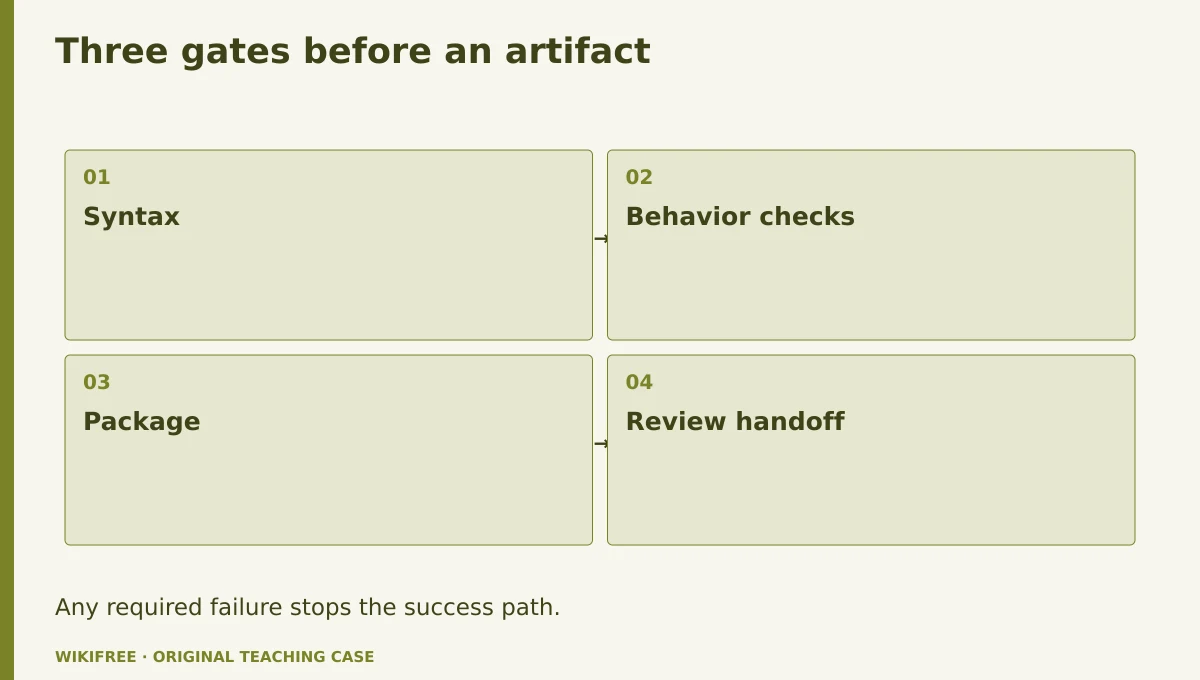
The table and explanations preserve the essential case information when the diagram is unavailable.
Your route
Five outputs, then a final handoff
- 01Define the integration contractPipeline contract
About 1h 9m including assigned learning and practice. - 02Create a meaningful behavior checkBehavior check evidence
About 1h 15m including assigned learning and practice. - 03Chain the gates safelyPipeline runner
About 1h 20m including assigned learning and practice. - 04Distinguish delivery from deploymentDelivery boundary note
About 1h 7m including assigned learning and practice. - 05Reproduce the resultTwo-run verification record
About 1h 5m including assigned learning and practice. - FINALCapstone reviewCombine the evidence into one inspectable handoff.
About 2h .
0 of 6 outputs checked. JavaScript adds browser-only progress saving.
The complete lesson and all downloads remain available. Use the printable project workbook to track your progress.
Use the minimum useful source material
The courses behind this route
IBM
Free DevOps Course: CI/CD, SRE and Infrastructure as Code
The IBM CI, testing, delivery and deployment lessons support the pipeline boundaries used here.
Selected material only; this path does not claim completion of the entire provider course.
Course publication and selected public lesson metadata were checked on 13 October 2026. This is not a claim of full video playback, provider-course completion or permanent availability. Recheck the linked source if a lesson changes.
Learn, make, inspect
The five-stage workshop
Define the integration contract
Video 14m · reading budget 0m · original practice about 55m.
Continuous integration makes frequent changes subject to repeatable checks. Choose checks that catch meaningful errors and define what blocks the pipeline. A green signal only covers the checks that actually ran. This case focuses on a local repeatable build, not a claim that a hosted service has been installed.
Watch these selected lessons
Do the work
Write the three gates and their failure behavior.
Save this output
Pipeline contract
Pass the review gate
Required gates cannot be skipped while reporting success.
If you need another attempt
Name the actual checks instead of a generic quality passed label.
Create a meaningful behavior check
Video 0m · reading budget 0m · original practice about 1h 15m.
A useful test compares behavior against a requirement. The sample function calculates a nonnegative seat total and rejects invalid counts. Include a boundary and an invalid case so the check can detect a real defect. Avoid testing only that a file exists or that the program prints a success message.
Original application stage. Use your preceding outputs and the supplied case; there is no additional required provider lesson.
Do the work
Run the sample tests and introduce a defect that one catches.
Save this output
Behavior check evidence
Pass the review gate
The intentional defect makes the process exit nonzero.
If you need another attempt
Choose a requirement the defect violates.
Chain the gates safely
Video 0m · reading budget 0m · original practice about 1h 20m.
Use explicit failure handling so a failed command stops the pipeline. Build outputs in a separate directory and record the source revision when available. A run outside Git should say revision unavailable rather than invent a commit hash. Do not let stale artifacts make a failed run appear successful.
Original application stage. Use your preceding outputs and the supplied case; there is no additional required provider lesson.
Do the work
Implement the local runner and a manifest for a successful artifact.
Save this output
Pipeline runner
Pass the review gate
A fresh failed run produces no success artifact.
If you need another attempt
Clear only the task-owned output path or use a new run directory.
Distinguish delivery from deployment
Video 11m · reading budget 0m · original practice about 55m.
An artifact ready for review is different from a change running in production. A later deployment needs its own environment, permissions and verification. The exercise stops at packaging. Explain what would need approval and what can remain automatic in a real workflow without embedding credentials in the project.
Watch these selected lessons
Do the work
Write a handoff note describing the boundary after packaging.
Save this output
Delivery boundary note
Pass the review gate
No cloud deployment or remote workflow run is claimed.
If you need another attempt
Label the optional workflow as a template until it actually runs.
Reproduce the result
Video 0m · reading budget 0m · original practice about 1h 5m.
Run from a clean copy and compare the report with the source and artifact. Save the actual command exit status and outputs. Reproducibility also needs dependency information; this case uses Python’s standard library to keep that burden small. A reviewer should be able to make the same deliberate failure occur.
Original application stage. Use your preceding outputs and the supplied case; there is no additional required provider lesson.
Do the work
Perform one passing and one intentionally failing run.
Save this output
Two-run verification record
Pass the review gate
The success and failure reports are distinguishable and correctly linked to their inputs.
If you need another attempt
Do not overwrite a failed report with a later success.
Make the result inspectable
Your final project
Deliver the project, local runner, successful artifact manifest and intentional-failure evidence. Explain which checks a future hosted pipeline should run unchanged.
The ZIP includes synthetic input data, a project workbook, worked reference, evidence log, scoring rubric and case-specific materials. Code projects include source and clearly stated local execution requirements.
Use one consistent rubric
| Criterion | Maximum | Evidence |
|---|---|---|
| Evidence and correctness | 30 | Calculations, source use and results match the supplied case; limitations are honest. |
| Required artifacts | 30 | All five stage outputs and the capstone handoff are present and inspectable. |
| Reasoning and decisions | 20 | Choices, assumptions, alternatives and the case-specific critical condition are explained. |
| Reproducibility | 10 | A reviewer can follow the stated steps and distinguish expected from observed results. |
| Clear communication | 10 | Labels, units, structure and evidence references make the work easy to review. |
Score at least 80/100, supply every required artifact, and satisfy the path-specific critical condition. Rework missing evidence before marking complete.
The critical condition
No successful artifact is reported after a required check fails, and remote execution is not invented.
Compare with a worked reference
The contract is syntax → behavior → package. If behavior fails, package is not reached. The reference runner records commands and statuses; it demonstrates local CI mechanics without claiming a GitHub Actions, Jenkins or other hosted run.
Know the boundary
This is a local integration workflow, not a configured hosted runner or production deployment.
Questions before you finish
Do I need to finish every source course?
No. This path names selected lessons or reading sections. Complete the full provider course only if it supports your wider goal. The path does not claim equivalence to that course.
How do I know when to advance?
Use the output and review gate in each stage. If evidence is missing or a result conflicts with the case, follow the repair step and retry before advancing.
Can I do the project without paid software?
The selected public provider lessons are free to view. The original case can be completed with paper, a text editor or freely available local tools. Paid exams, certificates, subscriptions and optional provider software are not required for this project.
What does my checklist prove?
It records your own review in this browser only. It does not verify viewing, skill, a provider credential or a real-world deployment.
What if a lesson or tool changes?
Use the linked course and provider page to inspect current availability. Record the change and revisit the relevant assignment; do not invent a replacement lesson or claim an unavailable activity was completed.
Questions & discussion
Share a useful question or correction. Comments appear after moderation. Please avoid personal or sensitive information.