Path 74 · The decision canvas · Beginner
Decide whether a model is needed at all.
A guided, practical route through machine learning problem framing.
What you will be able to do
Turn a business request into a measurable ML problem statement with a non-ML baseline, label plan and go/no-go conditions.
Plan about 8h 50m in total. Reading and practice are editorial estimates; video runtimes come from public provider metadata. Your pace will vary.
Table of Contents
Before you begin
Check your starting point
What you need
Basic data literacy. No model training, account or cloud spending is required.
The selected public provider lessons are free to view. The original case can be completed with paper, a text editor or freely available local tools. Paid exams, certificates, subscriptions and optional provider software are not required for this project.
Completing this Coursya path does not award a provider certificate. Any provider assessment, account requirement or credential must be checked separately on its official page.
Three readiness questions
Is use AI a measurable objective?
No. It names a method.
Why keep a non-ML baseline?
It establishes whether extra complexity produces useful value.
Can labels be defined after measuring success?
That invites inconsistent evaluation; define them first.
Use a workable pace
At 5 hours per week, allow about 2 weeks. Start with Stage 1, continue in order and reserve 2h for the capstone. If a gate fails, use its repair step before advancing. At another weekly budget, divide 530 estimated minutes by your available weekly minutes and round up.
Keep a small evidence folder. A checked box means you reviewed your output; it is not a certificate or proof that a provider lesson was watched.
The working case
The current routing baseline
A fictional library receives 200 weekly support messages. A manager asks for AI to route them. A simple keyword rule correctly routes 150 in a synthetic review, leaves 30 for humans and misroutes 20. The team has not yet trained a model or agreed the cost of an error.
| Baseline outcome | Messages |
|---|---|
| Correct automatic route | 150 |
| Human review | 30 |
| Wrong automatic route | 20 |
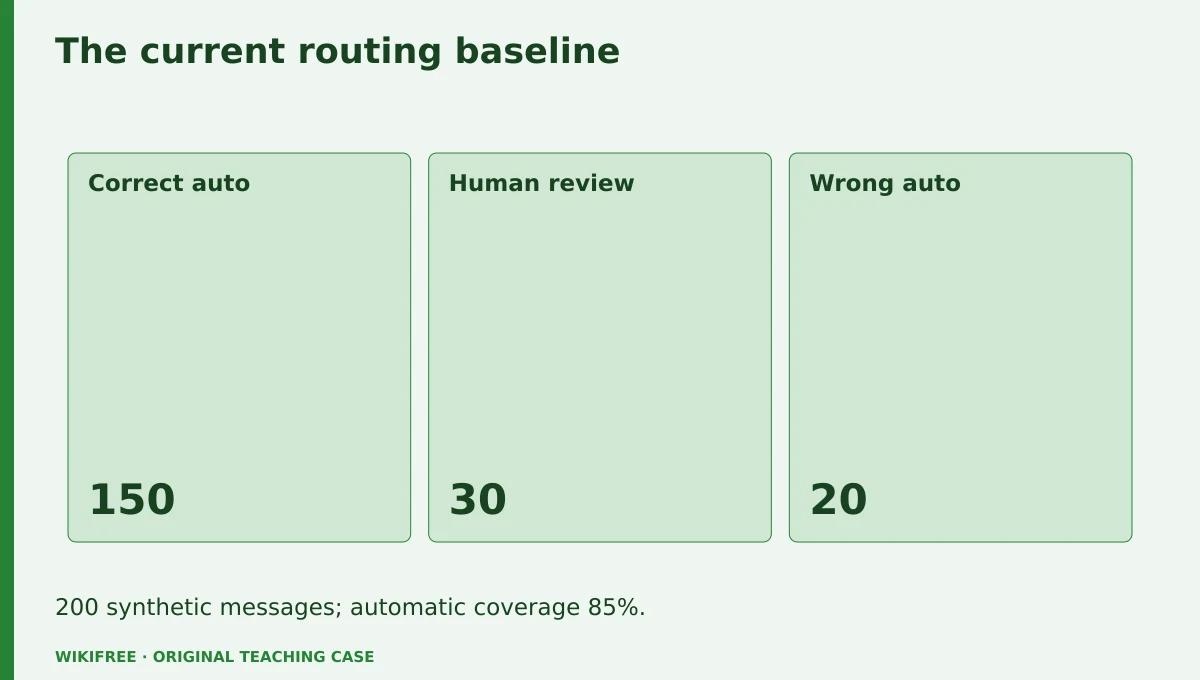
The table and explanations preserve the essential case information when the diagram is unavailable.
Your route
Five outputs, then a final handoff
- 01Translate the request into an outcomeProblem brief
About 1h 30m including assigned learning and practice. - 02Define inputs and labelsData and label specification
About 1h 50m including assigned learning and practice. - 03Measure the simple baselineBaseline scorecard
About 1h including assigned learning and practice. - 04Set a proportionate success testEvaluation and stop rules
About 1h 40m including assigned learning and practice. - 05Prepare a responsible handoffML opportunity assessment
About 50m including assigned learning and practice. - FINALCapstone reviewCombine the evidence into one inspectable handoff.
About 2h .
0 of 6 outputs checked. JavaScript adds browser-only progress saving.
The complete lesson and all downloads remain available. Use the printable project workbook to track your progress.
Use the minimum useful source material
The courses behind this route
Google Machine Learning Problem Framing: Free Beginner Course
The existing Google problem-framing course directly supports defining the problem, framing the task and deciding how implementation should be evaluated.
Selected material only; this path does not claim completion of the entire provider course.
Course publication and selected public lesson metadata were checked on 13 October 2026. This is not a claim of full video playback, provider-course completion or permanent availability. Recheck the linked source if a lesson changes.
Learn, make, inspect
The five-stage workshop
Translate the request into an outcome
Video 0m · reading budget 35m · original practice about 55m.
Start with the work to improve and the cost of current failure. A business objective is not identical to a model metric. Identify who acts on a prediction and what happens when it is wrong. The manager’s request is a hypothesis about a solution, not proof that ML is appropriate.
Assigned reading
Google Machine Learning Problem Framing: Free Beginner Course: Understand the problem.
Use the named provider navigation sections. Editorial reading budget for the named public material; not a verified completion duration
Do the work
Write an outcome statement and a decision flow for routing support messages.
Save this output
Problem brief
Pass the review gate
The brief names an action, an owner and an error consequence.
If you need another attempt
Replace use AI with an observable operational result.
Define inputs and labels
Video 0m · reading budget 40m · original practice about 1h 10m.
Specify when a prediction is made and which information is available then. Avoid including future outcomes as inputs. A label needs a consistent definition and a process for ambiguous cases. Do not assume that historical routing is correct simply because it is stored in a system.
Assigned reading
Google Machine Learning Problem Framing: Free Beginner Course: Framing an ML problem.
Use the named provider navigation sections. Editorial reading budget for the named public material; not a verified completion duration
Do the work
Create an input/label contract and an ambiguity-resolution procedure.
Save this output
Data and label specification
Pass the review gate
No future resolution field is used at prediction time.
If you need another attempt
Draw the prediction-time boundary before selecting features.
Measure the simple baseline
Video 0m · reading budget 0m · original practice about 1h .
Evaluate the existing rule with both coverage and error measures. Automatic coverage is automatically routed cases divided by all cases; precision among automatic routes uses a different denominator. Human review is not a correct automatic prediction. Keeping these measures separate reveals the actual workflow burden.
Original application stage. Use your preceding outputs and the supplied case; there is no additional required provider lesson.
Do the work
Calculate coverage, correct routing among automatic routes and total error rate.
Save this output
Baseline scorecard
Pass the review gate
Coverage is 85%, automatic-route correctness is about 88.24%, and total misroute rate is 10%.
If you need another attempt
Include the 20 wrong routes in the automatic-routing denominator.
Set a proportionate success test
Video 0m · reading budget 35m · original practice about 1h 5m.
A success test should compare a candidate with the baseline under the same conditions. Include review workload, error cost, maintenance effort and a rollback condition. A higher offline score is insufficient if the system creates unacceptable operational work. Define what evidence would justify stopping the ML effort.
Assigned reading
Google Machine Learning Problem Framing: Free Beginner Course: Implementing a model and summary.
Use the named provider navigation sections. Editorial reading budget for the named public material; not a verified completion duration
Do the work
Write go/no-go criteria and a small offline evaluation protocol.
Save this output
Evaluation and stop rules
Pass the review gate
The rules include an acceptable human-review load and a failure condition.
If you need another attempt
Avoid a target with no baseline or no decision consequence.
Prepare a responsible handoff
Video 0m · reading budget 0m · original practice about 50m.
A framing document should make unresolved questions visible. Record data access, privacy, label quality, integration and monitoring needs without pretending they are solved. The deliverable is a decision package for whether to proceed. It is not a trained model, approved deployment or evidence of improved support outcomes.
Original application stage. Use your preceding outputs and the supplied case; there is no additional required provider lesson.
Do the work
Write a one-page recommendation and a prioritized uncertainty register.
Save this output
ML opportunity assessment
Pass the review gate
The recommendation can legitimately be defer or keep the simple rule.
If you need another attempt
Remove claims of model performance that were never measured.
Make the result inspectable
Your final project
Deliver the outcome brief, prediction-time contract, label guide, baseline calculations, success criteria and recommendation. Include one reason to prefer a non-ML solution.
The ZIP includes synthetic input data, a project workbook, worked reference, evidence log, scoring rubric and case-specific materials. Code projects include source and clearly stated local execution requirements.
Use one consistent rubric
| Criterion | Maximum | Evidence |
|---|---|---|
| Evidence and correctness | 30 | Calculations, source use and results match the supplied case; limitations are honest. |
| Required artifacts | 30 | All five stage outputs and the capstone handoff are present and inspectable. |
| Reasoning and decisions | 20 | Choices, assumptions, alternatives and the case-specific critical condition are explained. |
| Reproducibility | 10 | A reviewer can follow the stated steps and distinguish expected from observed results. |
| Clear communication | 10 | Labels, units, structure and evidence references make the work easy to review. |
Score at least 80/100, supply every required artifact, and satisfy the path-specific critical condition. Rework missing evidence before marking complete.
The critical condition
The proposed outcome, prediction task and business decision are distinct, and no untrained model is given invented results.
Compare with a worked reference
The rule routes 170 of 200 messages automatically, so coverage is 85%. Of those 170, 150 are correct: 88.24%. The 20 misroutes are 10% of all messages. These figures describe a synthetic baseline and do not establish a target for a future model.
Know the boundary
This is an ML feasibility brief, not model development, compliance approval or production deployment.
Questions before you finish
Do I need to finish every source course?
No. This path names selected lessons or reading sections. Complete the full provider course only if it supports your wider goal. The path does not claim equivalence to that course.
How do I know when to advance?
Use the output and review gate in each stage. If evidence is missing or a result conflicts with the case, follow the repair step and retry before advancing.
Can I do the project without paid software?
The selected public provider lessons are free to view. The original case can be completed with paper, a text editor or freely available local tools. Paid exams, certificates, subscriptions and optional provider software are not required for this project.
What does my checklist prove?
It records your own review in this browser only. It does not verify viewing, skill, a provider credential or a real-world deployment.
What if a lesson or tool changes?
Use the linked course and provider page to inspect current availability. Record the change and revisit the relevant assignment; do not invent a replacement lesson or claim an unavailable activity was completed.
Questions & discussion
Share a useful question or correction. Comments appear after moderation. Please avoid personal or sensitive information.