Coursya learning path 18 · Beginner
The delivery pulse
Report the decision hiding in the status.
Build a concise project status report that separates evidence, forecasts, issues and decisions, then updates it consistently.
Video duration uses the selected lessons only. Reading and practice times are planning estimates; repeat difficult work as needed.
Table of Contents
A clear starting point
Who this is for
Basic project vocabulary and arithmetic; no reporting platform is required.
Your practical result
Build a concise project status report that separates evidence, forecasts, issues and decisions, then updates it consistently.
This path teaches decision-focused reporting, not earned-value certification or a full project-controls system.
Access and cost
Assigned public videos can be watched free. Complete the original case in a text editor, on paper or in a spreadsheet you already have. No paid course, exam or provider certificate is included.
The project pack contains an original workbook, case inputs, an evidence log and reference notes. Some technical paths include starter code and a runnable reference. Read the pack README before starting.
Three-minute readiness check
Answer first, then open each explanation. A missed answer identifies what to revisit; it does not stop you from starting.
Should work awaiting review count as accepted?
No. Keep the completion definition consistent.
Is an observed rate a guaranteed future rate?
No. Use it as an assumption and test capacity or variability.
What makes a status report actionable?
A clear implication, owner and decision or next step.
The case you will work on
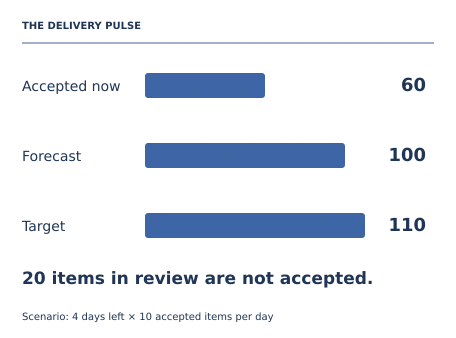
Willow Archive is digitizing a collection. At the reporting cut-off, 80 items were planned and 60 meet the acceptance check. Twenty more are in review, not yet accepted. The team has four working days remaining and an observed acceptance rate of ten items per day.
| Measure | Case value |
|---|---|
| Planned accepted items at cut-off | 80 |
| Actually accepted items | 60 |
| In review, not accepted | 20 |
| Observed accepted items per day | 10 |
| Days remaining | 4 |
| Final target accepted items | 110 |
These are supplied synthetic inputs, not observations from a real organization. Label assumptions and any additional data you create.
Keep an evidence trail
Save each stage output in the project folder. In evidence_log.csv, record the decision, the artifact or test that supports it, what failed, and the revision you made.
Your route from learning to evidence
- Stage 1Define the reporting contractA reporting contract45 minutes of original practice
- Stage 2Calculate the varianceA three-measure status table60 minutes of original practice
- Stage 3Forecast with assumptionsA three-scenario forecast60 minutes of original practice
- Stage 4Turn evidence into a decisionA sponsor-ready exception report75 minutes of original practice
- Stage 5Close and learnA close-out and residual-work note45 minutes of original practice
- Final projectMake the evidence reviewableConnect the five stage outputs and test a change.150 minutes estimated
Progress stays in this browser. Tick a stage only after its evidence check passes. This is a personal checklist, not a certificate.
Why these source courses
The path uses selected material from courses already published on Coursya. The original exercises below connect that material to one practical outcome. Follow only the listed assignments; completing the full source courses is optional.
Free Project Execution and Tracking Course by Google
The tracking, data-storytelling and close-out lessons support the complete reporting lifecycle.
Access: Free Video
Certificate: Free video viewing; a Google certificate is not included
Learn it, apply it, check it
Work in order. Every stage produces something the next stage uses. Revisit the repair instruction when a check fails.
Define the reporting contract
Basic project vocabulary and arithmetic; no reporting platform is required.
The idea to use
Agree on the cut-off, completion definition and audience before choosing charts. A report can be internally accurate yet misleading if one team counts submitted items and another counts accepted items. Record the source of each measure and the person responsible for updating it. Keep original observations separate from the interpretation added for the sponsor.
Watch the selected lessons
Selected video time: 37m. Open this course on Coursya.
Your 45-minute lab
Write a reporting specification with cut-off, accepted-item definition, data owner and source. Explain how the 20 review items will appear.
Save: A reporting contract.
Evidence check
The report distinguishes accepted from in-review work and uses one cut-off.
If it fails: If totals conflict, compare definitions and dates before assuming someone made an arithmetic error.
Calculate the variance
Bring your previous output: A reporting contract
The idea to use
A variance compares like with like. Here accepted output is 20 items behind the planned 80 at the cut-off. The completion ratio against the final target is a different calculation. Avoid choosing whichever denominator makes performance appear strongest. Show the denominator beside the number, especially when a percentage is used in a headline.
Original practice stage. No additional video or reading assignment is required.
Your 60-minute lab
Calculate accepted-versus-plan variance, acceptance against final target and the number still needed. Label each measure in plain language.
Save: A three-measure status table.
Evidence check
Variance is −20; 60/110 is about 54.5%; 50 accepted items remain.
If it fails: If the percentage is 75%, identify that it compares current actual with cut-off plan, not final completion.
Forecast with assumptions
Bring your previous output: A three-measure status table
The idea to use
A simple forecast can reveal a decision without pretending to be a sophisticated model. At ten accepted items per day, four remaining days add 40, giving 100 against a target of 110. State whether review capacity and input quality support that rate. Do not automatically add the 20 in-review items again if the daily acceptance rate already includes review output.
Original practice stage. No additional video or reading assignment is required.
Your 60-minute lab
Forecast the finish under rates of 8, 10 and 13 items per day. Explain the assumptions and the risk of double counting the review queue.
Save: A three-scenario forecast.
Evidence check
Forecasts are 92, 100 and 112 accepted items, with the rate assumption visible.
If it fails: If the baseline forecast reaches 120, check whether the review queue has been counted twice.
Turn evidence into a decision
Bring your previous output: A three-scenario forecast
The idea to use
A sponsor note should explain what changed, why it matters and what decision is needed. Use an issue for a current obstruction and a risk for an uncertain future event. A red status with no action is only decoration. Present options that affect a real constraint, such as extending the deadline or adding qualified review capacity, and state the trade-off.
Watch the selected lessons
Selected video time: 35m. Open this course on Coursya.
Your 75-minute lab
Write a one-page update with evidence, forecast, one current issue, one risk and two options. Assign an owner and deadline to the decision request.
Save: A sponsor-ready exception report.
Evidence check
The decision request follows from the forecast and does not claim that extra staff instantly increase throughput.
If it fails: If the note is an activity diary, remove completed meetings and retain facts that change a decision.
Close and learn
Bring your previous output: A sponsor-ready exception report
The idea to use
A final report records what was accepted, what remains and who owns the handover. Preserve the reporting history rather than retroactively making forecasts match actual outcomes. A lesson learned should describe a specific condition, consequence and recommended future action. Avoid attributing success or failure to a person without evidence.
Watch the selected lessons
Selected video time: 19m. Open this course on Coursya.
Your 45-minute lab
Simulate a final result of 104 accepted items. Reconcile the target gap, assign remaining work and write one lesson about review capacity.
Save: A close-out and residual-work note.
Evidence check
Six items remain against the target, and the report names their owner and agreed disposition.
If it fails: If the project is labelled complete, explain the acceptance decision and treatment of residual scope.
A worked reference to compare
At the cut-off, accepted output is 60, not 80. The base forecast is 60+4×10=100, ten below the final target. A final result of 104 is four above that forecast but still six below target. Those two comparisons answer different questions and should not be merged.
Compare your reasoning as well as the result. If your answer differs, state the assumption or input that explains the difference. Reference notes are for checking after an attempt; copying them is not evidence of independent work.
Your final project
Your brief
Create the Willow reporting portfolio: reporting contract, measures, forecast scenarios, one-page decision report and close-out note.
Time box: 2h 30m estimated. Extend it if a gate needs repair.
Hand in these artifacts
- A reporting contract
- A three-measure status table
- A three-scenario forecast
- A sponsor-ready exception report
- A close-out and residual-work note
- A short README: outcome, how to inspect or run the work, assumptions and limitations.
- A before-and-after change test and the completed evidence log.
Run a final review
- Use the supplied reference to reconcile the baseline result.
- Choose one relevant input or constraint to change. Write your expected effect before testing it.
- Run the calculation, walkthrough or test again and save the actual result.
- Ask a peer to inspect the evidence, or perform a separate self-review. Label which review you used.
- Score the work using the rubric and repair every critical failure.
Review rubric · 100 points
| Criterion | Points | Evidence to inspect |
|---|---|---|
| Practical outcome and case reasoning | 25 | Build a concise project status report that separates evidence, forecasts, issues and decisions, then updates it consistently. |
| Five stage checks | 30 | Award 6 points for each stage only when its stated gate is demonstrably met. |
| Traceable evidence | 20 | Artifacts, inputs and calculations or tests are reproducible; synthetic and simulated evidence is labelled. |
| Revision after a changed condition | 15 | Change one input or constraint, predict the effect, test it and record the result. |
| Handoff quality | 10 | A reviewer can find the files, follow the instructions and understand the remaining limitations. |
Completion target: at least 80/100, all five stage gates passed, and every critical issue below corrected. This is a learning benchmark, not an accredited qualification.
Critical issue: Do not count unaccepted output as complete, double-count the review queue or rewrite past forecasts after the fact.
Before you go further
What will I be able to produce?
Build a concise project status report that separates evidence, forecasts, issues and decisions, then updates it consistently.
Is the whole path free?
Assigned public videos can be watched free. Complete the original case in a text editor, on paper or in a spreadsheet you already have. No paid course, exam or provider certificate is included.
Do I need to finish every source course?
No. Follow the selected assignments at each stage. Source courses provide context, while the original case, labs and final review build the practical result. Extra study is optional.
What counts as completion?
Complete all five stage checks, earn at least 80/100 on the final rubric and correct every critical issue. This path teaches decision-focused reporting, not earned-value certification or a full project-controls system.
Questions & discussion
Share a useful question or correction. Comments appear after moderation. Please avoid personal or sensitive information.