Coursya learning path 13 · Beginner
The risk observatory
Uncertainty needs an owner and a next action.
Create and maintain a risk register with explicit triggers, response choices and a budget-aware contingency plan.
Video duration uses the selected lessons only. Reading and practice times are planning estimates; repeat difficult work as needed.
Table of Contents
A clear starting point
Who this is for
Basic project concepts and percentages; a spreadsheet is optional.
Your practical result
Create and maintain a risk register with explicit triggers, response choices and a budget-aware contingency plan.
This is operational project-risk practice, not actuarial, insurance, legal or safety-engineering advice.
Access and cost
Assigned public videos can be watched free. Complete the original case in a text editor, on paper or in a spreadsheet you already have. No paid course, exam or provider certificate is included.
The project pack contains an original workbook, case inputs, an evidence log and reference notes. Some technical paths include starter code and a runnable reference. Read the pack README before starting.
Three-minute readiness check
Answer first, then open each explanation. A missed answer identifies what to revisit; it does not stop you from starting.
Is an issue still a risk?
A risk is uncertain; an event that has happened becomes an issue requiring action.
Does a probability of 30% mean the loss will be 30% of the impact?
No. Expected value is a planning average under assumptions, not the amount of a single outcome.
Can risk be owned by everyone?
A named person should coordinate the response even when several people help.
The case you will work on
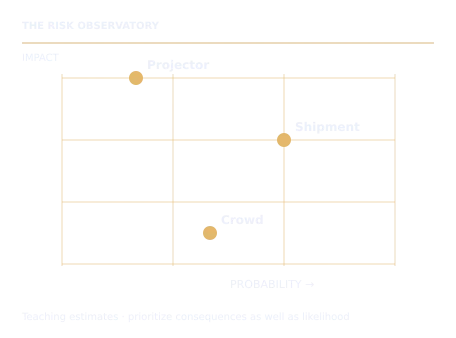
Maple Museum is preparing a pop-up exhibit. Its two major uncertainties are a late shipment and projector failure. The figures are fictional planning assumptions, not statistical forecasts.
| Risk | Assumed probability | Impact cost | Prevention cost | Residual probability |
|---|---|---|---|---|
| Late shipment | 0.3 | 2000 | 200 | 0.1 |
| Projector failure | 0.1 | 3000 | 150 | 0.05 |
| Unexpected crowd | 0.2 | 500 | 80 | 0.1 |
These are supplied synthetic inputs, not observations from a real organization. Label assumptions and any additional data you create.
Keep an evidence trail
Save each stage output in the project folder. In evidence_log.csv, record the decision, the artifact or test that supports it, what failed, and the revision you made.
Your route from learning to evidence
- Stage 1Write cause, event and effectThree risk statements and one issue entry45 minutes of original practice
- Stage 2Compare exposure carefullyAn exposure table with assumptions60 minutes of original practice
- Stage 3Choose a responseA response selection and budget note75 minutes of original practice
- Stage 4Define triggers and contingenciesA trigger and contingency sheet60 minutes of original practice
- Stage 5Review residual riskA revised register and decision log45 minutes of original practice
- Final projectMake the evidence reviewableConnect the five stage outputs and test a change.150 minutes estimated
Progress stays in this browser. Tick a stage only after its evidence check passes. This is a personal checklist, not a certificate.
Why these source courses
The path uses selected material from courses already published on Coursya. The original exercises below connect that material to one practical outcome. Follow only the listed assignments; completing the full source courses is optional.
Free Project Planning Course: Budgets and Risks
The focused risk lesson supplies the vocabulary before the original quantitative case.
Access: Free Video
Certificate: Free video viewing; a Google certificate is not included
Free Project Execution and Tracking Course by Google
The tracking lesson supports ongoing review rather than treating the register as a one-time document.
Access: Free Video
Certificate: Free video viewing; a Google certificate is not included
Learn it, apply it, check it
Work in order. Every stage produces something the next stage uses. Revisit the repair instruction when a check fails.
Write cause, event and effect
Basic project concepts and percentages; a spreadsheet is optional.
The idea to use
A usable risk statement separates why something could happen, the uncertain event and its consequence for the project. Late shipment is a starting label, not a complete analysis. Link the consequence to a named objective, such as opening day or cost. Keep current issues in a separate log so an already missed shipping date does not disappear into a future-risk score.
Watch the selected lessons
Selected video time: 30m. Open this course on Coursya.
Your 45-minute lab
Expand the three case labels into cause–event–effect statements. Add one current issue and explain why its treatment differs.
Save: Three risk statements and one issue entry.
Evidence check
Each risk has an uncertain event and a specific project consequence.
If it fails: Replace labels such as supplier problem with a causal statement that suggests a response.
Compare exposure carefully
Bring your previous output: Three risk statements and one issue entry
The idea to use
Expected monetary exposure multiplies a probability assumption by a monetary impact. It helps compare some options, but it does not capture reputation, safety or a hard opening-date constraint. A qualitative matrix can be useful if the meanings of its labels are explicit. Multiplying arbitrary ordinal labels does not create a precise probability. Preserve the assumptions behind every score.
Original practice stage. No additional video or reading assignment is required.
Your 60-minute lab
Calculate expected exposure for each risk. Add a separate opening-date impact column and explain one situation in which the largest cost is not the first priority.
Save: An exposure table with assumptions.
Evidence check
Expected costs are 600, 300 and 100; nonfinancial consequences remain visible.
If it fails: If a number appears precise, state the evidence and uncertainty supporting it.
Choose a response
Bring your previous output: An exposure table with assumptions
The idea to use
Compare the prevention cost with the change in expected exposure, then consider feasibility and consequences. A response can reduce likelihood, reduce impact, transfer part of a consequence or accept the exposure. Acceptance still needs a conscious decision. Insurance or a supplier clause may have exclusions; this exercise does not establish legal coverage.
Original practice stage. No additional video or reading assignment is required.
Your 75-minute lab
Calculate prevention cost plus residual expected loss for all three risks. Recommend responses within a 400-unit prevention budget and explain any constraint-driven exception.
Save: A response selection and budget note.
Evidence check
The chosen prevention costs fit the budget and every residual risk remains recorded.
If it fails: If all responses look worthwhile, rank by goal protection and expected reduction per budget unit.
Define triggers and contingencies
Bring your previous output: A response selection and budget note
The idea to use
A trigger is an observable signal that prompts a specific action. Monitor closely is not a contingency. For the shipment, a missing dispatch confirmation on the agreed date can trigger a backup display plan. Specify the decision owner and the latest useful action time. A response that cannot be started before its benefit disappears is not an operational plan.
Original practice stage. No additional video or reading assignment is required.
Your 60-minute lab
Create one trigger, owner, action and decision deadline per risk. Separate prevention work from actions taken after the trigger.
Save: A trigger and contingency sheet.
Evidence check
Each trigger can be observed and leads to a named action before it becomes too late.
If it fails: If the owner cannot observe the signal, assign an information source and check frequency.
Review residual risk
Bring your previous output: A trigger and contingency sheet
The idea to use
Review risk when assumptions, scope or evidence change. If the supplier confirms dispatch, reassess the shipment risk rather than deleting the history. If the projector fails, open an issue and execute the contingency. A register supports decisions only when it records what changed and why. The meeting should focus on exceptions and upcoming trigger dates.
Watch the selected lessons
Selected video time: 37m. Open this course on Coursya.
Your 45-minute lab
Simulate a dispatch confirmation and a projector failure. Update status, owner action and residual exposure, preserving the original assumptions in a change log.
Save: A revised register and decision log.
Evidence check
The happened event is handled as an issue and the remaining uncertainties are reassessed.
If it fails: If the log only changes colors, add the evidence and resulting decision.
A worked reference to compare
Initial expected exposure is 1000 units. Shipment prevention plus residual loss is 200 + 0.10×2000 = 400, compared with 600 untreated. Projector prevention gives 150 + 0.05×3000 = 300, the same expected cost as untreated, but it may protect the opening-day constraint. Buying both costs 350 and fits the 400 prevention budget.
Compare your reasoning as well as the result. If your answer differs, state the assumption or input that explains the difference. Reference notes are for checking after an attempt; copying them is not evidence of independent work.
Your final project
Your brief
Prepare the Maple risk review pack: causal risks, exposure assumptions, selected responses, triggers, contingencies and a simulated review update.
Time box: 2h 30m estimated. Extend it if a gate needs repair.
Hand in these artifacts
- Three risk statements and one issue entry
- An exposure table with assumptions
- A response selection and budget note
- A trigger and contingency sheet
- A revised register and decision log
- A short README: outcome, how to inspect or run the work, assumptions and limitations.
- A before-and-after change test and the completed evidence log.
Run a final review
- Use the supplied reference to reconcile the baseline result.
- Choose one relevant input or constraint to change. Write your expected effect before testing it.
- Run the calculation, walkthrough or test again and save the actual result.
- Ask a peer to inspect the evidence, or perform a separate self-review. Label which review you used.
- Score the work using the rubric and repair every critical failure.
Review rubric · 100 points
| Criterion | Points | Evidence to inspect |
|---|---|---|
| Practical outcome and case reasoning | 25 | Create and maintain a risk register with explicit triggers, response choices and a budget-aware contingency plan. |
| Five stage checks | 30 | Award 6 points for each stage only when its stated gate is demonstrably met. |
| Traceable evidence | 20 | Artifacts, inputs and calculations or tests are reproducible; synthetic and simulated evidence is labelled. |
| Revision after a changed condition | 15 | Change one input or constraint, predict the effect, test it and record the result. |
| Handoff quality | 10 | A reviewer can find the files, follow the instructions and understand the remaining limitations. |
Completion target: at least 80/100, all five stage gates passed, and every critical issue below corrected. This is a learning benchmark, not an accredited qualification.
Critical issue: A response without an owner or trigger, or a probability presented as a proven frequency, prevents completion.
Before you go further
What will I be able to produce?
Create and maintain a risk register with explicit triggers, response choices and a budget-aware contingency plan.
Is the whole path free?
Assigned public videos can be watched free. Complete the original case in a text editor, on paper or in a spreadsheet you already have. No paid course, exam or provider certificate is included.
Do I need to finish every source course?
No. Follow the selected assignments at each stage. Source courses provide context, while the original case, labs and final review build the practical result. Extra study is optional.
What counts as completion?
Complete all five stage checks, earn at least 80/100 on the final rubric and correct every critical issue. This is operational project-risk practice, not actuarial, insurance, legal or safety-engineering advice.
Questions & discussion
Share a useful question or correction. Comments appear after moderation. Please avoid personal or sensitive information.