Coursya learning path 15 · Beginner
The dependency yard
Dependencies decide what can happen next.
Build and update a dependency-based schedule, calculate a critical path and explain the effect of a delay.
Video duration uses the selected lessons only. Reading and practice times are planning estimates; repeat difficult work as needed.
Table of Contents
A clear starting point
Who this is for
Basic addition and a spreadsheet or paper; no Microsoft Project license is needed.
Your practical result
Build and update a dependency-based schedule, calculate a critical path and explain the effect of a delay.
This path covers a small deterministic network; probabilistic scheduling and complex resource leveling are outside scope.
Access and cost
Assigned public videos can be watched free. Complete the original case in a text editor, on paper or in a spreadsheet you already have. No paid course, exam or provider certificate is included.
The project pack contains an original workbook, case inputs, an evidence log and reference notes. Some technical paths include starter code and a runnable reference. Read the pack README before starting.
Three-minute readiness check
Answer first, then open each explanation. A missed answer identifies what to revisit; it does not stop you from starting.
Can an activity begin before all required predecessors finish?
Not under the finish-to-start rules in this case.
Is the longest single activity always critical?
Criticality depends on the longest complete dependency path.
Does a dependency-only schedule prove staff availability?
No. Resource constraints require a separate check.
The case you will work on
Oak Workshop is preparing a training event. Activities use working days, finish-to-start dependencies, zero lags and unlimited parallel resources unless stated otherwise. A starts at time zero.
| ID / activity | Duration | Predecessor |
|---|---|---|
| A / approve brief | 2 | None |
| B / prepare room | 3 | A |
| C / build materials | 5 | A |
| D / rehearsal | 2 | B and C |
| E / final checks | 1 | D |
These are supplied synthetic inputs, not observations from a real organization. Label assumptions and any additional data you create.
Keep an evidence trail
Save each stage output in the project folder. In evidence_log.csv, record the decision, the artifact or test that supports it, what failed, and the revision you made.
Your route from learning to evidence
- Stage 1Define schedulable workAn activity definition sheet45 minutes of original practice
- Stage 2Draw the dependency networkA dependency network and logic note60 minutes of original practice
- Stage 3Calculate earliest datesA forward-pass table75 minutes of original practice
- Stage 4Find flexibility and test a delayA float table and delay scenario75 minutes of original practice
- Stage 5Publish a usable baselineA baseline, update and sponsor note45 minutes of original practice
- Final projectMake the evidence reviewableConnect the five stage outputs and test a change.150 minutes estimated
Progress stays in this browser. Tick a stage only after its evidence check passes. This is a personal checklist, not a certificate.
Why these source courses
The path uses selected material from courses already published on Coursya. The original exercises below connect that material to one practical outcome. Follow only the listed assignments; completing the full source courses is optional.
Free Project Planning Course: Budgets and Risks
The planning lesson supplies the work-definition context. The critical-path calculations and examples are original Coursya instruction.
Access: Free Video
Certificate: Free video viewing; a Google certificate is not included
Learn it, apply it, check it
Work in order. Every stage produces something the next stage uses. Revisit the repair instruction when a check fails.
Define schedulable work
Basic addition and a spreadsheet or paper; no Microsoft Project license is needed.
The idea to use
Turn a deliverable into activities with a clear start, finish and acceptance condition. Distinguish duration from effort: three elapsed days may contain only a few hours of work. State calendar assumptions before adding dates. A precise-looking Gantt chart can conceal an unclear activity definition, so establish the logic in a table first.
Watch the selected lessons
Selected video time: 37m. Open this course on Coursya.
Your 45-minute lab
Describe completion for each activity and record the working-day, resource and dependency assumptions beside the case table.
Save: An activity definition sheet.
Evidence check
Every activity has an observable finish and duration is not confused with effort.
If it fails: Split vague activities such as organize everything into a result with a checkable boundary.
Draw the dependency network
Bring your previous output: An activity definition sheet
The idea to use
A dependency says what must be true before another activity can start. Do not add a link only because two tasks look convenient side by side. The rehearsal requires both the room and materials, so its start is controlled by the later predecessor. Check for circular dependencies; a cycle cannot be solved by moving bars on a chart.
Original practice stage. No additional video or reading assignment is required.
Your 60-minute lab
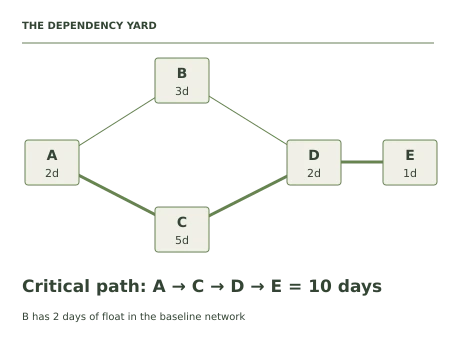
Draw the five-node network and list every dependency. Explain why D waits for C even when B has already finished.
Save: A dependency network and logic note.
Evidence check
A→B→D→E and A→C→D→E are both visible, with no cycle.
If it fails: If a start date is chosen manually, identify the dependency or external constraint justifying it.
Calculate earliest dates
Bring your previous output: A dependency network and logic note
The idea to use
In a forward pass, an activity’s earliest start is the greatest earliest finish among its predecessors. Earliest finish equals earliest start plus duration. Use time-zero boundaries consistently rather than mixing inclusive calendar dates with elapsed-day arithmetic. Keep the calculations visible so another person can reproduce them without relying on the drawing.
Original practice stage. No additional video or reading assignment is required.
Your 75-minute lab
Calculate ES and EF for all activities. Compare the two complete paths and identify the earliest project finish.
Save: A forward-pass table.
Evidence check
A:0–2, B:2–5, C:2–7, D:7–9 and E:9–10.
If it fails: If D begins at day five, check that both of its predecessors have completed.
Find flexibility and test a delay
Bring your previous output: A forward-pass table
The idea to use
A backward pass works from the project finish toward the start. Latest finish is the earliest latest start of the successors; latest start subtracts duration. Total float is latest start minus earliest start under the stated model. Float is not a personal entitlement to delay work. Test an actual change and recalculate the network before reporting its effect.
Original practice stage. No additional video or reading assignment is required.
Your 75-minute lab
Complete the backward pass, then increase B from three to six days. Recalculate the finish and critical path.
Save: A float table and delay scenario.
Evidence check
Original B float is two days; the changed B finishes at day eight and the project at day eleven.
If it fails: If a three-day activity delay becomes a three-day project delay, account for the original float.
Publish a usable baseline
Bring your previous output: A float table and delay scenario
The idea to use
A schedule baseline records an agreed model at a point in time. An update should show actual progress, remaining work and changed assumptions, not merely recolor the original plan. Add a resource review before making commitments: the room and materials tasks cannot run in parallel if one person must perform both full time. Report that limitation directly.
Original practice stage. No additional video or reading assignment is required.
Your 45-minute lab
Create a baseline and revised schedule with one decision request. Add a resource-conflict note and a short explanation for a nontechnical sponsor.
Save: A baseline, update and sponsor note.
Evidence check
The one-day finish impact is explained and resource feasibility is kept separate.
If it fails: If the update hides its assumptions, include a short change log next to the revised dates.
A worked reference to compare
The original critical path is A–C–D–E: 2+5+2+1=10 days. B has two days of float. When B takes six days, A–B–D–E becomes 11 days, making the project one day later. These results rely on the stated calendar and unlimited-resource assumptions.
Compare your reasoning as well as the result. If your answer differs, state the assumption or input that explains the difference. Reference notes are for checking after an attempt; copying them is not evidence of independent work.
Your final project
Your brief
Produce the Oak scheduling pack with dependency diagram, forward/backward calculations, baseline, delay scenario and resource-feasibility note.
Time box: 2h 30m estimated. Extend it if a gate needs repair.
Hand in these artifacts
- An activity definition sheet
- A dependency network and logic note
- A forward-pass table
- A float table and delay scenario
- A baseline, update and sponsor note
- A short README: outcome, how to inspect or run the work, assumptions and limitations.
- A before-and-after change test and the completed evidence log.
Run a final review
- Use the supplied reference to reconcile the baseline result.
- Choose one relevant input or constraint to change. Write your expected effect before testing it.
- Run the calculation, walkthrough or test again and save the actual result.
- Ask a peer to inspect the evidence, or perform a separate self-review. Label which review you used.
- Score the work using the rubric and repair every critical failure.
Review rubric · 100 points
| Criterion | Points | Evidence to inspect |
|---|---|---|
| Practical outcome and case reasoning | 25 | Build and update a dependency-based schedule, calculate a critical path and explain the effect of a delay. |
| Five stage checks | 30 | Award 6 points for each stage only when its stated gate is demonstrably met. |
| Traceable evidence | 20 | Artifacts, inputs and calculations or tests are reproducible; synthetic and simulated evidence is labelled. |
| Revision after a changed condition | 15 | Change one input or constraint, predict the effect, test it and record the result. |
| Handoff quality | 10 | A reviewer can find the files, follow the instructions and understand the remaining limitations. |
Completion target: at least 80/100, all five stage gates passed, and every critical issue below corrected. This is a learning benchmark, not an accredited qualification.
Critical issue: Do not present a dependency-only calculation as a resource-feasible commitment or silently change the time convention.
Before you go further
What will I be able to produce?
Build and update a dependency-based schedule, calculate a critical path and explain the effect of a delay.
Is the whole path free?
Assigned public videos can be watched free. Complete the original case in a text editor, on paper or in a spreadsheet you already have. No paid course, exam or provider certificate is included.
Do I need to finish every source course?
No. Follow the selected assignments at each stage. Source courses provide context, while the original case, labs and final review build the practical result. Extra study is optional.
What counts as completion?
Complete all five stage checks, earn at least 80/100 on the final rubric and correct every critical issue. This path covers a small deterministic network; probabilistic scheduling and complex resource leveling are outside scope.
Questions & discussion
Share a useful question or correction. Comments appear after moderation. Please avoid personal or sensitive information.