Path 73 · The relevance shelf · Intermediate
Rank candidates without hiding the rule.
A guided, practical route through recommendation systems.
What you will be able to do
Build a small content-based recommender, exclude already-seen items and evaluate a documented reranking rule.
Plan about 9h 5m in total. Reading and practice are editorial estimates; video runtimes come from public provider metadata. Your pace will vary.
Table of Contents
Before you begin
Check your starting point
What you need
Basic Python lists and arithmetic. Use a local script; no user accounts or recommendation API are needed.
The selected public provider lessons are free to view. The original case can be completed with paper, a text editor or freely available local tools. Paid exams, certificates, subscriptions and optional provider software are not required for this project.
Completing this Coursya path does not award a provider certificate. Any provider assessment, account requirement or credential must be checked separately on its official page.
Three readiness questions
Does a score prove a learner will like an item?
No. It is a model output.
When should seen items be removed here?
Before selecting the final top two.
Can a ranking encode policy choices?
Yes. Those choices should be documented.
Use a workable pace
At 5 hours per week, allow about 2 weeks. Start with Stage 1, continue in order and reserve 2h for the capstone. If a gate fails, use its repair step before advancing. At another weekly budget, divide 545 estimated minutes by your available weekly minutes and round up.
Keep a small evidence folder. A checked box means you reviewed your output; it is not a certificate or proof that a provider lesson was watched.
The working case
Score, then enforce eligibility
A fictional learner prefers the topic vector [2,1,0] for data, project and design content. Four items have binary vectors: A=[1,0,0], B=[1,1,0], C=[0,0,1], D=[0,1,1]. Item A is already seen. Rank by dot product, break ties by item ID and return two unseen items.
| Item | Data | Project | Design | Already seen |
|---|---|---|---|---|
| A | 1 | 0 | 0 | yes |
| B | 1 | 1 | 0 | no |
| C | 0 | 0 | 1 | no |
| D | 0 | 1 | 1 | no |
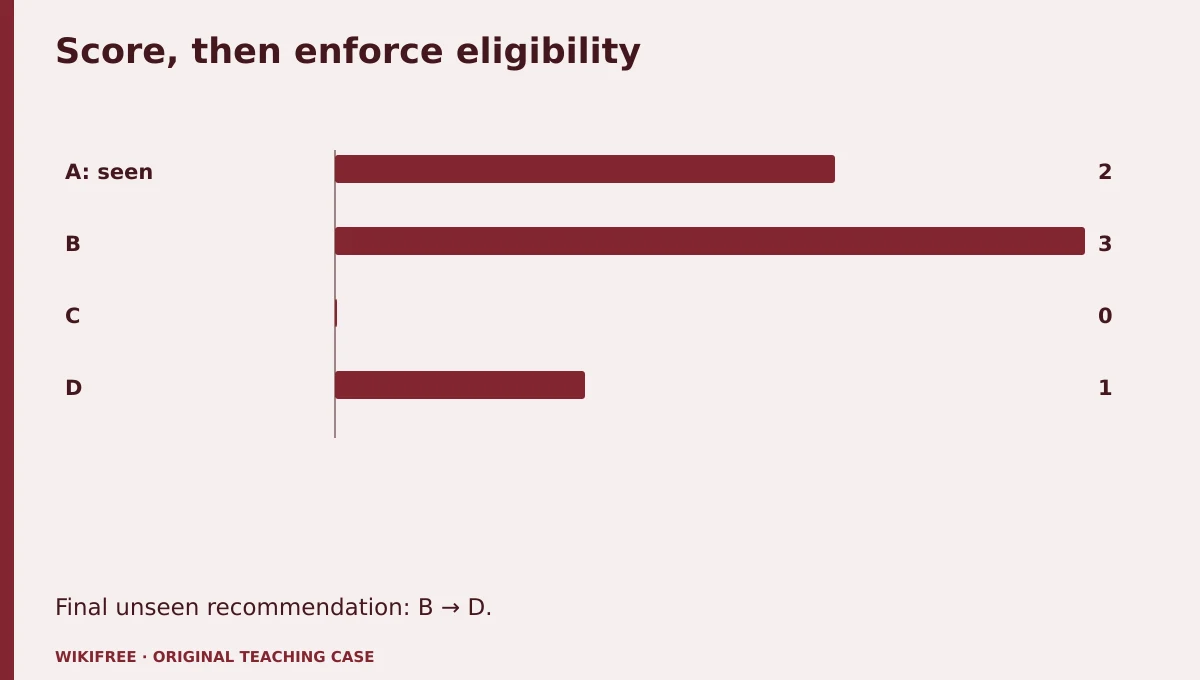
The table and explanations preserve the essential case information when the diagram is unavailable.
Your route
Five outputs, then a final handoff
- 01Separate the recommendation stagesPipeline specification
About 1h 25m including assigned learning and practice. - 02Implement a transparent scoreScore table and function
About 1h 55m including assigned learning and practice. - 03Apply exclusions and stable orderingRanking function and edge cases
About 1h 10m including assigned learning and practice. - 04Evaluate a reranking policyReranking note
About 1h 40m including assigned learning and practice. - 05Document evaluation limitsRecommendation handoff
About 55m including assigned learning and practice. - FINALCapstone reviewCombine the evidence into one inspectable handoff.
About 2h .
0 of 6 outputs checked. JavaScript adds browser-only progress saving.
The complete lesson and all downloads remain available. Use the printable project workbook to track your progress.
Use the minimum useful source material
The courses behind this route
Google Recommendation Systems: Free Machine Learning Course
The published Google course explicitly separates candidate generation, content-based scoring and reranking.
Selected material only; this path does not claim completion of the entire provider course.
Course publication and selected public lesson metadata were checked on 13 October 2026. This is not a claim of full video playback, provider-course completion or permanent availability. Recheck the linked source if a lesson changes.
Learn, make, inspect
The five-stage workshop
Separate the recommendation stages
Video 0m · reading budget 35m · original practice about 50m.
Candidate generation, scoring and reranking solve different problems. A small catalog can score every eligible item, while a large one often narrows candidates first. State eligibility separately from preference. The case uses one fictional profile and does not infer a real person’s interests from browsing behavior.
Assigned reading
Google Recommendation Systems: Free Machine Learning Course: Recommendation systems overview and candidate generation.
Use the named provider navigation sections. Editorial reading budget for the named public material; not a verified completion duration
Do the work
Draw the eligible-items → score → rank → top-two pipeline.
Save this output
Pipeline specification
Pass the review gate
Seen-item exclusion is a rule, not a negative preference score.
If you need another attempt
Move eligibility checks before the final selection.
Implement a transparent score
Video 0m · reading budget 40m · original practice about 1h 15m.
A dot product rewards overlap weighted by the profile. It is easy to inspect but sensitive to representation and magnitude. Do not call it cosine similarity: that requires normalization. Keep the vector order fixed and explain the meaning of each position so the numbers remain reproducible.
Assigned reading
Google Recommendation Systems: Free Machine Learning Course: Content-based filtering: basics and advantages and disadvantages.
Use the named provider navigation sections. Editorial reading budget for the named public material; not a verified completion duration
Do the work
Calculate all four scores and implement the scoring function.
Save this output
Score table and function
Pass the review gate
Scores are A=2, B=3, C=0 and D=1.
If you need another attempt
Check the feature order and distinguish the chosen score from other similarities.
Apply exclusions and stable ordering
Video 0m · reading budget 0m · original practice about 1h 10m.
A deterministic tie rule makes tests and explanations stable. Filter seen items before taking the top results; otherwise the list can be too short or contain repeats. Consider what happens when fewer eligible items remain than requested. Returning fewer is more honest than inserting an ineligible item.
Original application stage. Use your preceding outputs and the supplied case; there is no additional required provider lesson.
Do the work
Produce the top two unseen items and test a nearly exhausted catalog.
Save this output
Ranking function and edge cases
Pass the review gate
The case returns B then D; no seen item is returned.
If you need another attempt
Apply the eligibility predicate before slicing the ranked list.
Evaluate a reranking policy
Video 0m · reading budget 35m · original practice about 1h 5m.
A reranker can impose diversity, freshness or other constraints, but every rule has a trade-off. Explain what it changes and why. The case can test mechanics, not real satisfaction. A policy that promotes a low-scoring item should be visible rather than disguised as the original model score.
Assigned reading
Google Recommendation Systems: Free Machine Learning Course: Scoring and re-ranking sections.
Use the named provider navigation sections. Editorial reading budget for the named public material; not a verified completion duration
Do the work
Propose a rule requiring a design-tagged item in the top two and show its effect.
Save this output
Reranking note
Pass the review gate
D already satisfies the rule in the base result; no unnecessary change is made.
If you need another attempt
Check whether the constraint is already satisfied before altering the ranking.
Document evaluation limits
Video 0m · reading budget 0m · original practice about 55m.
Offline relevance checks need labeled outcomes or a defensible proxy. This case has neither real engagement nor satisfaction data, so do not invent accuracy or click-through improvements. Test correctness of exclusions and ordering, then outline how a voluntary future evaluation could examine usefulness and unwanted effects.
Original application stage. Use your preceding outputs and the supplied case; there is no additional required provider lesson.
Do the work
Write an evaluation plan and a model card for the toy scorer.
Save this output
Recommendation handoff
Pass the review gate
No real-user performance metric is claimed.
If you need another attempt
Separate code correctness from recommendation quality.
Make the result inspectable
Your final project
Deliver the vectors, scorer, exclusion tests, reranking policy and evaluation plan. Add a tied candidate and demonstrate the documented ID ordering.
The ZIP includes synthetic input data, a project workbook, worked reference, evidence log, scoring rubric and case-specific materials. Code projects include source and clearly stated local execution requirements.
Use one consistent rubric
| Criterion | Maximum | Evidence |
|---|---|---|
| Evidence and correctness | 30 | Calculations, source use and results match the supplied case; limitations are honest. |
| Required artifacts | 30 | All five stage outputs and the capstone handoff are present and inspectable. |
| Reasoning and decisions | 20 | Choices, assumptions, alternatives and the case-specific critical condition are explained. |
| Reproducibility | 10 | A reviewer can follow the stated steps and distinguish expected from observed results. |
| Clear communication | 10 | Labels, units, structure and evidence references make the work easy to review. |
Score at least 80/100, supply every required artifact, and satisfy the path-specific critical condition. Rework missing evidence before marking complete.
The critical condition
Eligibility is enforced before selection and the score is not mislabeled as observed satisfaction.
Compare with a worked reference
With profile [2,1,0], B scores 3 and D scores 1. A scores 2 but is excluded because it is seen; C scores 0. The final order is B, D. The design-diversity rule makes no change because D already carries that tag.
Know the boundary
This is a content-based toy recommender, not a personalized production service or an engagement experiment.
Questions before you finish
Do I need to finish every source course?
No. This path names selected lessons or reading sections. Complete the full provider course only if it supports your wider goal. The path does not claim equivalence to that course.
How do I know when to advance?
Use the output and review gate in each stage. If evidence is missing or a result conflicts with the case, follow the repair step and retry before advancing.
Can I do the project without paid software?
The selected public provider lessons are free to view. The original case can be completed with paper, a text editor or freely available local tools. Paid exams, certificates, subscriptions and optional provider software are not required for this project.
What does my checklist prove?
It records your own review in this browser only. It does not verify viewing, skill, a provider credential or a real-world deployment.
What if a lesson or tool changes?
Use the linked course and provider page to inspect current availability. Record the change and revisit the relevant assignment; do not invent a replacement lesson or claim an unavailable activity was completed.
Questions & discussion
Share a useful question or correction. Comments appear after moderation. Please avoid personal or sensitive information.