Coursya learning path 14 · Beginner
The stakeholder constellation
A useful conversation changes the plan.
Build a stakeholder engagement plan that connects interests, decision rights, messages and feedback to a real project decision.
Video duration uses the selected lessons only. Reading and practice times are planning estimates; repeat difficult work as needed.
Table of Contents
A clear starting point
Who this is for
A small project context and willingness to role-play; use fictional participants.
Your practical result
Build a stakeholder engagement plan that connects interests, decision rights, messages and feedback to a real project decision.
The case develops project engagement, not legal consultation or formal public-policy participation expertise.
Access and cost
Assigned public videos can be watched free. Complete the original case in a text editor, on paper or in a spreadsheet you already have. No paid course, exam or provider certificate is included.
The project pack contains an original workbook, case inputs, an evidence log and reference notes. Some technical paths include starter code and a runnable reference. Read the pack README before starting.
Three-minute readiness check
Answer first, then open each explanation. A missed answer identifies what to revisit; it does not stop you from starting.
Is influence the same as being affected?
No. A person can be heavily affected while having little formal influence.
Does silence mean agreement?
No. Check understanding and provide an accessible feedback route.
Should every stakeholder receive the same message?
The core facts must be consistent, but the relevant decision and detail can differ.
The case you will work on
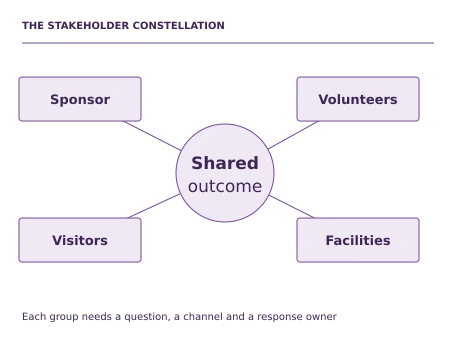
Riverbend Community Centre is changing its booking process. The sponsor wants fewer manual calls; volunteers want a simple workflow; visitors without reliable internet need an alternative route. The decision is whether to pilot online booking with a staffed fallback.
| Stakeholder | Case concern | Decision or contribution |
|---|---|---|
| Sponsor | Reduce call workload | Authorize pilot scope |
| Front-desk volunteers | Avoid double entry | Test operational handoff |
| Visitors | Keep non-digital access | Describe booking obstacles |
| Facilities lead | Room conflicts | Validate availability rules |
These are supplied synthetic inputs, not observations from a real organization. Label assumptions and any additional data you create.
Keep an evidence trail
Save each stage output in the project folder. In evidence_log.csv, record the decision, the artifact or test that supports it, what failed, and the revision you made.
Your route from learning to evidence
- Stage 1Map people and consequencesA stakeholder map with affectedness60 minutes of original practice
- Stage 2Clarify the decisionA transparent pilot decision brief45 minutes of original practice
- Stage 3Design a useful messageTwo audience-specific messages60 minutes of original practice
- Stage 4Work through disagreementA negotiation note with unresolved points75 minutes of original practice
- Stage 5Close the feedback loopA feedback update and engagement review45 minutes of original practice
- Final projectMake the evidence reviewableConnect the five stage outputs and test a change.150 minutes estimated
Progress stays in this browser. Tick a stage only after its evidence check passes. This is a personal checklist, not a certificate.
Why these source courses
The path uses selected material from courses already published on Coursya. The original exercises below connect that material to one practical outcome. Follow only the listed assignments; completing the full source courses is optional.
Free Project Management Course by Google
The selected stakeholder, communication and negotiation lessons support a complete engagement decision without repeating the general PM path.
Access: Free Video
Certificate: Free video viewing; a Google certificate is not included
Learn it, apply it, check it
Work in order. Every stage produces something the next stage uses. Revisit the repair instruction when a check fails.
Map people and consequences
A small project context and willingness to role-play; use fictional participants.
The idea to use
List who decides, who contributes and who experiences the outcome. Influence maps can reveal decision routes, but they can also hide people with little power. Add an affectedness lens before prioritizing attention. Use evidence from the case rather than guessing personal motives. An interest is a concern to understand; it is not a label for whether someone supports you.
Watch the selected lessons
Selected video time: 24m. Open this course on Coursya.
Your 60-minute lab
Map the four stakeholder groups and add one often-overlooked group. Explain how the booking change might affect each one.
Save: A stakeholder map with affectedness.
Evidence check
The map includes users of the non-digital route and avoids invented personal attitudes.
If it fails: If the map only contains managers, trace who performs and receives the service.
Clarify the decision
Bring your previous output: A stakeholder map with affectedness
The idea to use
Engagement is more effective when the question is explicit. Separate what is fixed from what participants can influence. Asking for opinions after a decision is final creates false expectations. State the decision owner, the deadline and the evidence needed. Success should include accessibility and volunteer workload, not only the sponsor’s preferred headline metric.
Watch the selected lessons
Selected video time: 42m. Open this course on Coursya.
Your 45-minute lab
Write a pilot decision brief with fixed constraints, open questions, decision owner and three success measures.
Save: A transparent pilot decision brief.
Evidence check
Readers can identify which choices remain open and who will decide.
If it fails: If the brief says consult everyone, specify the actual questions each group can help answer.
Design a useful message
Bring your previous output: A transparent pilot decision brief
The idea to use
A communication plan links audience, purpose, message, channel and feedback. Sending a document is not evidence that it was understood. Use plain language and match the channel to the participants’ context. Keep the same scope and risks across versions, even when the level of detail changes. A shorter message must not quietly remove the fallback option.
Watch the selected lessons
Selected video time: 35m. Open this course on Coursya.
Your 60-minute lab
Draft a sponsor decision note and a visitor-facing pilot invitation. Add how each audience can ask questions or challenge an assumption.
Save: Two audience-specific messages.
Evidence check
Both messages describe the same pilot and preserve the non-digital option.
If it fails: If a message is mostly project jargon, rewrite around what the recipient needs to do or decide.
Work through disagreement
Bring your previous output: Two audience-specific messages
The idea to use
A disagreement may concern goals, constraints or evidence. Identify which before proposing a compromise. In this case, volunteers fear duplicate work while the sponsor wants more data. Explore a limited pilot with one shared register before adding another form. Record unresolved points honestly. A role-play can test the conversation structure but cannot substitute for real stakeholder agreement.
Watch the selected lessons
Selected video time: 37m. Open this course on Coursya.
Your 75-minute lab
Rehearse the volunteer–sponsor discussion. Write two clarifying questions, one option and the conditions under which you would revise it.
Save: A negotiation note with unresolved points.
Evidence check
The option addresses both concerns and does not invent consent.
If it fails: If the discussion becomes a defense of the tool, return to workload and service outcomes.
Close the feedback loop
Bring your previous output: A negotiation note with unresolved points
The idea to use
A feedback loop reports what was heard, what changed and what remains unresolved. This allows participants to correct your interpretation. Keep a decision log with reasons and owners so the same issue does not restart in every meeting. Review the map when roles or impacts change; a stakeholder plan is not a static contact list.
Original practice stage. No additional video or reading assignment is required.
Your 45-minute lab
Write a short you-said/we-changed update and a decision log for the pilot. Include one suggestion declined with a clear reason.
Save: A feedback update and engagement review.
Evidence check
Every significant input has a visible response or a stated next step.
If it fails: If an input disappears, add its disposition before calling the consultation complete.
A worked reference to compare
A defensible pilot preserves staffed booking, uses one availability register and checks call volume, volunteer handling time and failed-booking reports. These are proposed measures, not measured improvements. The facilities lead validates room rules; visitors test whether the fallback is understandable; the sponsor makes the scope decision.
Compare your reasoning as well as the result. If your answer differs, state the assumption or input that explains the difference. Reference notes are for checking after an attempt; copying them is not evidence of independent work.
Your final project
Your brief
Deliver the Riverbend engagement pack: stakeholder map, decision brief, two messages, disagreement role-play and closed-loop feedback log.
Time box: 2h 30m estimated. Extend it if a gate needs repair.
Hand in these artifacts
- A stakeholder map with affectedness
- A transparent pilot decision brief
- Two audience-specific messages
- A negotiation note with unresolved points
- A feedback update and engagement review
- A short README: outcome, how to inspect or run the work, assumptions and limitations.
- A before-and-after change test and the completed evidence log.
Run a final review
- Use the supplied reference to reconcile the baseline result.
- Choose one relevant input or constraint to change. Write your expected effect before testing it.
- Run the calculation, walkthrough or test again and save the actual result.
- Ask a peer to inspect the evidence, or perform a separate self-review. Label which review you used.
- Score the work using the rubric and repair every critical failure.
Review rubric · 100 points
| Criterion | Points | Evidence to inspect |
|---|---|---|
| Practical outcome and case reasoning | 25 | Build a stakeholder engagement plan that connects interests, decision rights, messages and feedback to a real project decision. |
| Five stage checks | 30 | Award 6 points for each stage only when its stated gate is demonstrably met. |
| Traceable evidence | 20 | Artifacts, inputs and calculations or tests are reproducible; synthetic and simulated evidence is labelled. |
| Revision after a changed condition | 15 | Change one input or constraint, predict the effect, test it and record the result. |
| Handoff quality | 10 | A reviewer can find the files, follow the instructions and understand the remaining limitations. |
Completion target: at least 80/100, all five stage gates passed, and every critical issue below corrected. This is a learning benchmark, not an accredited qualification.
Critical issue: Do not infer agreement from silence or remove an affected group because it lacks formal power.
Before you go further
What will I be able to produce?
Build a stakeholder engagement plan that connects interests, decision rights, messages and feedback to a real project decision.
Is the whole path free?
Assigned public videos can be watched free. Complete the original case in a text editor, on paper or in a spreadsheet you already have. No paid course, exam or provider certificate is included.
Do I need to finish every source course?
No. Follow the selected assignments at each stage. Source courses provide context, while the original case, labs and final review build the practical result. Extra study is optional.
What counts as completion?
Complete all five stage checks, earn at least 80/100 on the final rubric and correct every critical issue. The case develops project engagement, not legal consultation or formal public-policy participation expertise.
Questions & discussion
Share a useful question or correction. Comments appear after moderation. Please avoid personal or sensitive information.