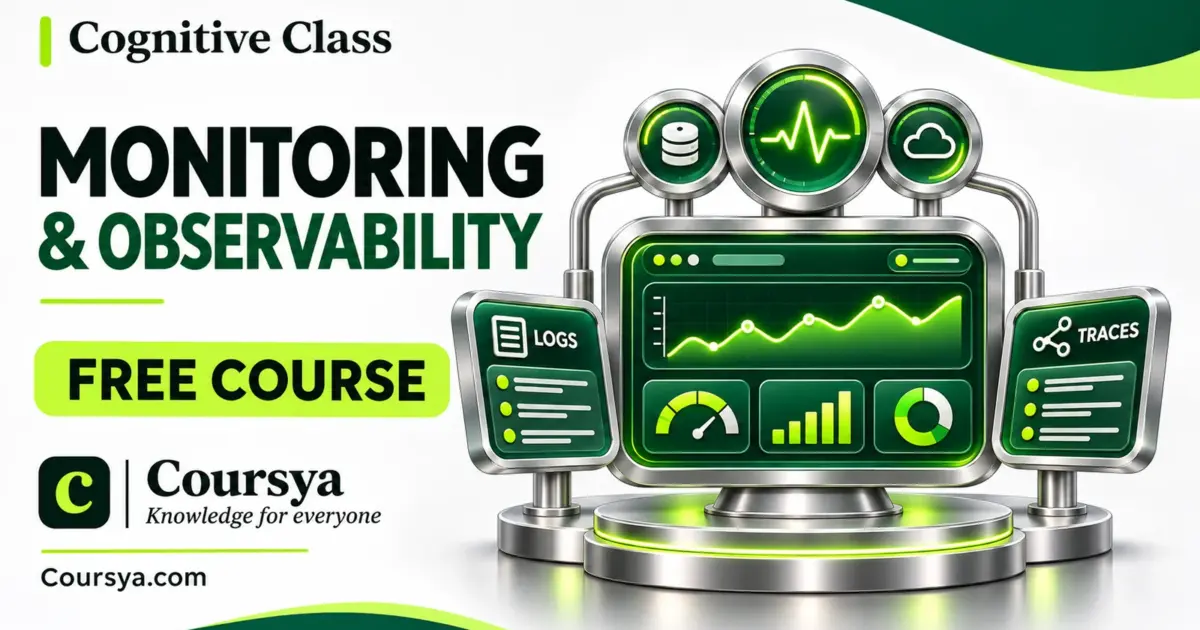
About this course
Learn how to ask useful questions about a running application. This course introduces monitoring and observability through signals and tools that help connect a reported symptom with evidence about what the system is doing.
Platform: Cognitive Class. Original course: Monitoring and Observability for Development and DevOps. Course code: WD0103EN. Estimated effort: 16 hours. Self-paced study in English. Listed level: Beginner.
What you will learn
- Distinguish monitoring from observability in an application workflow.
- Relate logs, metrics and traces to different diagnostic questions.
- Explore Prometheus, Grafana, Mezmo and Instana.
- Understand the role of OpenTelemetry and tracing in container applications.
Who this course is for and prerequisites
The provider labels this a beginner course. Familiarity with applications, containers and basic DevOps practices will help when working through its interactive labs. The course introduces observability rather than teaching programming from scratch.
Turn the lessons into practice
Imagine a service whose response time has increased. Choose one metric to show the change, a trace to locate the slow part of a request and a log entry that could add context. Define an alert condition and explain why collecting more data alone does not guarantee a useful diagnosis.
This is an optional Coursya exercise, separate from the provider curriculum. Use fictional or public information and document the assumptions behind your answer. Revisit the exercise after studying and record one thing you would change.
Course scope and completion
The course includes practical exercises with open-source and commercial tools. Free learning content is not a permanent subscription to every service discussed. Follow the supplied lab route and check account limits before connecting a tool to your own infrastructure.
The current public course page says No Certificate Offered. Free access to the learning content does not imply a certificate. Any separately mentioned badge has its own eligibility requirements.
Continue learning on Coursya
- DevOps for Beginners: Team Culture, CI/CD and Delivery Metrics — Free Course
- CI/CD Pipeline Tutorial: GitHub Actions, Tekton and OpenShift — Free Course
- Docker and Kubernetes Deployment: Containers, Scaling and OpenShift — Free Course
- Application Security for Developers: OWASP Risks and DevSecOps — Free Course
Frequently asked questions
Is the complete course content free?
The current public course page lists a free offer and its enrollment control says Enroll for free. This is access to the course content, rather than a short subscription trial. Check the prerequisites above before starting.
Where do I take the lessons?
Use Enroll Now to open the official Cognitive Class page, then sign in or register with the provider. Coursya supplies this learning guide; the lessons and provider assessments are on the learning platform.
Are logs, metrics and traces interchangeable?
They answer different questions. A useful investigation combines signals while preserving enough context to relate events and requests across services.
Do I have to purchase every named tool?
The page offers free enrollment and interactive labs. It does not promise paid product subscriptions. Use the course environment and review separate licensing if you adopt a tool beyond the lessons.
Does this course offer a completion certificate?
The current public course page says No Certificate Offered. Free access to the learning content does not imply a certificate. Any separately mentioned badge has its own eligibility requirements.
Public course information and free-enrollment availability checked on 26 November 2026.
Main instruction language: English. English public course materials; complete audio track not independently audited.
Learner reviews
Tell other learners what you actually tried. Reviews are moderated and may come from learners who have started or completed the course.
No published learner reviews yet.
Sign in to write a reviewQuestions still belong in the discussion below. Review and ranking rules.
Questions & discussion
Share a useful question or correction. Comments appear after moderation. Please avoid personal or sensitive information.